


Estimated reading time: 20-25 minutes
Series: The Incomparable: The Life of Paul (Episode 1)
Keywords: conversion of apostle paul, saul of tarsus, damascus road, acts 9 study, stephen and saul, ananias and saul, salvation of lost causes, irresistible grace.
Introduction: The Man You Would Be Afraid to Evangelize
Imagine a dangerous man. Not a common criminal who steals wallets in an alley, but an ideological fanatic. A man who is cultured, brilliant, articulate, and driven by a cold, calculated hatred against your faith. Imagine someone who carries official government authorization to invade your home in the middle of the night, drag your wife out by her hair, and throw your children into prison, all while believing he is doing God a favor.
If you lived in the year 34 A.D., this man had a name: Saul of Tarsus.
Today, we look at statues of “Saint Paul” in cathedrals, holding a scroll and a sword, with a golden halo around his head, and we forget who he really was before Grace collided with him. We romanticize Paul. But the early church did not romanticize him; they were terrified of him. Luke, the author of Acts, describes Saul with a chilling phrase: “Meanwhile, Saul was still breathing out murderous threats against the Lord’s disciples…” (Acts 9:1). He didn’t just threaten; he breathed death. His oxygen was the destruction of Christians.
In this first episode of our new series “The Incomparable,” we are going to dive into the mind of this religious “monster.” We will discover that Saul’s conversion is not just a nice story about a man who fell off a horse; it is the definitive proof that no one is a lost cause. If God saved the “Terrorist of Tarsus,” He can save your alcoholic husband, your rebellious child, or that atheist boss who mocks your faith. Prepare to witness the greatest miracle of transformation in history.
1. Profile of a Monster: Who Was Saul Before Christ?
To understand the magnitude of the miracle, we need to understand the magnitude of the obstacle. Saul was not a debauched atheist living a wild life of parties and drugs. He was the opposite: he was the pinnacle of human religion.
In Philippians 3:5-6, he gives us his résumé:
- “Circumcised on the eighth day”: He was born into the right covenant.
- “Of the people of Israel, of the tribe of Benjamin”: He had a purebred pedigree.
- “A Hebrew of Hebrews”: He spoke the sacred language; he wasn’t just a culturally assimilated Hellenist Jew.
- “In regard to the law, a Pharisee”: He belonged to the strictest sect. He knew the Torah by heart.
- “As for zeal, persecuting the church”: Here is the key.
Saul devoutly believed that Jesus of Nazareth was a false messiah, a charlatan who had been cursed by God (because the Torah said, “cursed is everyone who hangs on a tree”). To Saul, Christians were a plague, a spiritual cancer that was leading Israel away from the One True God. He didn’t persecute them because he was “bad”; he persecuted them because he was zealous. He thought he was cleaning up God’s honor.
The Geographical Context: He was from Tarsus, a university city (in modern-day Turkey) that rivaled Athens in philosophy. This means Saul had the best of both worlds: the rigorous theology of Jerusalem (he was a student of Gamaliel, the greatest teacher of the era) and the intellectual philosophy of the Greek world. He was a genius. And a genius at the service of destroying the Church.
2. The Trigger: The Blood of Stephen and a Guilty Conscience
Saul’s conversion didn’t start on the road to Damascus. It started a little earlier, at a brutal execution in Jerusalem. In Acts 7, we see the stoning of Stephen, the first martyr. Stephen preached a sermon that cut the religious leaders to the heart. They were furious, covered their ears, and dragged him out of the city.
And the Bible says in Acts 7:58:
“Meanwile, the witnesses laid their coats at the feet of a young man named Saul.”
Saul didn’t throw the stones (likely because as a leader, he was supervising the execution), but he “approved of their killing him” (Acts 8:1). He held the coats so the others could kill with more agility. But something happened there that Saul never forgot. As the stones crushed Stephen’s bones, that young deacon didn’t scream curses. He looked up to heaven, saw Jesus, and said: “Lord, do not hold this sin against them.”
Saul saw a man die forgiving his murderers. That was a needle in Saul’s conscience. How could a heretic have such peace in death? How could a “false believer” have the face of an angel? Jesus later said to Saul: “It is hard for you to kick against the goads” (Acts 26:14). God was already pricking his conscience. The blood of Stephen was the seed of the church, but it was also the seed of Saul’s conversion.
3. The Collision: High Noon in Damascus (Acts 9)
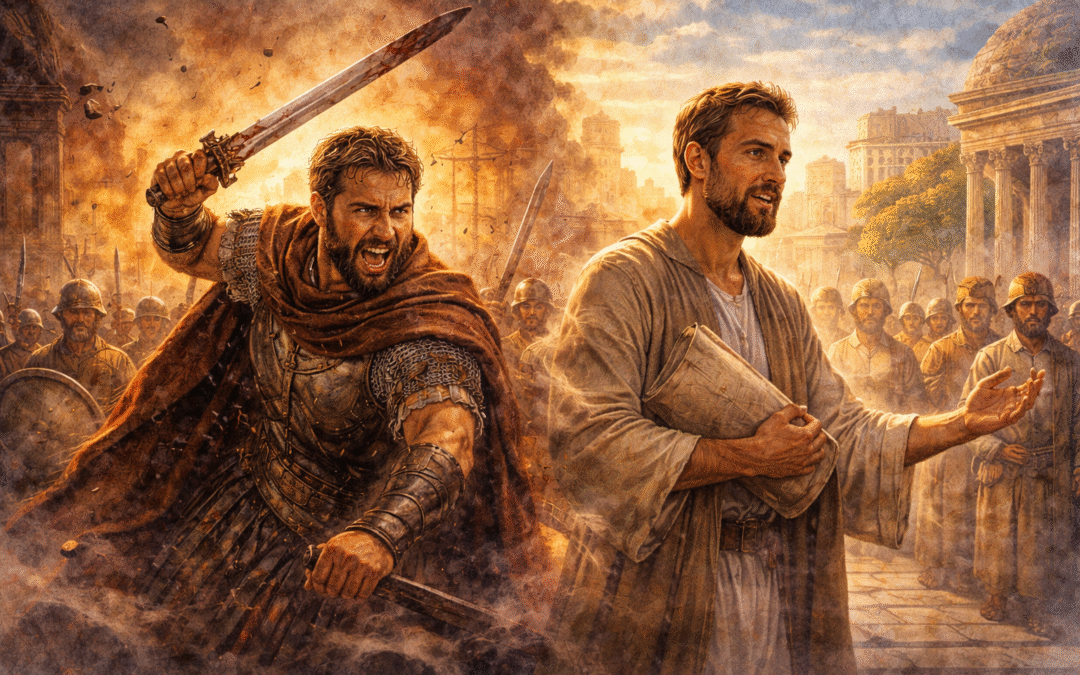
Disturbed by Stephen’s death, Saul tries to silence his conscience with more activism. He demands letters of authority to go to Damascus (in Syria, 135 miles away) to arrest the believers who had fled there. He travels with a troop. It is noon. The desert sun is at its peak. Suddenly, a Light brighter than the midday sun explodes over him. This wasn’t an “inner illumination”; it was a physical event. Everyone saw the light; everyone fell to the ground.
And a voice speaks in Aramaic (Hebrew dialect):
“Saul, Saul, why do you persecute ME?”
This is the most profound theological question in the New Testament. Saul asks: “Who are you, Lord?” The answer must have made Saul’s blood run cold:
“I am Jesus, whom you are persecuting.”
The Shocking Revelation:
- Jesus is Alive: If Jesus spoke, then the tomb is empty. The Christians were right. Stephen was right. Saul was wrong. He wasn’t serving God; he was fighting against God.
- The Mystical Union: Jesus didn’t say: “Why do you persecute my church?” He said: “Why do you persecute ME?” Saul learned his first lesson in Ecclesiology right there: To touch a Christian is to touch Jesus Himself. The Church is the Body of Christ. No one hits the Body without hurting the Head.
Saul fell to the ground as a “great Pharisee” and stood up as a blind, broken, and dependent man. The terrorist was surrendered by the General of the Universe.
4. The Dark Room: Three Days of Death and Resurrection
Many think Saul got up from the road and immediately started preaching. No. Acts 9:9 says: “For three days he was blind, and did not eat or drink anything.”
Imagine the scene. The most powerful man in Judaism is now in a rented room on Straight Street in Damascus, blind, trembling, and in total fasting. Why three days? Because Saul needed to die. All his theology, all his pride, all his self-righteousness, all his titles… everything had to be deconstructed in the dark. In those three days, he replayed every verse he knew from the Old Testament and realized: “It was all about Him. The Lamb was Him. The Prophet was Him. The Messiah is Jesus.”
It was a time of mourning for “Old Saul.” Sometimes, God puts us in a “dark room”—an illness, unemployment, a crisis—not to kill us, but to kill our pride so that we can be reborn. It is in the darkness of the cocoon that the caterpillar dissolves to become a butterfly.
5. The Unsung Hero: The Courage of Ananias
While Saul prays in the dark, God calls an ordinary disciple in Damascus: Ananias. God says: “Go to the house of Judas on Straight Street and ask for a man from Tarsus named Saul.” Ananias’ reaction is panic (and rightly so):
“Lord, I have heard many reports about this man and all the harm he has done to your holy people…” (Acts 9:13).
Basically, Ananias said: “God, do You know who he is? He is the Hitler of Christians! If I go there, I’m dead.” But God responds with the phrase that defines Paul’s destiny:
“Go! This man is my chosen instrument to proclaim my name to the Gentiles and their kings and to the people of Israel.”
Ananias obeys. He walks down the street, enters the room where the monster is sitting in the dark. And the first words that come out of Ananias’ mouth are the proof that the Gospel is real. He doesn’t say: “You murderer!” or “Now you’re going to pay!” He places his hands on the eyes of the ex-terrorist and says:
“Brother Saul…”
Brother. That man had killed Ananias’ friends. He had destroyed families. But grace is so scandalous that it turns enemies into brothers in a second. Right there, something like scales fell from Saul’s eyes. He could see again. He was filled with the Holy Spirit. And he was baptized. The Terrorist died. The Apostle was born.
6. Lessons for Today: What Do We Learn from Saul’s Conversion?
What does this 2,000-year-old story have to do with your life today? Everything.
A. No One is “Too Hard” for God
Maybe you have someone in your family who hates the Gospel. An intellectual father who mocks the Bible. An addicted husband. A child immersed in anti-Christian ideologies. You look at them and think: “That one will never convert. Their heart is too hard.” Saul of Tarsus was harder. If Grace knocked Saul down, it can knock anyone down. Don’t stop praying for the “lost causes.” God specializes in turning persecutors into preachers.
B. Sincerity Does Not Save Anyone
Was Saul sincere? Yes. He was sincerely devoted. But he was sincerely wrong. Many people say: “The important thing is to have faith, it doesn’t matter in what.” That is a lie. You can drink poison sincerely believing it is orange juice; your sincerity will not prevent your death. Saul needed an encounter with the Truth (Jesus) so that his sincerity could be directed to the right place. Zeal without knowledge is dangerous.
C. The Past Does Not Cancel the Future
You might think: “I’ve done too many wrong things. I had an abortion. I stole. I committed adultery. I was violent. God can’t use me.” Paul called himself “the chief of sinners” (1 Timothy 1:15). He carried the memory of Stephen’s face for the rest of his life. But God didn’t use Paul despite his past; God used even his past. The strength, the stubbornness, and the knowledge he used for evil, God redeemed for good. God doesn’t want to throw you away; He wants to recycle your story for His Glory.
Conclusion: Which Side Are You On?
Saul’s story places us in front of a mirror. There are only two groups of people in the world:
- Those who, like the old Saul, think they can save themselves by their religion, morality, and “doing good,” but deep down are fighting against God.
- Those who, like the new Paul, fell off their high horse, recognized their blindness, and were saved solely by undeserved Grace.
Saul’s conversion was violent because his pride was strong. Maybe you need to fall off your “horse” today—the horse of self-sufficiency, of “I know everything,” of “I am a good person.” Let the Light blind you to the world, so you can finally see Jesus.
The Terrorist of Tarsus became the Apostle to the Nations. What can God do with you, if you surrender today?
Hearing Him Org — The Grace that saved a wretch like me (and like Paul).
Support Links (CTA)
Conversion is just the beginning. After Damascus, Paul had to spend years in the desert learning to hear God’s voice. In the next episode of “The Incomparable” series, we will travel with him to the Arabian Desert and discover why God sometimes “hides” us before He uses us.
In the meantime, if you have a “Saul” in your life (someone difficult to convert), don’t give up. Learn to pray effectively by downloading our guide: 👉 Prayer Guide for Difficult Family Members
Biblical References Used
- Acts 9:1-19 (The central account of the conversion and Ananias).
- Acts 7:58 and 8:1 (Saul at the stoning of Stephen).
- Philippians 3:5-6 (Paul’s religious credentials).
- 1 Timothy 1:15 (Paul declares himself the chief of sinners).
- Acts 26:14 (It is hard to kick against the goads).
- Galatians 1:13-14 (Paul’s persecuting zeal).
Postagens/Posts/Publicaciones
- “Is It God or Is It Just My Head?” The Ultimate Guide to Stop Guessing and Start Discerning
- “Show Me Your Glory”: The Mystery of the Cleft of the Rock and the Safe Place in Jesus
- A Kenosis: The Emptying of Glory (Philippians 2)
- Anxiety and Faith: Is it a sin to take medication or go to therapy? What the Bible really says
- Celestial Breaking News: “New Year” Doesn’t Exist in the Bible? A Deep Investigation into the Theology of New Beginnings
- Celestial Breaking News: The Day Heaven Invaded Earth (The True Story of Christmas You Never Heard)
- Christmas Investigation: Does the Bible Reveal the Exact Day Jesus Was Born? (The Mystery of Tabernacles)
- Church or Cult? The Ultimate Biblical Guide for the New Convert to Find a Safe Spiritual Home
- Corinth: Sacred Monday (Tentmaker’s Work)
- Ephesus: The Theater of Shadows (Spiritual War and Culture)
- Ephesus: The Theater of Shadows (Spiritual Warfare and Culture)
- First Steps with Jesus: A Biblical Guide to Start Your Journey of Faith
- From Failure to Rock: The Denial and Restoration of Peter.
- From the Pit to the Palace: When God’s Presence Feels Like Absolute Silence
- Fruit vs. Gifts: The Priority of Character
- God’s Radar: Integrity and the Gaze of God (2 Chr 16:9)
- Grace in Lo-debar: The King’s Call (Mephibosheth / 2 Samuel 9)
- I Converted, But I Sinned Again: The Liberating Truth About Your Internal Struggle
- I Find Reading the Bible and Praying Boring: How to Overcome Spiritual Boredom and Build Consistency
- Jerusalem/Rome: The Compass (The End of the Race)
- Justification: The Courtroom of Grace
- Melchizedek: The King Without Genealogy
- Nicodemus: The Theologian in Darkness (The New Birth)
- Real Life #1: “How to Share Jesus with My Family Without Starting World War III” — The Ultimate Guide to Home Evangelism
- Real Life #2: “Do I Really Need to Get Baptized? What Really Happens in the Water” — The Ultimate Guide to the Public Wedding with Christ
- Real Life #3: “Did God Call Me? How to Discover My Purpose Without Becoming a Pastor” — Ending the Sacred-Secular Divide
- Real Life #4: “Christian Dating vs. Hookup Culture: The Survival Manual for Singles” — Purity, Purpose, and the Physics of Being Unequally Yoked
- Real Life #5: “Tithes and Offerings: Is God Broke or Am I Greedy?” — Money as a Spiritual Thermometer
- Silence in Chaos: Why Having Faith Doesn’t Make You Immune to Anxiety (And How to Find Real Peace)
- Silence is Not Absence: A Deep Guide to Resetting Your Frequency and Finding the Overflow of Purpose
- Spiritual Detox #1: “I Accepted Jesus, Now My Problems Will End” — The Big Lie and the True Promise
- Spiritual Detox #2: “Do I Have to Cut Off Non-Christian Friends?” — The Definitive Guide to the “Holy Bubble”
- Spiritual Detox #3: “Christians Don’t Get Depressed?” — Breaking the Mental Health Taboo in the Church
- Spiritual Detox #4: “Can the Devil Read My Thoughts?” — The End of Paranoia and True Spiritual Authority
- Spiritual Detox #5: “I Don’t Feel God, So He’s Not Listening” — The Danger of Goosebump-Based Faith
- Spiritual Detox #6: “If I Sin, Does God Walk Away and Stop Loving Me?” — The Survival Guide for the “Spiritual Hangover”
- Spiritual Detox #7: “Do I Have to Become a Boring Christian?” — The End of the ‘Do’s and Don’ts’ List and True Holiness
- Start Here: 7 Days to Hear God (Reading John)
- The Abyss of Glory: The Depth of the Riches (Romans 11:33).
- The Anatomy of a Heart: Why Did God Love Such an Imperfect Man So Much?
- The Art of Abiding: Prayer, Discipleship, and the Secret of Consistency
- The Art of Provocation: Communion and Mutual Encouragement in Hebrews 10:24
- The Art of Provocation: Communion and Mutual Encouragement in Hebrews 10:24
- The Crimson Mystery: The Theology, Legality, and Power of “Pleading the Blood”
- The Dungeon: The Winter of the Soul (Solitude/2 Timothy)
- The Emmaus Bread: Eyes Opened in Communion (Luke 24).
- The Eternity Code: Forensic Evidence That the Bible Is the Word of God
- The Final Metanoia: What It Really Means to Have the Mind of Christ
- The Great Discovery of December 31st: The End of Waiting (The Kingdom is Now)
- The Great Plan: The Architecture of Rescue (When the Fall Meets Grace)
- The Great Plan: Understanding the “Exchange” That Changes Everything
- The Importunate Friend: A Theology of Persistence
- The Incomparable #1: “The Terrorist of Tarsus: How God Turns His Worst Enemy Into His Greatest General”
- The Incomparable #10: The Last Breath — The Death of the Servant vs. The Death of the Atheist (Final Special)
- The Incomparable #2: “The Arabian Desert: Why Does God ‘Hide’ Those He Plans to Use?” — The Secret Power of Anonymity
- The Incomparable #3: The Fight with Barnabas and the Cost of Leadership
- The Incomparable #4: When Heaven Says “No” (The Frequency of the Spirit)
- The Incomparable #5: The Overflow — When the Gospel Faces Culture (Paul in Athens)
- The Incomparable #6: Silence in Chaos — The Theology of the Shipwreck (Paul in Acts 27)
- The Incomparable #7: The Art of Letting Go — The Radical Theology of Forgiveness (Paul and Philemon)
- The Invitation of the Maimed: The Parable of the Great Banquet
- The Invitation of the Maimed: The Parable of the Great Banquet
- The Iron Mask: Why We Feel Like a Fraud and How to Cure Spiritual Imposter Syndrome
- The Judgment of the Nations: The Sheep and the Goats
- The Kairos of God: Sovereignty Over Time in Eternity
- The Logic of Blood: Why was Jesus’ death the only solution?
- The Mirror: The Death of the Slave, The Birth of the Son
- The Orphan Syndrome: Why Do You Keep Acting Like a Slave When You Already Have the House Keys?
- The Place of the Sinner: The Alabaster Jar (Luke 7).
- The Prince, The Shepherd, and The Deliverer: When the Desert Is the Only School
- The Prison of Resentment: How to forgive someone who never said “I’m sorry”
- The Rich Young Ruler: The Tragedy of Almost-Salvation
- The Samaritan Woman: The Forgotten Jar at the Well
- The School of Prayer: How to Learn to Speak the Language of Heaven
- The Seal of the Spirit: Pledge and Property
- The Secret of the Secret Place: The Intimacy that Pleases God (Martha and Mary)
- The Shrewd Manager: Investing in Eternity
- The Sound of Silence: What God Was Doing When He Stopped Speaking
- The Tabernacle: The Engineering of Presence
- The Table in the Wilderness: The Valley of the Shadow (Psalm 23).
- The Table of Betrayal: The Dipped Bread (Judas and Rejected Grace)
- The Table of Betrayal: The Dipped Bread (Judas and Rejected Grace)
- The Ten Virgins: The Danger of Borrowed Oil
- The Terror of God (The Invisible War)
- The Upside-Down Kingdom: Why Jesus’ Logic Offends Our Human Logic
- The Widow of Nain: When Two Processions Meet
- Tongues of Fire or Strange Fire? The Gift of Tongues, Paul, and the Ghost of Montanism
- When Heaven is Silent: A Survival Guide for the “Dark Night of the Soul”
- Zacchaeus: The Tree of Curiosity