


Series: Deep Dive Specials (Vol. 4)
Theme: Pneumatology (Doctrine of the Holy Spirit) and Church History
Scripture Base: Acts 2:1-13 / 1 Corinthians 12-14
Estimated Reading Time: 25 minutes
Few subjects have divided the Church of Christ as much over the last 2,000 years as the Gift of Tongues. On one side, we have the ice of Rationalism, which says: “All of this ended with the apostles; anyone speaking in tongues today is crazy or demon-possessed.” On the other side, we have the fire of Fanaticism, which says: “If you don’t speak in tongues, you don’t have the Holy Spirit; the service has to be chaotic to be powerful.”
In the middle of this theological crossfire, the sincere Christian gets confused. He sees people spinning around and shouting repetitive syllables and asks: “Is this the Holy Spirit?” He reads 1 Corinthians 14 and sees Paul saying “do not forbid speaking in tongues” and asks: “So should I seek this?”
To answer these questions with depth, we cannot stay on the surface. We need to take a journey to two stations:
- The Biblical Station: What did Paul really teach about the use, abuse, and purpose of tongues?
- The Historical Station: What was Montanism (2nd Century) and how does this ancient movement explain the mess we see in many neo-Pentecostal churches today?
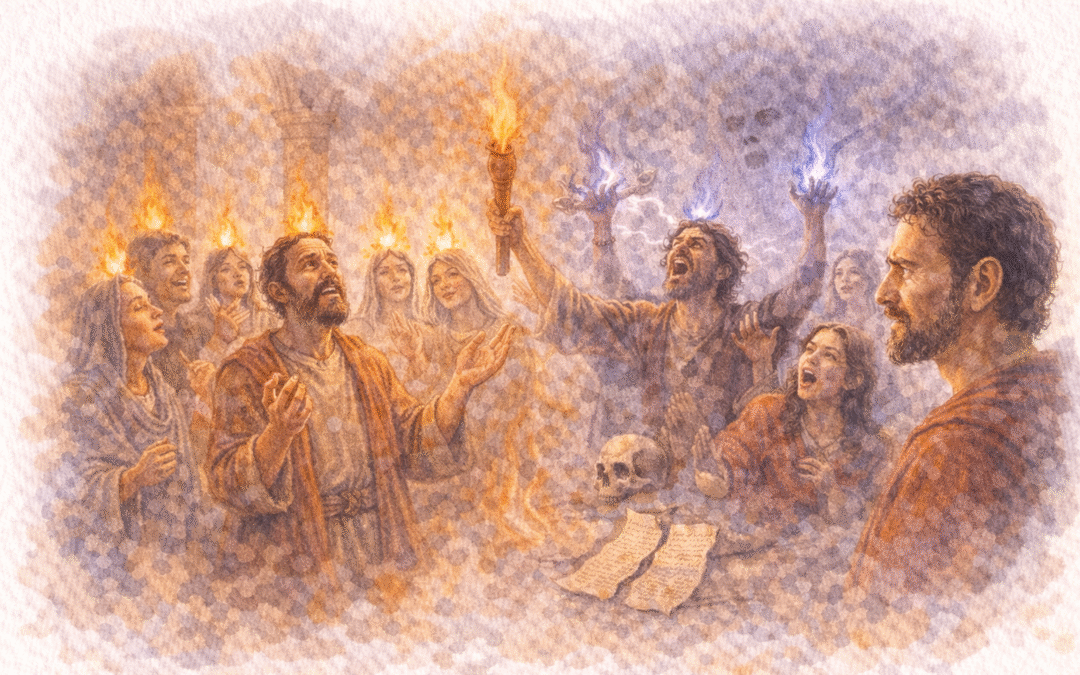
Today, we will learn to differentiate the “Fire of the Altar” (which purifies and illuminates) from the “Strange Fire” (which only makes noise and burns).
I. The Two Faces of the Gift: Acts 2 vs. 1 Corinthians 14
The first confusion we need to undo is the definition. Not every “tongue” in the Bible is the same thing. The New Testament presents two distinct phenomena, with distinct purposes.
1. Xenolalia (Acts 2): The Sign for the World
On the Day of Pentecost, the Spirit descended and the disciples began to speak “in other tongues as the Spirit enabled them” (Acts 2:4 – NIV). The result? Jews from every nation (Parthians, Medes, Elamites) heard in their own native language. This is Xenolalia (Xenos = Foreign + Lalia = Speech). These were real human languages that the disciples had not studied. Purpose: Evangelism and a Sign of Judgment. God was reversing the Tower of Babel. It was a public sign to unbelievers that the Gospel was now global.
2. Glossolalia (1 Corinthians 14): The Sign for the Soul
In Corinth, things were different. Paul says:
“For anyone who speaks in a tongue does not speak to people but to God. Indeed, no one understands them; they utter mysteries by the Spirit.” (1 Corinthians 14:2 – NIV)
Here, it is not a human language to preach to foreigners (since “no one understands”). It is a language of spiritual prayer. Purpose: Personal Edification. “Anyone who speaks in a tongue edifies themselves” (1 Cor 14:4). It is a devotional tool for when our human intelligence reaches its limit and our spirit needs to communicate directly with God (the “groans that words cannot express” of Romans 8:26).
The Common Error: Many critics attack tongues today saying: “They aren’t real languages like in Acts 2, therefore they are false.” They forget that Paul describes a category of tongues that are not for men, but for God. Paul himself says: “If I speak in the tongues of men or of angels…” (1 Cor 13:1).
II. The Historical Warning: Who Was Montanus?
To understand the danger of excess, we need to step out of the Bible for a minute and go to the year 156 A.D., in the region of Phrygia (modern-day Turkey). The early Church was beginning to institutionalize. Services were becoming more organized. Then appeared a man named Montanus, a recent convert from paganism (he had been a priest of the goddess Cybele, known for cults of frenetic ecstasy). Montanus, along with two prophetesses (Priscilla and Maximilla), started a movement called “The New Prophecy.”
They preached and entered into violent trances. They rolled on the floor. They spoke unintelligible tongues in an uncontrolled manner. But Montanus’s error wasn’t just the noise. It was the theology:
- The Loss of Reason: Montanus said that when the Spirit came, the human mind should be “shut down.” The prophet was like a passive lyre being played by God.
- The “New” Revelation: They claimed that what they spoke in ecstasy had the same (or greater) authority as Scripture and the Apostles. Montanus went so far as to say: “I am the Father, the Son, and the Paraclete.”
- Spiritual Elitism: They divided the church between the “Pneumatics” (spiritual ones, who spoke in tongues and prophesied like them) and the “Psychics” (carnal, ordinary Christians).
The Church rejected Montanism. Not because the Church hated the Holy Spirit, but because the Church understood that the Holy Spirit does not annul the mind of Christ and does not contradict the Scriptures.
The Modern Parallel: Today, we see the “Ghost of Montanus” in many places. Preachers who say: “Don’t think, just feel!” Services where collective hysteria is viewed as revival. People who say “God told me” to justify absurdities that contradict the Bible. This is not Pentecost; this is Montanism re-edited.
III. The Pauline Regulation: The Course Correction
Back to the Bible. The church in Corinth was the “Montanist church” before Montanus. They loved the gifts, but they were childish, carnal, and chaotic. Paul doesn’t tell them to stop using the gifts (as a cessationist would). He tells them to mature in the use of the gifts. In 1 Corinthians 14, Paul establishes the “Traffic Laws” for the move of the Spirit.
1. The Rule of Intelligibility (Mind vs. Spirit)
“For if I pray in a tongue, my spirit prays, but my mind is unfruitful. So what shall I do? I will pray with my spirit, but I will also pray with my understanding…” (1 Cor 14:14-15)
Paul destroys the idea that “being spiritual is being irrational.” He says: I want both things. The fervor of the spirit and the clarity of the mind. In public worship, the mind takes priority. Why? Because of love for the neighbor.
“But in the church I would rather speak five intelligible words to instruct others than ten thousand words in a tongue.” (v. 19) Application: If you are in your room (Secret Place), speak 10,000 words in tongues. Edify yourself. But if you take the microphone in church and speak in tongues without interpretation, you are not edifying the church; you are showing off.
2. The Rule of Control (The Fruit of Self-Control)
“The spirits of prophets are subject to the control of prophets.” (v. 32)
This is the litmus test against pagan emotionalism. In paganism (and in spiritism), the spirit “takes over” the person. They fall, thrash around, and say: “I couldn’t hold it back, it was stronger than me.” Paul says: That is a lie. The Holy Spirit is a gentleman. He grants the power, but the prophet keeps his hands on the wheel. God does not violate your free will or your dignity. If someone starts screaming and running around disrupting the preaching and says “it was the Spirit,” biblically speaking, it was either the flesh seeking attention, or a spirit of disorder. The Spirit of God produces Self-Control (Galatians 5:23).
3. The Rule of Order (Cosmopolitan God)
“For God is not a God of disorder but of peace.” (v. 33) “But everything should be done in a fitting and orderly way.” (v. 40)
A chaotic service, where no one understands anything, where there is disconnected shouting and fear, does not reflect God’s character. God organized the universe (Cosmos) out of Chaos. The Spirit always brings order (Genesis 1). Where there is persistent chaos, the Spirit is being grieved, not exalted.
IV. How to Discern True Fire?
So, how do we know if the experience is genuine? How do we know if speaking in tongues is from the Spirit, from human psychology, or from the devil? The Bible gives us the litmus test:
1. Is the Focus on Christ?
“Therefore I want you to know that no one who is speaking by the Spirit of God says, ‘Jesus be cursed,’ and no one can say, ‘Jesus is Lord,’ except by the Holy Spirit.” (1 Cor 12:3) True gifts exalt Jesus, not the gift-bearer. If tongues draw attention to the “Super Apostle” and make the church forget the Cross, it is strange fire.
2. Does It Generate Love? Paul places the famous chapter on Love (1 Corinthians 13) sandwiched between the chapters on gifts (12 and 14). It is no accident. He says: “If I speak in the tongues of men or of angels, but do not have love, I am only a resounding gong or a clanging cymbal” (1 Cor 13:1). Tongues without love are just noise. People who speak in tongues in the service but gossip in the hallway, destroy their family at home, and treat the waiter poorly are not filled with the Spirit; they are filled with noisy religiosity. The sign of the fullness of the Spirit is not the gift (charisma), it is the fruit (character).
3. Is There Interpretation (in Public)? If there are tongues in public worship, there must be interpretation. If there is no interpreter, “they should keep quiet in the church” (1 Cor 14:28). This command is frequently disobeyed today. The insistence on speaking tongues into the microphone without translation is direct biblical disobedience.
V. The Danger of the Other Extreme: “Cold Cessationism”
We have spoken a lot about abuses, but we need to warn about the opposite error: the fear of the supernatural. Many historical (“traditional”) churches, afraid of the ghost of Montanism and neo-Pentecostal excesses, “threw the baby out with the bathwater.” They quenched the Spirit (1 Thessalonians 5:19). They became cerebral, dry, and academic.
Paul ends chapter 14 with a perfectly balanced directive:
“Therefore, my brothers and sisters, be eager to prophesy, and do not forbid speaking in tongues.” (v. 39)
“Do not forbid.” If you forbid it, you amputate a tool of edification and spiritual warfare that God gave to His Church. The gift of tongues (in the private/devotional realm) is a powerful weapon for:
- Personal Edification: Recharging the spiritual battery (Jude 20).
- Deep Intercession: Praying God’s will when we don’t know what to ask (Romans 8).
- Spiritual Rest: Isaiah 28:11-12 associates “strange tongues” with rest and repose for the weary.
Don’t be afraid of the gift because of those who misuse it. Don’t stop using money because someone counterfeited it. The counterfeit only exists because the real thing is valuable.
VI. Practical Application: The “User Manual” for Today
How do we apply this to our devotional and community life?
1. Seek the Gift (Without Anxiety): Paul says: “Eagerly desire gifts of the Spirit” (1 Cor 14:1). You can and should ask God: “Lord, if there is a prayer language that can edify me, I want it. Baptize me with power.” But don’t make this a condition for salvation. Don’t create trauma if it doesn’t happen today. Receive by faith, not by the force of shouting.
2. Use it in the Secret Place: The greatest utility of tongues is in your room.
When you are anxious, out of words, with your mind racing, start praying in the spirit (even if quietly). Let the Holy Spirit pacify your mind through your spirit. It is divine therapy.
3. Have Decency in Public: If you feel like praying in tongues during worship at church, great. But ask yourself: “Am I shouting to show that I am spiritual? Am I bothering the person next to me?” The Spirit is polite. You can pray in tongues by whispering. Power is not in decibels.
4. Judge Prophecies: If someone comes with a “strange prophecy,” use the filter of the Word. “Does this agree with the Bible? Does this glorify Christ? Does this person’s character back up what they say?” Do not accept the “yoke” of manipulative prophets who use “God told me” to control your life, your money, or your marriage.
Conclusion: The Most Excellent Way
The Church desperately needs the Holy Spirit. Without Him, we are just a social club with gospel music and moral lectures. We need the power. We need the signs. We need the tongues and the healings.
But we need, with the same urgency, Maturity. Paul calls us to be “infants in evil, but in your thinking be adults” (1 Cor 14:20). Being an adult is knowing how to use fire to cook and warm, without burning the house down.
May our pursuit not be for the goosebumps, but for the character of Christ. May our tongues not just be “strange,” but be tongues of love, of truth, and of fire that purifies. Because, in the end, tongues will be stilled and prophecies will cease (1 Cor 13:8), but Love will remain forever.
Seek the Gift. But, above all, seek the Giver.
“Do not get drunk on wine, which leads to debauchery. Instead, be filled with the Spirit.” — Ephesians 5:18
Postagens/Posts/Publicaciones
- “Is It God or Is It Just My Head?” The Ultimate Guide to Stop Guessing and Start Discerning
- “Show Me Your Glory”: The Mystery of the Cleft of the Rock and the Safe Place in Jesus
- A Kenosis: The Emptying of Glory (Philippians 2)
- Anxiety and Faith: Is it a sin to take medication or go to therapy? What the Bible really says
- Celestial Breaking News: “New Year” Doesn’t Exist in the Bible? A Deep Investigation into the Theology of New Beginnings
- Celestial Breaking News: The Day Heaven Invaded Earth (The True Story of Christmas You Never Heard)
- Christmas Investigation: Does the Bible Reveal the Exact Day Jesus Was Born? (The Mystery of Tabernacles)
- Church or Cult? The Ultimate Biblical Guide for the New Convert to Find a Safe Spiritual Home
- Corinth: Sacred Monday (Tentmaker’s Work)
- Ephesus: The Theater of Shadows (Spiritual War and Culture)
- Ephesus: The Theater of Shadows (Spiritual Warfare and Culture)
- First Steps with Jesus: A Biblical Guide to Start Your Journey of Faith
- From Failure to Rock: The Denial and Restoration of Peter.
- From the Pit to the Palace: When God’s Presence Feels Like Absolute Silence
- Fruit vs. Gifts: The Priority of Character
- God’s Radar: Integrity and the Gaze of God (2 Chr 16:9)
- Grace in Lo-debar: The King’s Call (Mephibosheth / 2 Samuel 9)
- I Converted, But I Sinned Again: The Liberating Truth About Your Internal Struggle
- I Find Reading the Bible and Praying Boring: How to Overcome Spiritual Boredom and Build Consistency
- Jerusalem/Rome: The Compass (The End of the Race)
- Justification: The Courtroom of Grace
- Melchizedek: The King Without Genealogy
- Nicodemus: The Theologian in Darkness (The New Birth)
- Real Life #1: “How to Share Jesus with My Family Without Starting World War III” — The Ultimate Guide to Home Evangelism
- Real Life #2: “Do I Really Need to Get Baptized? What Really Happens in the Water” — The Ultimate Guide to the Public Wedding with Christ
- Real Life #3: “Did God Call Me? How to Discover My Purpose Without Becoming a Pastor” — Ending the Sacred-Secular Divide
- Real Life #4: “Christian Dating vs. Hookup Culture: The Survival Manual for Singles” — Purity, Purpose, and the Physics of Being Unequally Yoked
- Real Life #5: “Tithes and Offerings: Is God Broke or Am I Greedy?” — Money as a Spiritual Thermometer
- Silence in Chaos: Why Having Faith Doesn’t Make You Immune to Anxiety (And How to Find Real Peace)
- Silence is Not Absence: A Deep Guide to Resetting Your Frequency and Finding the Overflow of Purpose
- Spiritual Detox #1: “I Accepted Jesus, Now My Problems Will End” — The Big Lie and the True Promise
- Spiritual Detox #2: “Do I Have to Cut Off Non-Christian Friends?” — The Definitive Guide to the “Holy Bubble”
- Spiritual Detox #3: “Christians Don’t Get Depressed?” — Breaking the Mental Health Taboo in the Church
- Spiritual Detox #4: “Can the Devil Read My Thoughts?” — The End of Paranoia and True Spiritual Authority
- Spiritual Detox #5: “I Don’t Feel God, So He’s Not Listening” — The Danger of Goosebump-Based Faith
- Spiritual Detox #6: “If I Sin, Does God Walk Away and Stop Loving Me?” — The Survival Guide for the “Spiritual Hangover”
- Spiritual Detox #7: “Do I Have to Become a Boring Christian?” — The End of the ‘Do’s and Don’ts’ List and True Holiness
- Start Here: 7 Days to Hear God (Reading John)
- The Abyss of Glory: The Depth of the Riches (Romans 11:33).
- The Anatomy of a Heart: Why Did God Love Such an Imperfect Man So Much?
- The Art of Abiding: Prayer, Discipleship, and the Secret of Consistency
- The Art of Provocation: Communion and Mutual Encouragement in Hebrews 10:24
- The Art of Provocation: Communion and Mutual Encouragement in Hebrews 10:24
- The Crimson Mystery: The Theology, Legality, and Power of “Pleading the Blood”
- The Dungeon: The Winter of the Soul (Solitude/2 Timothy)
- The Emmaus Bread: Eyes Opened in Communion (Luke 24).
- The Eternity Code: Forensic Evidence That the Bible Is the Word of God
- The Final Metanoia: What It Really Means to Have the Mind of Christ
- The Great Discovery of December 31st: The End of Waiting (The Kingdom is Now)
- The Great Plan: The Architecture of Rescue (When the Fall Meets Grace)
- The Great Plan: Understanding the “Exchange” That Changes Everything
- The Importunate Friend: A Theology of Persistence
- The Incomparable #1: “The Terrorist of Tarsus: How God Turns His Worst Enemy Into His Greatest General”
- The Incomparable #10: The Last Breath — The Death of the Servant vs. The Death of the Atheist (Final Special)
- The Incomparable #2: “The Arabian Desert: Why Does God ‘Hide’ Those He Plans to Use?” — The Secret Power of Anonymity
- The Incomparable #3: The Fight with Barnabas and the Cost of Leadership
- The Incomparable #4: When Heaven Says “No” (The Frequency of the Spirit)
- The Incomparable #5: The Overflow — When the Gospel Faces Culture (Paul in Athens)
- The Incomparable #6: Silence in Chaos — The Theology of the Shipwreck (Paul in Acts 27)
- The Incomparable #7: The Art of Letting Go — The Radical Theology of Forgiveness (Paul and Philemon)
- The Invitation of the Maimed: The Parable of the Great Banquet
- The Invitation of the Maimed: The Parable of the Great Banquet
- The Iron Mask: Why We Feel Like a Fraud and How to Cure Spiritual Imposter Syndrome
- The Judgment of the Nations: The Sheep and the Goats
- The Kairos of God: Sovereignty Over Time in Eternity
- The Logic of Blood: Why was Jesus’ death the only solution?
- The Mirror: The Death of the Slave, The Birth of the Son
- The Orphan Syndrome: Why Do You Keep Acting Like a Slave When You Already Have the House Keys?
- The Place of the Sinner: The Alabaster Jar (Luke 7).
- The Prince, The Shepherd, and The Deliverer: When the Desert Is the Only School
- The Prison of Resentment: How to forgive someone who never said “I’m sorry”
- The Rich Young Ruler: The Tragedy of Almost-Salvation
- The Samaritan Woman: The Forgotten Jar at the Well
- The School of Prayer: How to Learn to Speak the Language of Heaven
- The Seal of the Spirit: Pledge and Property
- The Secret of the Secret Place: The Intimacy that Pleases God (Martha and Mary)
- The Shrewd Manager: Investing in Eternity
- The Sound of Silence: What God Was Doing When He Stopped Speaking
- The Tabernacle: The Engineering of Presence
- The Table in the Wilderness: The Valley of the Shadow (Psalm 23).
- The Table of Betrayal: The Dipped Bread (Judas and Rejected Grace)
- The Table of Betrayal: The Dipped Bread (Judas and Rejected Grace)
- The Ten Virgins: The Danger of Borrowed Oil
- The Terror of God (The Invisible War)
- The Upside-Down Kingdom: Why Jesus’ Logic Offends Our Human Logic
- The Widow of Nain: When Two Processions Meet
- Tongues of Fire or Strange Fire? The Gift of Tongues, Paul, and the Ghost of Montanism
- When Heaven is Silent: A Survival Guide for the “Dark Night of the Soul”
- Zacchaeus: The Tree of Curiosity