


Series: Deep Dive Specials (Vol. 7 – Extra)
Theme: Biblical Theology and the History of Redemption
Scripture Base: Genesis 3:15 / Ephesians 1:4 / Revelation 13:8
Estimated Reading Time: 25 minutes
There is a subtle theological lie that many Christians believe without realizing it. It is the idea that God was “caught by surprise” by Adam’s sin. We imagine the scene like this: God creates the perfect world, turns His back for a minute, Adam eats the fruit, and God panics, screaming: “Now what? They ruined everything! What do I do? I have an idea: I’ll send Jesus!”
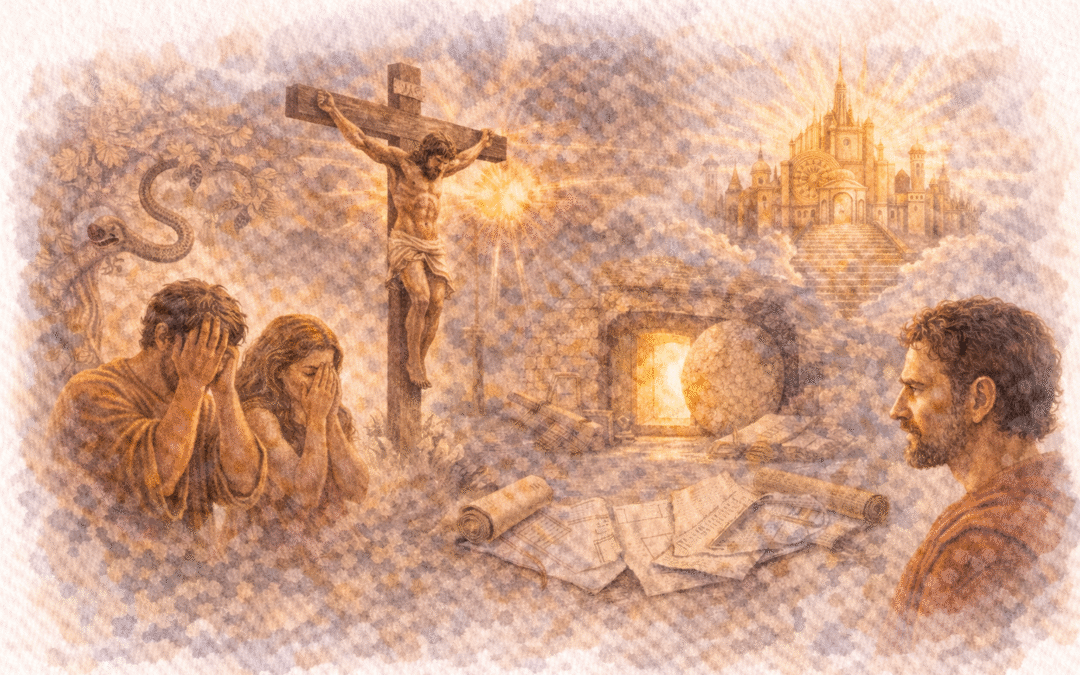
This is heresy. God has no “Plan B.” The Bible categorically states that Christ is the “Lamb who was slain from the creation of the world” (Revelation 13:8 – NIV). This means that before God said “Let there be Light,” He already knew there would be darkness. Before forming man from the dust, He already knew man would return to the dust. And, before planting the Tree of Life, He had already planted the tree that would become the Cross.
The story of the Bible is not the story of a God stumbling around trying to fix the world. It is the story of a God who, in the face of every human fall, reveals a new layer of a rescue plan that was already designed in eternity. The focus of our study today is to trace this divine pattern:
- Man falls and breaks the covenant.
- Justice demands judgment.
- Grace intervenes immediately with a rescue plan superior to the previous one.
Let’s travel from Genesis to Revelation following the “Scarlet Thread” of Redemption.
ACT I: The Garden — The First Fall and the First Blood
The drama begins in Genesis 3. The man and the woman disobey. The catastrophe is cosmic. Death enters the world. Shame is born (they realize they are naked). Fear is born (they hide from God).
The logical reaction of Justice would be: “End of project. Destroy and start over.” But look at the reaction of Grace. God goes to meet them in the cool of the day. He pronounces judgment on the serpent, on the woman, and on the man. But, in the middle of the sentence, He plants the seed of hope.
The Protoevangelium (Genesis 3:15)
God says to the serpent:
“And I will put enmity between you and the woman, and between your offspring and hers; he will crush your head, and you will strike his heel.”
Here is the first promise of the Bible. God promises an “Offspring” (seed). He warns that there will be blood (strike his heel), but guarantees there will be victory (crush the head). Man has just fallen, and God is already talking about the Messiah.
The First Sacrifice (Genesis 3:21)
But the future promise does not resolve the present shame. Adam and Eve tried to cover themselves with fig leaves (human religion: the effort to cover one’s own shame). God rejects the leaves.
“The Lord God made garments of skin for Adam and his wife and clothed them.”
For there to be skin, there was death. For the first time in the history of the universe, blood was shed. God killed an innocent animal (probably a lamb) to cover the nakedness of the guilty. The Pattern: Man sins -> God provides a substitute. God did not let Adam leave the Garden naked. He expelled him, yes, but He expelled him covered by the sacrifice.
ACT II: The Flood — Total Corruption and the Ark
Time passes. Cain’s sin spreads. Humanity reaches a level of moral rot that is unsustainable. Genesis 6 says that “every inclination of the thoughts of the human heart was only evil all the time.”
Justice says: “I will wipe man from the face of the earth.” The Flood is the decree of un-creation. God is reversing creation, bringing the chaos of the waters back. But Grace says: “It’s not over yet.”
God finds Noah. And God gives Noah a project: the Ark. The Ark is not just a boat; it is a type of Christ.
- It had only one door (Jesus said: “I am the door”).
- It was pitched inside and out (the Hebrew word for pitch, kopher, is the same root as kippur, atonement/covering).
- It passed through the waters of judgment, and whoever was inside it was saved from divine wrath.
The Pattern: The world deserves to sink -> God builds a floating refuge. Even in the most severe judgment in history, God preserved the seed. He never destroys without first preparing the escape for the remnant.
ACT III: Babel and Abraham — Dispersion and Election
After the Flood, man fails again. In Genesis 11, they build the Tower of Babel. It is humanism’s attempt to reach heaven without God, to “make a name” for themselves. God comes down, confuses the languages, and scatters the nations. Now humanity is fragmented, idolatrous, and lost.
How does God react to this global fragmentation? He does something counter-intuitive. He doesn’t speak to all nations; He chooses one man. In Genesis 12, He calls Abram, an idolater from Ur of the Chaldeans.
“Go from your country… I will make you into a great nation… and all peoples on earth will be blessed through you.” (Genesis 12:1-3 – NIV)
Here is the strategy of the Scandal of Election. God funnels the plan. He will invest everything in one family, to save all other families through that family. Abraham fails (lies about Sarah, tries to have a child with Hagar), but God keeps the promise. In Genesis 22, in the sacrifice of Isaac, we see the pattern repeating: Isaac (the son of the promise) is about to die. At the last second, God provides a ram caught by its horns in the thicket. God says to Abraham: “Do not lay a hand on the boy.” But, centuries later, on the same mountain (Moriah/Calvary), God would not spare His own Son.
The Pattern: Man builds towers of pride -> God builds a family of faith.
ACT IV: The Exodus — Slavery and the Lamb
Abraham’s family becomes a nation but ends up enslaved in Egypt. Four hundred years of silence and the whip. Pharaoh (a type of Satan) wants to kill the Hebrew boys. It looks like the end.
God raises up Moses. But the plagues don’t free the people. What frees the people? Death. In the tenth plague, the angel of death would pass through. The only protection wasn’t being Hebrew, nor being a “good person.” The protection was the Blood of the Lamb.
“The blood will be a sign for you on the houses where you are, and when I see the blood, I will pass over you.” (Exodus 12:13 – NIV)
This is Passover (Pesach). God institutes a pedagogical system. He teaches the people: “Freedom costs a life.” They cross the Red Sea (baptism) and go into the desert. There, they sin again (Golden Calf). God should consume them. What does God do? He commands the Tabernacle to be built. The Tabernacle is God’s answer to Israel’s sin. It is God saying: “You are sinners and I am Holy, and if I dwell among you without protection, I will kill you. So, I will create a system of sacrifices, a priesthood, and a holy place so that I can dwell in the midst of your filth without consuming you.”
The Pattern: Man is a slave and idolater -> God provides the Blood and the Tabernacle to dwell among them.
ACT V: The Monarchy and the Exile — The Failure of Kings
Israel enters the Promised Land but wants a king “like the other nations.” God gives them kings. Saul fails. David is a man after God’s own heart, but commits adultery and murder. Solomon starts well and ends in idolatry. The kingdom splits. Idolatry takes over. God sends prophets (Isaiah, Jeremiah, Hosea) to warn: “Return, or judgment will come.” They kill the prophets.
Finally, the Exile comes. Babylon destroys Jerusalem. The Temple (God’s house) is burned. The Ark of the Covenant disappears. For a Jew, that was the end of the world. Did God fail? Did the promise to David (of an eternal throne) break?
No. Amidst the ashes of the Exile, God gives the greatest prophecies of hope.
- Jeremiah 31: God promises a “New Covenant”, not written on stone, but on the heart.
- Ezekiel 37: God promises to breathe Spirit into “dry bones”.
- Isaiah 53: God reveals that the Suffering Servant will come to be “crushed for our iniquities”.
God uses Israel’s political failure to set the stage for a Spiritual Kingdom. He takes the focus off the earthly throne and points to an eternal throne.
The Pattern: The earthly throne falls -> God promises an Eternal King and a new heart.
ACT VI: The Cross — The Climax of the Rescue
The “fullness of time” arrives (Galatians 4:4). The scenario seems grim. Rome rules the world with an iron fist. Israel is a rebellious province. The Jewish religion has become dead legalism (Pharisees) or political commerce (Sadducees). Man has failed every test:
- In Paradise (Adam).
- In Human Government (Noah).
- In the Promised Land (Israel).
- Under the Law (Judaism).
Then, God sends the Son. And what does humanity do with the ultimate expression of God’s love? They kill Him. The Cross is, at the same time, the most heinous crime in human history and the most glorious plan in divine history. In Acts 2:23, Peter tells the Jews:
“This man was handed over to you by God’s deliberate plan and foreknowledge; and you, with the help of wicked men, put him to death…”
Notice the tension: You killed Him (human guilt), but it was by God’s deliberate plan (divine plan). On the Cross, God takes the worst man could do (deicide – killing God) and transforms it into the best God could do (Redemption). The veil is torn. Access is granted. The sacrifice of Genesis 3:21, the Lamb of Exodus 12, and the Servant of Isaiah 53 converge in a single Person. Jesus cries out: “It is Finished”. It is not a cry of defeat; it is a cry of “Debt Paid.” The plan worked. The serpent’s head was crushed.
ACT VII: The Church and the End — The Stubbornness of Grace
But the story didn’t end at the Resurrection. Jesus ascends, but sends the Holy Spirit. The Church is born. The plan is now global. The mystery that was hidden is revealed: the Gentiles (us) are co-heirs. Is the Church perfect? No. We read Paul’s letters and see incest in Corinth, legalism in Galatia, laziness in Thessalonica. Man continues to fail. But Grace continues to operate. God does not give up on His Bride. He sanctifies her, washes her with the Word (Ephesians 5), and uses her, even though imperfect, to preach the Kingdom.
And finally, we arrive at Revelation 21-22. God’s Plan is not just “saving souls for heaven”; it is restoring Creation. John sees “a new heaven and a new earth”. Note the detail: The Bible begins in a Garden (Genesis) and ends in a Garden-City (The New Jerusalem).
- In Genesis, access to the Tree of Life was blocked by cherubim.
- In Revelation, the Tree of Life is in the middle of the city square, and its leaves are for the healing of the nations.
- In Genesis, Satan enters to deceive.
- In Revelation, Satan is thrown into the lake of fire forever.
God didn’t just fix what Adam broke. He made it better. Adam was innocent but could sin. The redeemed in glory will be holy and will not be able to sin anymore (posse non peccare vs. non posse peccare). The last state is superior to the first. Where sin abounded, grace superabounded.
Personal Application: What Does This Mean for Me?
Why spend time understanding this “Great Story”? Because it is your story.
If God reacted this way over 6,000 years of human history—responding to every rebellion with a deeper rescue plan—why would He act differently with you?
- Your Failure Doesn’t Scare God: Did you fall? Did you sin? Did you ruin everything? God is not in heaven pacing back and forth, biting His nails, asking “what do I do with [Your Name]?”. The restoration plan for your life was on the table before you were born. The blood of Jesus covers your past, your present, and your future.
- Judgment is Real, but so is the Refuge: God didn’t ignore sin in the Flood or on the Cross. He punished sin. But He always provides an Ark. Don’t play with sin, but if you sin, run to the Ark, not from the Ark. The Ark is Christ.
- History Has a Direction: Your life is not a meaningless cycle (like in Hinduism) nor a random tragedy (like in atheism). Your life is a straight line toward the New Jerusalem. The sufferings of the present time (“labor pains”) are not worth comparing with the glory that will be revealed (“the birth”).
- Grace is Stubborn: From Genesis to Revelation, we see a God who refuses to abandon the work of His hands. He pursues. He clothes. He calls. He dies for us. He rises. And He will return.
You can trust an Architect like that. The project of your salvation is fail-safe, because it does not depend on Adam’s fidelity, nor Moses’s, nor yours. It depends, solely and exclusively, on the fidelity of the Lamb who was slain, but who is now alive for ever and ever.
The Plan is secure. Rest.
“For from him and through him and for him are all things. To him be the glory forever! Amen.” — Romans 11:36
Postagens/Posts/Publicaciones
- “Is It God or Is It Just My Head?” The Ultimate Guide to Stop Guessing and Start Discerning
- “Show Me Your Glory”: The Mystery of the Cleft of the Rock and the Safe Place in Jesus
- A Kenosis: The Emptying of Glory (Philippians 2)
- Anxiety and Faith: Is it a sin to take medication or go to therapy? What the Bible really says
- Celestial Breaking News: “New Year” Doesn’t Exist in the Bible? A Deep Investigation into the Theology of New Beginnings
- Celestial Breaking News: The Day Heaven Invaded Earth (The True Story of Christmas You Never Heard)
- Christmas Investigation: Does the Bible Reveal the Exact Day Jesus Was Born? (The Mystery of Tabernacles)
- Church or Cult? The Ultimate Biblical Guide for the New Convert to Find a Safe Spiritual Home
- Corinth: Sacred Monday (Tentmaker’s Work)
- Ephesus: The Theater of Shadows (Spiritual War and Culture)
- Ephesus: The Theater of Shadows (Spiritual Warfare and Culture)
- First Steps with Jesus: A Biblical Guide to Start Your Journey of Faith
- From Failure to Rock: The Denial and Restoration of Peter.
- From the Pit to the Palace: When God’s Presence Feels Like Absolute Silence
- Fruit vs. Gifts: The Priority of Character
- God’s Radar: Integrity and the Gaze of God (2 Chr 16:9)
- Grace in Lo-debar: The King’s Call (Mephibosheth / 2 Samuel 9)
- I Converted, But I Sinned Again: The Liberating Truth About Your Internal Struggle
- I Find Reading the Bible and Praying Boring: How to Overcome Spiritual Boredom and Build Consistency
- Jerusalem/Rome: The Compass (The End of the Race)
- Justification: The Courtroom of Grace
- Melchizedek: The King Without Genealogy
- Nicodemus: The Theologian in Darkness (The New Birth)
- Real Life #1: “How to Share Jesus with My Family Without Starting World War III” — The Ultimate Guide to Home Evangelism
- Real Life #2: “Do I Really Need to Get Baptized? What Really Happens in the Water” — The Ultimate Guide to the Public Wedding with Christ
- Real Life #3: “Did God Call Me? How to Discover My Purpose Without Becoming a Pastor” — Ending the Sacred-Secular Divide
- Real Life #4: “Christian Dating vs. Hookup Culture: The Survival Manual for Singles” — Purity, Purpose, and the Physics of Being Unequally Yoked
- Real Life #5: “Tithes and Offerings: Is God Broke or Am I Greedy?” — Money as a Spiritual Thermometer
- Silence in Chaos: Why Having Faith Doesn’t Make You Immune to Anxiety (And How to Find Real Peace)
- Silence is Not Absence: A Deep Guide to Resetting Your Frequency and Finding the Overflow of Purpose
- Spiritual Detox #1: “I Accepted Jesus, Now My Problems Will End” — The Big Lie and the True Promise
- Spiritual Detox #2: “Do I Have to Cut Off Non-Christian Friends?” — The Definitive Guide to the “Holy Bubble”
- Spiritual Detox #3: “Christians Don’t Get Depressed?” — Breaking the Mental Health Taboo in the Church
- Spiritual Detox #4: “Can the Devil Read My Thoughts?” — The End of Paranoia and True Spiritual Authority
- Spiritual Detox #5: “I Don’t Feel God, So He’s Not Listening” — The Danger of Goosebump-Based Faith
- Spiritual Detox #6: “If I Sin, Does God Walk Away and Stop Loving Me?” — The Survival Guide for the “Spiritual Hangover”
- Spiritual Detox #7: “Do I Have to Become a Boring Christian?” — The End of the ‘Do’s and Don’ts’ List and True Holiness
- Start Here: 7 Days to Hear God (Reading John)
- The Abyss of Glory: The Depth of the Riches (Romans 11:33).
- The Anatomy of a Heart: Why Did God Love Such an Imperfect Man So Much?
- The Art of Abiding: Prayer, Discipleship, and the Secret of Consistency
- The Art of Provocation: Communion and Mutual Encouragement in Hebrews 10:24
- The Art of Provocation: Communion and Mutual Encouragement in Hebrews 10:24
- The Crimson Mystery: The Theology, Legality, and Power of “Pleading the Blood”
- The Dungeon: The Winter of the Soul (Solitude/2 Timothy)
- The Emmaus Bread: Eyes Opened in Communion (Luke 24).
- The Eternity Code: Forensic Evidence That the Bible Is the Word of God
- The Final Metanoia: What It Really Means to Have the Mind of Christ
- The Great Discovery of December 31st: The End of Waiting (The Kingdom is Now)
- The Great Plan: The Architecture of Rescue (When the Fall Meets Grace)
- The Great Plan: Understanding the “Exchange” That Changes Everything
- The Importunate Friend: A Theology of Persistence
- The Incomparable #1: “The Terrorist of Tarsus: How God Turns His Worst Enemy Into His Greatest General”
- The Incomparable #10: The Last Breath — The Death of the Servant vs. The Death of the Atheist (Final Special)
- The Incomparable #2: “The Arabian Desert: Why Does God ‘Hide’ Those He Plans to Use?” — The Secret Power of Anonymity
- The Incomparable #3: The Fight with Barnabas and the Cost of Leadership
- The Incomparable #4: When Heaven Says “No” (The Frequency of the Spirit)
- The Incomparable #5: The Overflow — When the Gospel Faces Culture (Paul in Athens)
- The Incomparable #6: Silence in Chaos — The Theology of the Shipwreck (Paul in Acts 27)
- The Incomparable #7: The Art of Letting Go — The Radical Theology of Forgiveness (Paul and Philemon)
- The Invitation of the Maimed: The Parable of the Great Banquet
- The Invitation of the Maimed: The Parable of the Great Banquet
- The Iron Mask: Why We Feel Like a Fraud and How to Cure Spiritual Imposter Syndrome
- The Judgment of the Nations: The Sheep and the Goats
- The Kairos of God: Sovereignty Over Time in Eternity
- The Logic of Blood: Why was Jesus’ death the only solution?
- The Mirror: The Death of the Slave, The Birth of the Son
- The Orphan Syndrome: Why Do You Keep Acting Like a Slave When You Already Have the House Keys?
- The Place of the Sinner: The Alabaster Jar (Luke 7).
- The Prince, The Shepherd, and The Deliverer: When the Desert Is the Only School
- The Prison of Resentment: How to forgive someone who never said “I’m sorry”
- The Rich Young Ruler: The Tragedy of Almost-Salvation
- The Samaritan Woman: The Forgotten Jar at the Well
- The School of Prayer: How to Learn to Speak the Language of Heaven
- The Seal of the Spirit: Pledge and Property
- The Secret of the Secret Place: The Intimacy that Pleases God (Martha and Mary)
- The Shrewd Manager: Investing in Eternity
- The Sound of Silence: What God Was Doing When He Stopped Speaking
- The Tabernacle: The Engineering of Presence
- The Table in the Wilderness: The Valley of the Shadow (Psalm 23).
- The Table of Betrayal: The Dipped Bread (Judas and Rejected Grace)
- The Table of Betrayal: The Dipped Bread (Judas and Rejected Grace)
- The Ten Virgins: The Danger of Borrowed Oil
- The Terror of God (The Invisible War)
- The Upside-Down Kingdom: Why Jesus’ Logic Offends Our Human Logic
- The Widow of Nain: When Two Processions Meet
- Tongues of Fire or Strange Fire? The Gift of Tongues, Paul, and the Ghost of Montanism
- When Heaven is Silent: A Survival Guide for the “Dark Night of the Soul”
- Zacchaeus: The Tree of Curiosity