



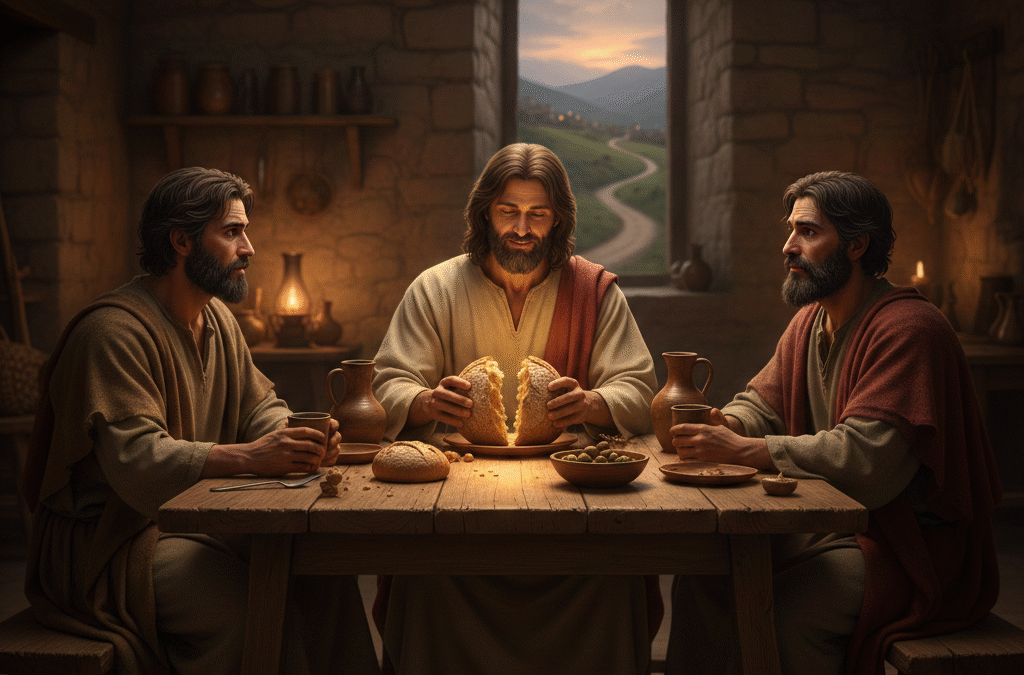
Title: The Emmaus Bread: Eyes Opened in Communion (Luke 24)
Introduction: The Journey from Blindness to Sight
The Gospel of Luke concludes with one of the most poignant and theologically rich narratives in all of Scripture: the encounter of the risen Christ with two disciples on the road to Emmaus (Luke 24:13-35). This story is far more than a simple resurrection appearance; it is a masterful paradigm of spiritual transformation, a divine pedagogy that maps the journey from despair to faith, from blindness to recognition, from solitude to communion. At its heart lies a profound mystery: the supreme revelation of the resurrected Lord occurs not in a grand theophany on a mountain, but in the humble, ordinary act of breaking bread. This study will explore the Emmaus Road as the archetypal Christian journey, examining the condition of spiritual blindness and religious disappointment, the internal work of Christ through the Word, and the ultimate, sacramental unveiling that happens in the fellowship of the table. It is here, in the confluence of Scripture and Sacrament, that our burning hearts find their object and our eyes are finally opened.
Historical Context: The Atmosphere of Crushed Hope
To understand the weight of this passage, we must situate ourselves in the immediate aftermath of the crucifixion. For Jesus’ followers, the events of Friday were not a prelude to Sunday but an absolute, catastrophic end. Their world had collapsed. They had followed a prophet “mighty in deed and word before God and all the people” (Luke 24:19), who they hoped “was the one to redeem Israel” (24:21). Their hope was national, political, and messianic in a conventional Jewish sense—a hope for the restoration of the Davidic kingdom and liberation from Roman oppression.
The crucifixion shattered this hope utterly. In Jewish understanding, a crucified man was accursed by God (Deuteronomy 21:23). The Messiah was to be a triumphant figure, not a condemned criminal. The disciples on the road are not just sad; they are in a state of profound theological disillusionment. Their words, “we had hoped” (24:21, Greek: ēlpizomen—past tense), drip with the finality of a dream abandoned. Furthermore, the reports from the women about the empty tomb and angelic vision are met not with faith, but with perplexity and skepticism (24:22-24). They are “slow of heart to believe all that the prophets have spoken” (24:25).
The setting of the journey itself is significant. Emmaus, about seven miles from Jerusalem, represents a movement away from the epicenter of the divine action. They are leaving the community of disciples, retreating into isolation and dejection. This physical departure mirrors their spiritual state: they are walking away from the very place where God has acted, blinded by their own misunderstanding of how He promised to act.
Exegesis: A Divine Pedagogy on the Road
The narrative structure of Luke 24:13-35 is meticulously crafted, forming a chiastic (symmetrical) pattern that centers on the breaking of the bread.
A. Departure in Blindness (13-24): The two disciples, one named Cleopas, are discussing the events in Jerusalem. Jesus himself draws near and walks with them, “but their eyes were kept from recognizing him” (24:16). The passive voice “were kept” (ekratounto) suggests a divine restraint, a purposeful veiling that will set the stage for a deeper revelation. Jesus, playing the role of the ignorant stranger, draws out their despair. Their summary of Jesus is respectful but terminally past-tense. They even know of the empty tomb, but it is a puzzle, not a promise.
B. The Heart Ignited by the Word (25-27): This is the first pivotal moment. Jesus’ response is not comfort first, but rebuke: “O foolish ones, and slow of heart to believe all that the prophets have spoken!” The Greek for “foolish” (anoētoi) means “without understanding,” pointing to a failure of biblical interpretation, not a lack of intelligence. Then begins the greatest Bible study in history: “And beginning with Moses and all the Prophets, he interpreted to them in all the Scriptures the things concerning himself” (24:27). The Greek word for “interpreted” (diermēneusen) means to explain, to unfold, to hermeneutically open up. He re-narrates their entire sacred story, showing how the Law, the Prophets, and the Writings (the Tanakh) all point to a Messiah who must suffer, die, and then enter his glory (24:26). This was the missing hermeneutical key. The result is not yet visual recognition, but internal ignition: “Did not our hearts burn within us while he talked to us on the road, while he opened to us the Scriptures?” (24:32). The “burning heart” (kaiomenē kardia) signifies the internal witness of the Holy Spirit, using the Word to authenticate the Truth.
C. The Supreme Revelation in the Broken Bread (28-31): They press him to stay, for hospitality was a sacred duty. At the table, the roles dramatically reverse. The guest becomes the host: “When he was at table with them, he took the bread and blessed and broke it and gave it to them” (24:30). This fourfold action—took, blessed, broke, gave—is the exact language used at the feeding of the 5,000 (Luke 9:16) and, most crucially, at the Last Supper (Luke 22:19). It is a liturgical, sacramental gesture. In this act, the veil is lifted: “And their eyes were opened, and they recognized him” (24:31). The Greek for “opened” (diēnoichthēsan) is intensive, meaning “were fully opened,” and is the same verb used for Jesus “opening” the Scriptures (24:32). The opening of the Word leads to the opening of the eyes at the Table. Recognition is immediate, and in that moment of supreme revelation, “he vanished from their sight.” His physical presence is no longer needed; the sign has done its work. Faith has been born through the combined ministry of Word and Sacrament.
B’. The Heart Confirms the Word (32): They immediately reflect: “Did not our hearts burn within us…?” The internal testimony of the burning heart, once mysterious, is now understood in light of the revealed Christ. The Word prepared them for the Sacrament, and the Sacrament now confirms and explains their experience of the Word.
A’. Return in Witness (33-35): Immediately, though it is evening, they return the seven miles to Jerusalem. Their journey away from the community is reversed. They are no longer blind and depressed, but sighted and urgent witnesses: “They rose that same hour and returned to Jerusalem… Then they told what had happened on the road, and how he was known to them in the breaking of the bread” (24:33, 35). Their testimony is specific: he was made known en tē klasei tou artou—in the breaking of the bread.
Theology: The Confluence of Word, Sacrament, and Christ’s Real Presence
The Emmaus narrative provides a profound theology of how Christ makes himself known to his people.
Christ as Hermeneutical Key: The risen Jesus presents himself as the central, unifying subject of all Scripture. The Old Testament is not a collection of moral tales or ancient history; it is a coherent, Christotelic narrative. Without this key, the Bible remains a closed book, and the suffering of the Messiah a scandal. With it, the entire story of redemption makes sense. This establishes the principle of Christocentric interpretation.
The Ministry of the Word and the Internal Witness: Jesus’ exposition of the Scriptures did not force recognition but created the condition for it. The “burning heart” is a vital theological reality—the work of the Holy Spirit illuminating the Word, creating faith, and stirring affections long before full intellectual comprehension is achieved. This underscores that faith is not merely intellectual assent but involves the whole person—mind, heart, and will.
Sacramental Epiphany: The climax of the story is profoundly Eucharistic. The breaking of the bread is the moment of anagnorisis (recognition). This teaches us that Christ chooses ordinary, material means (bread, wine, water) as vehicles of his grace and self-disclosure. It is not a mere memorial. In the gathered community, as they re-enact the dominical action of taking, blessing, breaking, and giving, the living Christ makes himself truly present to the faith of his people. The Sacrament is where the preached Word becomes tangible, where the promise is sealed and received.
The Pattern of Divine Pedagogy: God’s method is one of gracious condescension. Jesus meets the disciples where they are—on a road of disappointment. He listens, questions, and then instructs. He does not overwhelm them with glory but walks with them in their confusion. The revelation is gradual, moving from the external Word, to the internal witness, to the sacramental confirmation. This is a model for discipleship and pastoral care.
Communion as the Site of Recognition: The recognition happens in communion—koinōnia. It happens not in solitary contemplation but in the context of fellowship, hospitality, and a shared meal. The Christian faith is inherently communal. Our eyes are opened as we are together, inviting the stranger in, and participating in the Lord’s Supper.
Application: Walking the Emmaus Road Today
The Emmaus story is our story. Its applications are direct and pastoral.
For the Spiritually Blind and Disappointed: Many walk their own road to Emmaus, bearing the weight of “we had hoped.” Hope may have died in a relationship, a career, a ministry, or a prayer long unanswered. This text assures us that the risen Christ draws near in our disappointment, even when we cannot recognize him. Our task is not to manufacture certainty but to honestly confess our confusion, and to invite him to stay. He specializes in resurrecting dead hopes according to the true pattern of his Word—through suffering to glory.
For Engaging with Scripture: We must come to the Bible not as a rulebook or an answer key, but as the story of Jesus. Every sermon, every study, every private reading should ask: “Where is Christ here?” We need the ministry of the One who can open the Scriptures to us, which he does through his Spirit within the community of faith. Let us pray for burning hearts as we read.
For the Centrality of the Lord’s Supper: The Eucharist should never be a ritual appendage but the expected climax of our worship, the place where the Word proclaimed becomes the Word shared. We must come to the Table expectantly, asking for our eyes to be opened afresh to the real presence of the crucified and risen Lord among us. In a world of virtual connections, the tangible, shared meal is a counter-cultural proclamation of Christ’s embodied grace.
For Hospitality and Community: Christ was made known in an act of hospitality (“Stay with us”). The church is called to be a community where strangers are welcomed, where the weary can find a place at the table. In opening our homes and our lives, we may unknowingly entertain Christ himself (Hebrews 13:2).
For Witness: The natural result of a burning heart and opened eyes is immediate witness. The disciples did not keep the experience to themselves; they returned to the community to share their news. Our testimony is simple and powerful: “Let me tell you what happened to me on the road, and how I met Jesus in the breaking of the bread.”
Conclusion: The Ongoing Feast of Recognition
The road to Emmaus does not end at Emmaus. It turns back toward Jerusalem, toward the community, toward mission. Luke’s Gospel closes with the disciples continually in the temple blessing God (24:53), and his sequel, Acts, begins with them breaking bread from house to house (Acts 2:46). The pattern established on that first Easter evening became the pattern of the early church: the apostles’ teaching (the opened Word), fellowship, the breaking of bread, and prayer (Acts 2:42).
The Emmaus narrative thus gives us the blueprint for the Christian life. We are a people on a journey, often confused and sightless. Yet, we are accompanied by the Stranger who is the Lord. He opens our minds to understand the Scriptures, setting our hearts ablaze with the truth of his suffering and glory. And then, at his table, in the simple, profound act of communion, he opens our eyes. We recognize him. He is not dead; he is risen. He is not absent; he is host. And in that recognition, our despair turns to joy, our isolation to fellowship, and our silence to proclamation. We rise and return to the world, not with a complex philosophy, but with the transformative witness: “We have met the Lord. He was made known to us in the breaking of the bread.”