


Estimated Reading Time: 15-20 minutes
Biblical Basis: Genesis 3, Matthew 3-4, Romans 8, Galatians 4 (NIV)
We live in the age of curation. If you open your social media right now, you will see perfect snippets of imperfect lives: smiling marriages, aesthetic breakfasts, Bible verses highlighted in leather-bound Bibles, and rising careers.
But if we could place a stethoscope on the soul of our generation—even inside the church—we would hear an arrhythmic heartbeat, accelerated by anxiety and fear. There is a silent abyss between who we show we are and who we feel we are.
In psychology, this is called Imposter Syndrome: the chronic feeling of being a fraud, the constant fear of being “found out,” and the inability to internalize success or love.
In spiritual life, this manifests devastatingly. We sing “I am a Child of God,” but we live as if we are on probation at work, terrified of divine termination. We pray, we serve, and we say “Amen,” but deep down, a voice whispers: “If people knew what you thought last night… if they knew about your envy, your lust, or your doubt… no one would respect you. Not even God.”
In this deep study, we are not going to offer cheap self-help (“Just believe in yourself!”). We are going to descend into the basement of the human soul, using Scripture, to understand the root of spiritual orphanhood and how the theology of Adoption is the only real cure for our insecurity.
1. The Archaeology of the Mask: Where Did It All Begin?
To understand our obsession with performance and hiding, we need to go back to the “scene of the crime”: Genesis 3.
Before the Fall, the Bible describes the emotional state of humanity with a short, powerful phrase:
“Adam and his wife were both naked, and they felt no shame.” (Genesis 2:25 – NIV)
Nakedness, in the Bible, is not just physical. It is transparency. Adam and Eve had nothing to hide. There was no “backstage” and no “stage.” Who they were on the inside was exactly who they were on the outside. There was a fluid, noise-free connection between them and the Creator.
The Birth of Shame
The moment sin enters (the disconnection from the Source, as we saw in our previous study), something changes instantly in the human psyche. Even before God appears to judge them, their conscience collapses.
“Then the eyes of both of them were opened, and they realized they were naked; so they sewed fig leaves together and made coverings for themselves.” (Genesis 3:7 – NIV)
Here, human religion and Imposter Syndrome are born. Notice the sequence:
- The Loss of Glory: They felt that something essential had been lost (the covering of God’s glory).
- The Fear of Exposure: “If I am seen as I am now (broken), I will be rejected.”
- The Creation of the Character (Fig Leaves): They tried to solve a spiritual problem with a material resource. They sewed a fragile covering to look “presentable.”
Today, we don’t use fig leaves. We use more sophisticated things:
- Intellectualism: “If I know a lot of theology, no one will see that my heart is cold.”
- Activism: “If I work at the church until exhaustion, God won’t notice my hidden sins.”
- Moralism: “If I criticize others’ sins, I feel better about my own.”
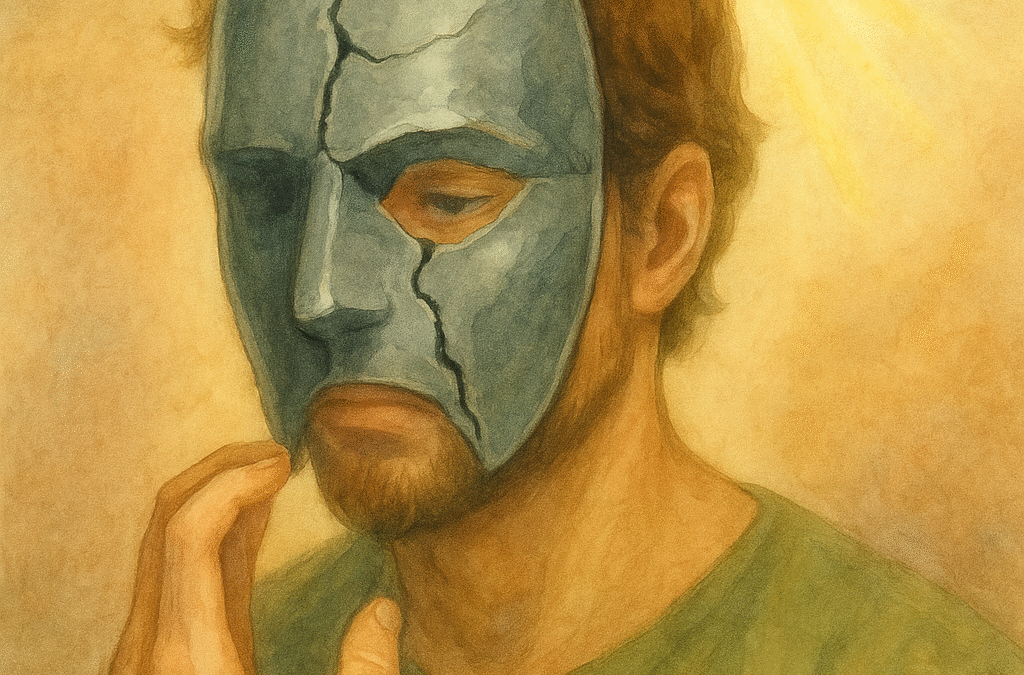
All of these are masks. They are desperate attempts to cover our existential nakedness so we can be accepted. The problem? Masks are heavy. Living an act consumes all our vital energy.
2. The Diagnosis: Orphan Mindset vs. Sonship Mindset
The root of spiritual Imposter Syndrome is what theology calls Spiritual Orphanhood. Even Christians who have been converted for years can operationally live as orphans.
What is the difference? It is not a matter of status (both can be in the house), but of mindset.
The Orphan Profile
The orphan has no father to protect or provide for him. He is on his own. This generates a survival anxiety.
- Based on Performance: The orphan thinks love is a wage. “I need to do to earn.” If he fails, he expects punishment or abandonment.
- Lives in Competition: If a brother gets a gift, the orphan feels there is less left for him. Another’s success is a threat. He needs to be “better” to guarantee his slice of bread.
- Fear of Asking: He has no intimacy. He “begs” for God’s attention or tries to bargain with sacrifices.
- Fragile Identity: His self-esteem fluctuates with his performance. If he had a “holy” day, he feels good. If he stumbled, he feels like irredeemable trash.
The Son Profile
“The Spirit you received does not make you slaves, so that you live in fear again; rather, the Spirit you received brought about your adoption to sonship. And by him we cry, ‘Abba, Father.'” (Romans 8:15 – NIV)
The son operates on an opposing logic:
- Based on Birth: He doesn’t work to be a son; he works because he is a son. Love is an inheritance, not a salary.
- Celebrates Others: He knows the Father’s resources are infinite. His brother’s success does not diminish his inheritance.
- Free Access: He enters the Father’s room without an appointment. He knows he belongs there.
- Fixed Identity: If he fails, he is disciplined, but not evicted. His name is not erased from the birth certificate because of a mistake.
The cure for Imposter Syndrome is not “faking it better.” It is the deep transition, in the heart, from Orphan to Son.
3. The Identity Test: Jesus in the Desert
Many think Jesus was “exempt” from these pressures. But the Bible shows that Jesus’ humanity was tested exactly on this point of Identity.
Before beginning His ministry, Jesus was baptized. The heavens opened, and the Father declared the foundation of everything:
“This is my Son, whom I love; with him I am well pleased.” (Matthew 3:17)
Think about this chronologically. Jesus, up to that moment, had healed no blind men, multiplied no bread, and had not died on the cross. Socially, He was just a furniture builder from an irrelevant town. Yet, the Father already loved Him and was already pleased with Him. Identity preceded Activity. God loved Him for who He was, not for what He did.
Immediately after, Jesus is led into the desert to be tempted. And what is Satan’s first phrase?
“If you are the Son of God, tell these stones to become bread.” (Matthew 4:3)
See the evil subtlety. The devil didn’t tempt Jesus with an obvious moral sin (like stealing or killing). He attacked Identity. The devil basically said: “Are you sure you are the Son? Look at you… you are hungry, alone, in the desert. If you are the Son, PROVE IT. Do something. Perform to be.”
The temptation was to transform Sonship into Performance. Jesus refused. He didn’t need to turn stones into bread to know who He was. He had already heard the Father’s voice. He had nothing to prove.
We fall into this temptation every day. “If you are a real Christian, why do you still have this addiction?” “If God loved you, why are you unemployed?” And so we start running on the treadmill of performance to “turn stones into bread” and prove our worth.
4. The Way Back: How to Remove the Fig Leaves?
If you identified with the orphan mindset or the exhaustion of maintaining a mask, how do you get out of it? How do you internalize grace enough to feel safe?
A. Radical Confession (Coming Out of Hiding)
James 5:16 says: “Therefore confess your sins to each other and pray for each other so that you may be healed.” Note that James connects confession to healing, not just forgiveness. Forgiveness comes from God (vertical). Healing comes from community (horizontal). Imposter Syndrome loses its power when you have the courage to be vulnerable with someone safe. When you say, “I struggle with this,” and the other person doesn’t reject you but prays for you, the power of the secret is broken. The mask falls off, and you discover you are loved despite your flaws.
B. The Exchange of Robes (Zechariah 3)
There is a powerful scene in the prophet Zechariah. The high priest Joshua stands before God in “filthy clothes” (excrement-stained, in the original Hebrew). Satan is standing there accusing him (rightly so, for he was dirty). But God doesn’t tell Joshua to clean himself up. God says to the angels:
“Take off his filthy clothes… See, I have taken away your sin, and I will put fine garments on you.” (Zechariah 3:4)
This is the Gospel. Religion is you trying to wash your dirty clothes in the dark. The Gospel is you admitting you are dirty, and letting God dress you in the Righteousness of Christ. When you wake up in the morning, God doesn’t see your “dirty clothes”; He sees the “fine garments” of Jesus on you. You are accepted by someone else’s merit. This removes the weight of having to be perfect.
C. Practicing the Father’s Voice
You need to replace the voice of the “Inner Critic” (or the Accuser) with the Father’s voice. The Accuser says: “Look at what you did. You are hopeless.” The Father says: “You messed up, but you are mine. Let’s fix this together. Get up.”
This requires training. It requires reading the Bible not as a rulebook, but as adoption papers. Romans 8 needs to be read until it enters your bloodstream.
Conclusion: The Freedom of Having Nothing to Prove
Imagine the freedom of walking into a room and not needing anyone to admire you for you to feel good. Imagine the freedom of making a mistake, apologizing, and moving on, without spiraling into self-hatred. Imagine the freedom of praying to God without feeling like you need to “buy” His audience.
This is the life of a Son. Imposter Syndrome dies when our identity is anchored in God’s unchanging love, not our unstable performance.
You are not your job title. You are not your sin. You are not your ministerial success. You are who God says you are: Beloved, Chosen, Forgiven, and Adopted.
Take off the mask. The Father likes your real face.
Going Deeper: Did this article touch a deep wound? The feeling of inadequacy often comes from a confused theology about Salvation. If you still feel like you need to “pay” to be loved, you urgently need to read our guide “The Grand Plan”. It explains the legal logic of why you are already approved.
And stay tuned: we will soon release “The Mirror”, a guide focused 100% on restoring your self-image in God’s light.
Postagens/Posts/Publicaciones
- “Is It God or Is It Just My Head?” The Ultimate Guide to Stop Guessing and Start Discerning
- “Show Me Your Glory”: The Mystery of the Cleft of the Rock and the Safe Place in Jesus
- A Kenosis: The Emptying of Glory (Philippians 2)
- Anxiety and Faith: Is it a sin to take medication or go to therapy? What the Bible really says
- Celestial Breaking News: “New Year” Doesn’t Exist in the Bible? A Deep Investigation into the Theology of New Beginnings
- Celestial Breaking News: The Day Heaven Invaded Earth (The True Story of Christmas You Never Heard)
- Christmas Investigation: Does the Bible Reveal the Exact Day Jesus Was Born? (The Mystery of Tabernacles)
- Church or Cult? The Ultimate Biblical Guide for the New Convert to Find a Safe Spiritual Home
- Corinth: Sacred Monday (Tentmaker’s Work)
- Ephesus: The Theater of Shadows (Spiritual War and Culture)
- Ephesus: The Theater of Shadows (Spiritual Warfare and Culture)
- First Steps with Jesus: A Biblical Guide to Start Your Journey of Faith
- From Failure to Rock: The Denial and Restoration of Peter.
- From the Pit to the Palace: When God’s Presence Feels Like Absolute Silence
- Fruit vs. Gifts: The Priority of Character
- God’s Radar: Integrity and the Gaze of God (2 Chr 16:9)
- Grace in Lo-debar: The King’s Call (Mephibosheth / 2 Samuel 9)
- I Converted, But I Sinned Again: The Liberating Truth About Your Internal Struggle
- I Find Reading the Bible and Praying Boring: How to Overcome Spiritual Boredom and Build Consistency
- Jerusalem/Rome: The Compass (The End of the Race)
- Justification: The Courtroom of Grace
- Melchizedek: The King Without Genealogy
- Nicodemus: The Theologian in Darkness (The New Birth)
- Real Life #1: “How to Share Jesus with My Family Without Starting World War III” — The Ultimate Guide to Home Evangelism
- Real Life #2: “Do I Really Need to Get Baptized? What Really Happens in the Water” — The Ultimate Guide to the Public Wedding with Christ
- Real Life #3: “Did God Call Me? How to Discover My Purpose Without Becoming a Pastor” — Ending the Sacred-Secular Divide
- Real Life #4: “Christian Dating vs. Hookup Culture: The Survival Manual for Singles” — Purity, Purpose, and the Physics of Being Unequally Yoked
- Real Life #5: “Tithes and Offerings: Is God Broke or Am I Greedy?” — Money as a Spiritual Thermometer
- Silence in Chaos: Why Having Faith Doesn’t Make You Immune to Anxiety (And How to Find Real Peace)
- Silence is Not Absence: A Deep Guide to Resetting Your Frequency and Finding the Overflow of Purpose
- Spiritual Detox #1: “I Accepted Jesus, Now My Problems Will End” — The Big Lie and the True Promise
- Spiritual Detox #2: “Do I Have to Cut Off Non-Christian Friends?” — The Definitive Guide to the “Holy Bubble”
- Spiritual Detox #3: “Christians Don’t Get Depressed?” — Breaking the Mental Health Taboo in the Church
- Spiritual Detox #4: “Can the Devil Read My Thoughts?” — The End of Paranoia and True Spiritual Authority
- Spiritual Detox #5: “I Don’t Feel God, So He’s Not Listening” — The Danger of Goosebump-Based Faith
- Spiritual Detox #6: “If I Sin, Does God Walk Away and Stop Loving Me?” — The Survival Guide for the “Spiritual Hangover”
- Spiritual Detox #7: “Do I Have to Become a Boring Christian?” — The End of the ‘Do’s and Don’ts’ List and True Holiness
- Start Here: 7 Days to Hear God (Reading John)
- The Abyss of Glory: The Depth of the Riches (Romans 11:33).
- The Anatomy of a Heart: Why Did God Love Such an Imperfect Man So Much?
- The Art of Abiding: Prayer, Discipleship, and the Secret of Consistency
- The Art of Provocation: Communion and Mutual Encouragement in Hebrews 10:24
- The Art of Provocation: Communion and Mutual Encouragement in Hebrews 10:24
- The Crimson Mystery: The Theology, Legality, and Power of “Pleading the Blood”
- The Dungeon: The Winter of the Soul (Solitude/2 Timothy)
- The Emmaus Bread: Eyes Opened in Communion (Luke 24).
- The Eternity Code: Forensic Evidence That the Bible Is the Word of God
- The Final Metanoia: What It Really Means to Have the Mind of Christ
- The Great Discovery of December 31st: The End of Waiting (The Kingdom is Now)
- The Great Plan: The Architecture of Rescue (When the Fall Meets Grace)
- The Great Plan: Understanding the “Exchange” That Changes Everything
- The Importunate Friend: A Theology of Persistence
- The Incomparable #1: “The Terrorist of Tarsus: How God Turns His Worst Enemy Into His Greatest General”
- The Incomparable #10: The Last Breath — The Death of the Servant vs. The Death of the Atheist (Final Special)
- The Incomparable #2: “The Arabian Desert: Why Does God ‘Hide’ Those He Plans to Use?” — The Secret Power of Anonymity
- The Incomparable #3: The Fight with Barnabas and the Cost of Leadership
- The Incomparable #4: When Heaven Says “No” (The Frequency of the Spirit)
- The Incomparable #5: The Overflow — When the Gospel Faces Culture (Paul in Athens)
- The Incomparable #6: Silence in Chaos — The Theology of the Shipwreck (Paul in Acts 27)
- The Incomparable #7: The Art of Letting Go — The Radical Theology of Forgiveness (Paul and Philemon)
- The Invitation of the Maimed: The Parable of the Great Banquet
- The Invitation of the Maimed: The Parable of the Great Banquet
- The Iron Mask: Why We Feel Like a Fraud and How to Cure Spiritual Imposter Syndrome
- The Judgment of the Nations: The Sheep and the Goats
- The Kairos of God: Sovereignty Over Time in Eternity
- The Logic of Blood: Why was Jesus’ death the only solution?
- The Mirror: The Death of the Slave, The Birth of the Son
- The Orphan Syndrome: Why Do You Keep Acting Like a Slave When You Already Have the House Keys?
- The Place of the Sinner: The Alabaster Jar (Luke 7).
- The Prince, The Shepherd, and The Deliverer: When the Desert Is the Only School
- The Prison of Resentment: How to forgive someone who never said “I’m sorry”
- The Rich Young Ruler: The Tragedy of Almost-Salvation
- The Samaritan Woman: The Forgotten Jar at the Well
- The School of Prayer: How to Learn to Speak the Language of Heaven
- The Seal of the Spirit: Pledge and Property
- The Secret of the Secret Place: The Intimacy that Pleases God (Martha and Mary)
- The Shrewd Manager: Investing in Eternity
- The Sound of Silence: What God Was Doing When He Stopped Speaking
- The Tabernacle: The Engineering of Presence
- The Table in the Wilderness: The Valley of the Shadow (Psalm 23).
- The Table of Betrayal: The Dipped Bread (Judas and Rejected Grace)
- The Table of Betrayal: The Dipped Bread (Judas and Rejected Grace)
- The Ten Virgins: The Danger of Borrowed Oil
- The Terror of God (The Invisible War)
- The Upside-Down Kingdom: Why Jesus’ Logic Offends Our Human Logic
- The Widow of Nain: When Two Processions Meet
- Tongues of Fire or Strange Fire? The Gift of Tongues, Paul, and the Ghost of Montanism
- When Heaven is Silent: A Survival Guide for the “Dark Night of the Soul”
- Zacchaeus: The Tree of Curiosity