


Publication Date: December 24th
Estimated reading time: 20 minutes
Scripture Base: Luke 1-2, Matthew 1-2, Isaiah 9, Micah 5 (NIV)
Keywords: true meaning of christmas, birth of jesus, christmas bible study, incarnation, manger, immanuel god with us, magi and herod, messianic prophecies, christian hope.
Introduction: Today’s Noise vs. Yesterday’s Silence
Today is December 24th. If you look out the window or check your Instagram feed, you’ll see a world in a frenzy. Crowded malls, chaotic traffic, endless lines at supermarkets, the desperate dash for the last-minute gift, and the anxiety of preparing the perfect dinner. Modern Christmas is loud, lit by millions of LEDs, fueled by consumption, and, quite often, exhausting.
But let’s rewind the tape of history two thousand years. Let’s travel to first-century Judea. The first Christmas didn’t have flashing lights. It didn’t have joyful music playing in the streets. It didn’t have a bountiful feast. The first Christmas happened in the dark. It happened in the cold. It happened in the dirt. And, above all, it happened in silence.
There was no countdown in Rome. The powerful Emperor Caesar Augustus didn’t know his reign was about to be eclipsed. The high priests in Jerusalem, scholars of the prophecies, were asleep in their comfortable beds. While the world spun busy with its taxes, politics, and survival, the most seismic event in the history of the universe—the turning point of eternity—was happening in a smelly stable behind a poor inn, in a village that barely appeared on the map.
The Creator was becoming a creature. The Eternal Word was losing speech to become a dependent baby. The Infinite God was squeezing Himself into a body of a few pounds, subject to cold, hunger, and pain.
If you are feeling tired, empty, anxious, or just “numb” with the routine of this Christmas, stop everything now. This report is not about a cultural party; it is about a rescue operation. Let’s rediscover, through the lens of the Bible (NIV), the theology, history, and emotion of what really happened that night and why this is the only news capable of saving your heart today.
1. The Historical Setting: 400 Years of Silence and Darkness
To understand the light of Christmas, we need to understand the darkness that came before it. When you turn the page from the Old Testament (Malachi) to the New Testament (Matthew), it looks like just a single sheet of paper. But in reality, there is an abyss of 400 years.
For four centuries, God remained silent. There were no prophets. No recorded miracles. No fire falling from heaven. The sky seemed like bronze. The people of Israel were under the iron heel of the Roman Empire. They were oppressed, taxed abusively, and humiliated. The hope of a “Messiah” seemed like an ancient legend that grandparents told but never came true.
The political scenario was tense:
- Rome: The global superpower, bringing “Pax Romana” (armed peace) through brute force.
- Herod: A paranoid, cruel, and illegitimate king who killed anyone who threatened his throne (including his own wife and children).
- Religion: It had become a cold system of rules, without life and without power.
It was in this scenario of hopelessness, fear, and absolute silence that God decided to break protocol. Galatians 4:4 says: “But when the set time had fully come, God sent his Son…” God was not late. He was setting the stage. Christmas was not Plan B; it was the planned invasion of the Kingdom of Light into the territory of Darkness.
2. Mary’s Scandal: Faith Costs Reputation
The story begins with a scandal. Today, we romanticize Mary, but we need to understand the social weight she carried. Mary was a teenager, probably between 13 and 15 years old, betrothed to Joseph. In Jewish culture, betrothal was a legal contract as serious as marriage.
When the angel Gabriel appears and announces that she would become pregnant by the Holy Spirit, Mary accepts: “I am the Lord’s servant… May your word to me be fulfilled” (Luke 1:38). But think about the cost of this obedience.
- Who would believe her? “I’m pregnant by God” sounds like madness or blasphemy.
- She ran the risk of being stoned for adultery (Deuteronomy 22).
- She would certainly be (and was) the target of gossip in the village of Nazareth. “There goes Mary, the holy one, pregnant before the wedding…”
The first Christmas cost Mary her reputation. She accepted carrying the shame of men to carry the Glory of God. Lesson for us: Often, we want Jesus, but we don’t want the social “cost” of following Him. Mary teaches us that radical obedience often brings misunderstanding, but it brings the Savior into the world.
And Joseph? Matthew 1 tells us that he, being a righteous man, thought about divorcing her quietly so as not to expose her. He was hurt. He thought he had been betrayed. But upon hearing God’s voice in a dream, he embraced the scandal along with her. Joseph adopted a son who wasn’t his, giving Jesus the royal lineage of David. Christmas is also the story of an adoptive father who loved sacrificially.
3. The Theology of the Manger: When God Chooses the “No-Place”
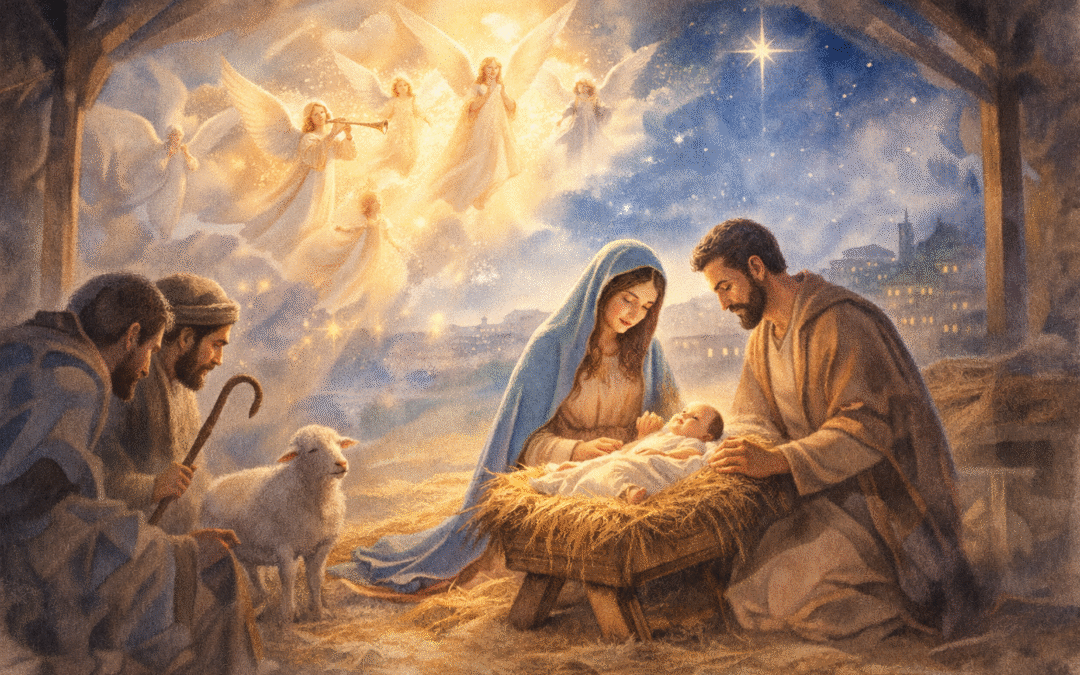
Luke 2:7 (NIV) contains one of the saddest and most profound sentences in the Bible:
“and she gave birth to her firstborn, a son. She wrapped him in cloths and placed him in a manger, because there was no guest room available for them.”
Let’s analyze the spiritual geography of this. The King of Kings was not born in Rome. He was not born in Athens (the center of wisdom). He was not even born in Jerusalem (the religious center). He was born in Bethlehem, the “House of Bread,” a working-class village 6 miles from the capital. And, within Bethlehem, He wasn’t born in a comfortable house. He was born where the animals slept.
What is a Manger? It is not the polished wooden crib we see in mall nativity scenes. A manger was a stone or wooden trough, dirty with animal saliva, where hay and feed were placed. The Holy One of Israel was placed where beasts ate.
Why did God allow this humiliation?
- Radical Accessibility: If Jesus were born in a palace protected by guards, poor shepherds couldn’t enter. Lepers couldn’t get close. But a stable has no door, no guard, and no entrance fee. The manger screams: “I am accessible to everyone. No one is too dirty, too poor, or too broken to come to Me.”
- Identification with Pain: Jesus started his life as a homeless refugee. He knows what rejection is. He knows what it is to have nowhere to lay his head. If you feel alone or rejected this Christmas, know this: Your God understands your pain in the flesh, not just in theory.
4. The Shepherds: The Gospel for the Outcasts
The first congregation to hear the Gospel was not formed by theologians, but by sheep herders. At that time, shepherds were a despised class. They were considered ceremonially unclean (because they dealt with blood, birthing, and animal filth and couldn’t keep all the washing rituals). A shepherd’s testimony wasn’t even valid in a court of law.
However, God ignores Herod’s palace and the priests’ Temple and sends the choir of angels to the fields. Luke 2:10-11 (NIV):
“But the angel said to them, ‘Do not be afraid. I bring you good news that will cause great joy for all the people. Today in the town of David a Savior has been born to you; he is the Messiah, the Lord’.”
Why the shepherds? Perhaps because those shepherds of Bethlehem were responsible for raising the sheep that would be sacrificed in the Temple in Jerusalem. What divine irony! The men who cared for the sacrificial lambs were the first to see the Lamb of God who takes away the sin of the world. They went to see the “Final Lamb.” They came running. Unbathed. Without party clothes. Without expensive gifts. They brought only their presence and their awe. And they were received. Christmas is for the imperfect. If you think you need to “clean yourself up” spiritually to come to Jesus, you haven’t understood Christmas. Come as you are.
5. The Magi and Herod: The Reaction of Power
Matthew 2 introduces mysterious characters: the Magi from the East. Probably astronomers and wise men from the region of Babylon or Persia. They represent the elite, science, wealth, and the Gentile nations.
The contrast between the Magi and King Herod is brutal:
- The Magi: Traveled hundreds of miles, braved the desert, spent fortunes to Worship a King who wasn’t theirs.
- Herod: Was only 6 miles from Bethlehem, knew the Scriptures, but wanted to Kill the King so as not to lose his power.
The Meaning of the Gifts: The gifts were not random. They told the story of Jesus’ life:
- Gold: A gift for a King. They recognized His sovereignty.
- Frankincense: A gift for a Priest. Incense was used in the Temple to carry prayers to God. They recognized that Jesus was the bridge between man and God.
- Myrrh: A gift for a Dead Man. Myrrh was a resin used to embalm bodies. Prophetically, they were saying: “This baby was born to die.” The shadow of the Cross was already cast over the manger.
They teach us that true worship involves sacrifice. They gave their best. They bowed down. Christmas levels humanity. The stable door is low: both the ignorant shepherd and the learned magus must bow to enter. Before Jesus, every knee bows.
6. The Mystery of Incarnation: God With Us (Immanuel)
The central theology of Christmas is in Matthew 1:23: “and they will call him Immanuel” (which means “God with us”).
Religion is man’s attempt to climb up to God (through morality, charity, meditation). The Gospel is God climbing down to man.
In John 1:14 (NIV), we read: “The Word became flesh and made his dwelling among us.” The Greek word for “made his dwelling” is skenoo, which means “tabernacled” or “pitched his tent.” In the Old Testament, God’s Glory stayed in the Tabernacle, isolated, untouchable. Whoever touched it died. At Christmas, God pitched His tent in the middle of our mess. He became “touchable.”
- The God who holds the universe in His hands needed to be held in Mary’s lap.
- The God who is the Bread of Life felt hunger.
- The God who is the Living Water felt thirst.
This is frightening and wonderful. God didn’t stay shouting orders from heaven. He came down into the trench. He wore our skin. He understands your anxiety, your fatigue, and your temptation, because He lived it all (Hebrews 4:15).
7. The Dark Side of Christmas: The Massacre of the Innocents
We cannot ignore that Christmas has a bloody side. Matthew 2 tells that Herod, furious, ordered the killing of all boys in Bethlehem under 2 years old. Rachel’s weeping (the mothers of Israel) mixed with the angels’ praise.
Why is this in the Bible? To remind us that Jesus was born in a war zone. He didn’t come to a “cute” world. He came to a world dominated by evil, selfishness, and death. From the cradle, the Dragon tried to devour the Son (Revelation 12). This gives us real hope. Jesus is not a detached Savior living in a bubble. He was born in the middle of conflict to save people living in conflict. If your Christmas today holds grief, pain, or family war, Jesus is perfectly at home in that scenario. He came exactly for this.
8. Application: Is There Room in the Inn?
The crucial question of this night of December 24th is not “What did I get?” but rather: “Is there room in my inn?”
The text says that “there was no guest room available for them.” The word isn’t necessarily “hotel,” but “guest room.” The houses were full. Lives were full. Many of us are like that inn. We aren’t “evil,” we are just busy.
- We are full of anxiety about the future.
- Full of past hurts.
- Full of entertainment and social media.
- Full of religiosity and Christmas rituals.
We are so busy decorating the house for Jesus’ party that we forget to open the door for the Birthday Boy to enter. We leave Him in the backyard, in the manger, while we celebrate inside.
Today’s invitation is to unlock the door. Maybe your life is a mess, similar to that dirty stable. Jesus doesn’t care about the mess; He only cares about availability. If you give Him space, He is born there. And where He is born, the mess becomes a sanctuary.
Conclusion: The Good News for Your Dinner
Tonight, when you sit down for dinner, look at the lights, eat the food, hug your family (even those difficult relatives who require patience). But, in the secret of your heart, take a moment of silence and gratitude.
Remember: The true gift was not wrapped in colorful paper under a plastic tree. The true gift was wrapped in cloths and placed in an animal trough. And, 33 years later, that same gift was nailed to a tree and wrapped in linen sheets in a cold tomb, so that three days later, Death would be defeated forever.
Because He was born, we have hope. Because He died, we have forgiveness. Because He lives, we do not need to fear tomorrow.
Merry Christmas, truly.
Hearing Him Org — Hearing the voice of the One who became flesh to save us.
Postagens/Posts/Publicaciones
- “Is It God or Is It Just My Head?” The Ultimate Guide to Stop Guessing and Start Discerning
- “Show Me Your Glory”: The Mystery of the Cleft of the Rock and the Safe Place in Jesus
- Anxiety and Faith: Is it a sin to take medication or go to therapy? What the Bible really says
- Celestial Breaking News: “New Year” Doesn’t Exist in the Bible? A Deep Investigation into the Theology of New Beginnings
- Celestial Breaking News: The Day Heaven Invaded Earth (The True Story of Christmas You Never Heard)
- Christmas Investigation: Does the Bible Reveal the Exact Day Jesus Was Born? (The Mystery of Tabernacles)
- Church or Cult? The Ultimate Biblical Guide for the New Convert to Find a Safe Spiritual Home
- First Steps with Jesus: A Biblical Guide to Start Your Journey of Faith
- From the Pit to the Palace: When God’s Presence Feels Like Absolute Silence
- I Converted, But I Sinned Again: The Liberating Truth About Your Internal Struggle
- I Find Reading the Bible and Praying Boring: How to Overcome Spiritual Boredom and Build Consistency
- Real Life #1: “How to Share Jesus with My Family Without Starting World War III” — The Ultimate Guide to Home Evangelism
- Real Life #2: “Do I Really Need to Get Baptized? What Really Happens in the Water” — The Ultimate Guide to the Public Wedding with Christ
- Real Life #3: “Did God Call Me? How to Discover My Purpose Without Becoming a Pastor” — Ending the Sacred-Secular Divide
- Real Life #4: “Christian Dating vs. Hookup Culture: The Survival Manual for Singles” — Purity, Purpose, and the Physics of Being Unequally Yoked
- Real Life #5: “Tithes and Offerings: Is God Broke or Am I Greedy?” — Money as a Spiritual Thermometer
- Silence in Chaos: Why Having Faith Doesn’t Make You Immune to Anxiety (And How to Find Real Peace)
- Silence is Not Absence: A Deep Guide to Resetting Your Frequency and Finding the Overflow of Purpose
- Spiritual Detox #1: “I Accepted Jesus, Now My Problems Will End” — The Big Lie and the True Promise
- Spiritual Detox #2: “Do I Have to Cut Off Non-Christian Friends?” — The Definitive Guide to the “Holy Bubble”
- Spiritual Detox #3: “Christians Don’t Get Depressed?” — Breaking the Mental Health Taboo in the Church
- Spiritual Detox #4: “Can the Devil Read My Thoughts?” — The End of Paranoia and True Spiritual Authority
- Spiritual Detox #5: “I Don’t Feel God, So He’s Not Listening” — The Danger of Goosebump-Based Faith
- Spiritual Detox #6: “If I Sin, Does God Walk Away and Stop Loving Me?” — The Survival Guide for the “Spiritual Hangover”
- Spiritual Detox #7: “Do I Have to Become a Boring Christian?” — The End of the ‘Do’s and Don’ts’ List and True Holiness
- Start Here: 7 Days to Hear God (Reading John)
- The Anatomy of a Heart: Why Did God Love Such an Imperfect Man So Much?
- The Art of Abiding: Prayer, Discipleship, and the Secret of Consistency
- The Crimson Mystery: The Theology, Legality, and Power of “Pleading the Blood”
- The Eternity Code: Forensic Evidence That the Bible Is the Word of God
- The Final Metanoia: What It Really Means to Have the Mind of Christ
- The Great Discovery of December 31st: The End of Waiting (The Kingdom is Now)
- The Great Plan: The Architecture of Rescue (When the Fall Meets Grace)
- The Great Plan: Understanding the “Exchange” That Changes Everything
- The Incomparable #1: “The Terrorist of Tarsus: How God Turns His Worst Enemy Into His Greatest General”
- The Incomparable #10: The Last Breath — The Death of the Servant vs. The Death of the Atheist (Final Special)
- The Incomparable #2: “The Arabian Desert: Why Does God ‘Hide’ Those He Plans to Use?” — The Secret Power of Anonymity
- The Incomparable #3: The Fight with Barnabas and the Cost of Leadership
- The Incomparable #4: When Heaven Says “No” (The Frequency of the Spirit)
- The Incomparable #5: The Overflow — When the Gospel Faces Culture (Paul in Athens)
- The Incomparable #6: Silence in Chaos — The Theology of the Shipwreck (Paul in Acts 27)
- The Iron Mask: Why We Feel Like a Fraud and How to Cure Spiritual Imposter Syndrome
- The Logic of Blood: Why was Jesus’ death the only solution?
- The Mirror: The Death of the Slave, The Birth of the Son
- The Orphan Syndrome: Why Do You Keep Acting Like a Slave When You Already Have the House Keys?
- The Prince, The Shepherd, and The Deliverer: When the Desert Is the Only School
- The Prison of Resentment: How to forgive someone who never said “I’m sorry”
- The School of Prayer: How to Learn to Speak the Language of Heaven
- The Sound of Silence: What God Was Doing When He Stopped Speaking
- The Upside-Down Kingdom: Why Jesus’ Logic Offends Our Human Logic
- Tongues of Fire or Strange Fire? The Gift of Tongues, Paul, and the Ghost of Montanism
- When Heaven is Silent: A Survival Guide for the “Dark Night of the Soul”