


By The Hearing Him Team
If Christianity were based on moral meritocracy, David would never be the “man after God’s own heart.” If we were to hire a CEO for a multinational company or a senior pastor for a large church today, and looked only at David’s rap sheet, he would be discarded in the initial screening by HR.
Let’s face the facts without the romantic filter of religion. David was a man of brutal contrasts. He was the worshiper who wrote: “The Lord is my shepherd,” but he was also the warrior who cut off 200 Philistine foreskins as a marriage dowry. He was the king who brought the Ark of the Covenant with dancing and joy, but he was the absentee father who didn’t notice the incest and hatred growing inside his own house between Amnon and Absalom. He was the man who spared the life of his enemy Saul, but he was the monarch who ordered the killing of Uriah, one of his most loyal soldiers, to cover up an affair with Bathsheba.
And yet, when we open the Scriptures, God seems to have a scandalous predilection for this man. In Acts 13:22, God Himself declares:
“I have found in David the son of Jesse a man after my heart, who will do all my will.”
How is this theologically possible? How can a Holy, Just, and Perfect God align His reputation with a man with blood-stained hands and a tainted moral record? What did David have that Saul (the previous king) didn’t? And most importantly: what does David’s life teach you, who may be reading this text feeling unworthy, flawed, or “on the bench” of life?
Today, we will perform a spiritual autopsy on the life of this shepherd-king. We will traverse the three phases of his journey—the Pasture, the Cave, and the Crown—to understand the mystery of Grace and discover how David’s life is the blueprint upon which the Cross of Christ would be built.
1. The Pasture: Anointing Happens in the Dark
David’s story doesn’t start on the throne; it starts in obscurity. When God sends the prophet Samuel to Bethlehem to anoint the new king of Israel, Jesse (David’s father) organizes a parade of his sons. He brings Eliab, the firstborn. Eliab had the “full package”: height, athletic build, the look of a leader. Samuel, even being a prophet, falls into the trap of appearance: “Surely the Lord’s anointed is before him” (1 Samuel 16:6).
But Heaven interrupts Earth with one of the most revolutionary directives in the Bible:
“The Lord sees not as man sees: man looks on the outward appearance, but the Lord looks on the heart.”
Where was David? David wasn’t even invited to the sacrifice. He was in the field, tending sheep. In the culture of the time, shepherding was dirty, lonely, and dangerous work. David was the youngest, the “least,” the one who served for manual labor but not for the adults’ table.
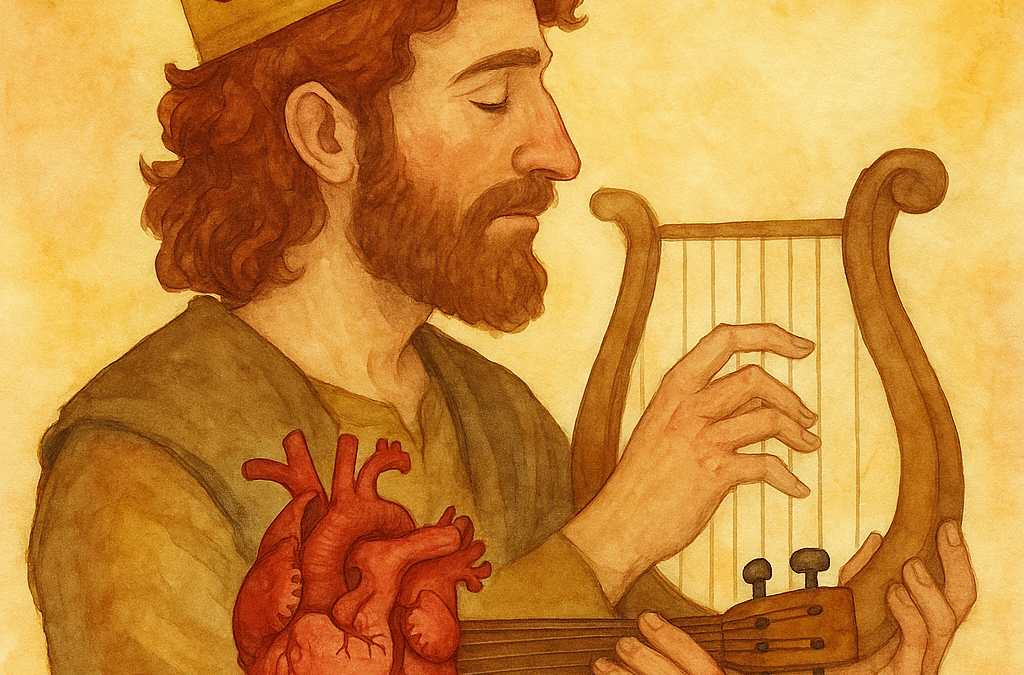
But it was exactly in this solitude that David developed the “hardware” that would support the “software” of the Kingdom. While his brothers trained for war or sought status, David was killing bears and lions to protect sheep that weren’t even his. He was composing songs to a God he didn’t see but felt in the breeze of Bethlehem.
The Lesson of Identity (Phase 1) God chose David because David chose God when no one was looking. Integrity is what you do in the dark. Many want David’s public life (killing giants) but reject David’s private life (the harp and the staff). If you feel you are hidden, invisible in your job or ministry, know this: God has X-Ray eyes. He is not looking for who has the most followers or who speaks the best. He is looking for who has a heart that beats in rhythm with His. The anointing of a king fell upon the head of one who smelled like sheep.
2. The Cave of Adullam: The University of the Desert
Here is a common mistake: we think Anointing brings immediate ease. Samuel anointed David. The oil flowed. The Spirit seized him. And what happened the next day? Did he become king? No. He went back to serving cheese to his brothers and playing the harp to soothe the mad king (Saul).
Between the promise (the anointing) and the fulfillment (the crown), there was an interval of approximately 13 to 15 years. And this interval was not a bed of roses; it was a Winter of the Soul (Phase 2).
David became a national hero by killing Goliath, but this awakened Saul’s murderous jealousy. The king began to hunt him. David, the anointed one, had to flee to the desert. He ended up in the Cave of Adullam.
The Recruitment of the Unlikely In 1 Samuel 22, we read who joined David in the cave:
“And everyone who was in distress, and everyone who was in debt, and everyone who was bitter in soul, gathered to him. And he became commander over them.”
Imagine the scene. The future king of Israel leading an army of bankrupt, depressed, and fugitive men. About 400 broken men. Why did God allow this? Because God was forging a Shepherd, not a Manager. If David had assumed the throne at 17, full of victory and glory, he would have been an arrogant king. But by having to lead bitter men in the cave, David learned empathy. He learned to transform “indebted men” into the famous “Mighty Men of David.” The cave was David’s leadership school.
Are you in the cave today? Are things going wrong even though you have a promise? Don’t waste your pain. God is using this time to kill pride in you and teach you to depend purely on Him. It is in the cave that the deepest Psalms are written. It is under pressure that the oil is extracted.
3. The Great Sin: The Difference Between Saul and David
This is the crucial point. How can God call David a “man after my own heart” after the affair with Bathsheba?
David’s sin was terrible. It wasn’t a “slip-up”; it was a sequence of conscious choices.
- Idleness: Kings should have been at war; David stayed home.
- Lust: He looked and desired.
- Abuse of Power: He sent for the woman.
- Adultery: He consummated the act.
- Murder: He sent Uriah to the front line to die.
For much less, God rejected Saul. Saul offered an improper sacrifice, and God took the kingdom from him. Why did David kill a man and remain king? Does God have double standards?
No. The difference was not in the gravity of the sin, but in the quality of the repentance.
Saul’s Reaction to Sin: When the prophet Samuel confronted Saul, Saul’s response was to blame others: “The people brought the best of the sheep…”, “I was forced by circumstances…”. And in the end, Saul asked Samuel: “Honor me now before the elders” (1 Samuel 15:30). Saul was worried about his public reputation. He didn’t lose the kingdom because of the sin, but because of the hardness of his heart.
David’s Reaction to Sin: When the prophet Nathan confronted David with the parable of the sheep, David was unmasked. He could have ordered Nathan killed. But David crumbled. He didn’t blame Bathsheba (for bathing), didn’t blame the war, didn’t blame loneliness. He said just two words in Hebrew: Chatati L’Adonai — “I have sinned against the Lord.”
David wrote Psalm 51, history’s greatest treatise on repentance. He didn’t pray: “Lord, don’t let the people know” or “Lord, don’t take my crown.” He prayed: “Take not your Holy Spirit from me.”
The Key to God’s Heart David was a man after God’s own heart because he was teachable and breakable. He valued God’s Presence above his own life. He knew the crown without the Spirit was just a piece of metal. Holiness is not the absence of falls, but the swiftness to get up and run into the Father’s arms, not away from Him.
4. The Heart That Honors: The En Gedi Test
Another proof of David’s character was his refusal to take shortcuts. During the persecution, there was a moment in the cave of En Gedi when Saul entered to relieve himself, unaware that David and his men were hiding in the back of the cave. David’s soldiers whispered: “This is the day! God has delivered the enemy into your hand. Kill him and the kingdom is yours!”
It seemed logical. It seemed “prophetic.” But David felt his heart heavy just for cutting off the corner of Saul’s robe.
“The Lord forbid that I should do this thing to my lord, the Lord’s anointed, to put out my hand against him…” (1 Samuel 24:6).
David understood a Kingdom principle that our generation has forgotten: You cannot use fleshly methods to fulfill spiritual purposes. Killing Saul would be murder and a coup d’état. Waiting for God to remove Saul would be providence. David chose to trust God’s timing. He preferred to be a fugitive in God’s will than a king outside of it.
This is what we call Discernment (Phase 3 of our teaching). It is knowing the difference between an “opportunity” and a “temptation.” Not every open door is God; sometimes it is a test to see if you trust the Giver or if you want to take the blessing by force.
5. David and Jesus: The Messianic Revelation
Finally, why does the Bible spend so many pages on David? Because David is the model. Jesus is the Building. Jesus is not often called “Son of Moses” or “Son of Abraham.” The messianic title par excellence is “Son of David.”
See how David’s life sketches Jesus:
- The Shepherd-King:
- David risked his life for the sheep against the lion and the bear.
- Jesus is the Good Shepherd who lays down His life for the sheep (John 10:11).
- The Lone Champion:
- When Goliath challenged Israel, the entire army fled. David went down into the valley alone. He defeated the giant, but the victory was credited to all Israel. The people, who did not fight, shared in the spoils and the glory.
- When Sin and Death challenged humanity, no one could fight. Jesus went to the cross (the valley) alone. He conquered death. And His victory is imputed to us. We didn’t kill the giant, but we enjoy the freedom. This is the Great Exchange (Phase 1).
- The Exiled King:
- David was anointed but rejected by his people for a time, living as a king without a visible throne.
- Jesus came to His own, was rejected, and today reigns in the hearts of those who accept Him, awaiting the final coronation at His second coming.
- Undeserved Kindness (Mephibosheth):
- David asked: “Is there still anyone left of the house of Saul, that I may show him the kindness of God?”. They found Mephibosheth, crippled, grandson of David’s enemy. David brought him to the palace, restored his lands, and made him eat at the king’s table forever.
- This is us. Crippled by sin, descendants of Adam (enemies of God by nature), but invited by Jesus to sit at the King’s Table and eat the bread of life, not by merit, but by covenant.
Conclusion: The Invitation to Authenticity
David’s life destroys performance-based religion. It shows us that God is not looking for marble superheroes, perfect and cold. God is looking for human beings of flesh and blood, who make mistakes but love; who fall but cling to grace.
David was a man after God’s own heart because, in all seasons—in the lonely pasture, in the cold cave, in the luxurious palace, or on the dirty floor of repentance—he always knew who God was.
You may not have David’s courage or David’s harp, but you can have David’s heart. A heart that says: “I need You, Lord. More than status, more than money, more than life itself.”
If you pray this prayer today, you are closer to the throne than you imagine.
🚀 Take the Next Step in Your Journey
Did this analysis of David’s life touch deep areas of your walk? Don’t let this flame go out.
- Transform Your Worship: David learned to be intimate in secret. At the Christian Portal, we have practical modules on how to develop a devotional life that is not boring, but vibrant and real.
- Understand the Process: If you feel you are in the “Cave of Adullam,” read our articles on Waiting and Purpose on the Official Blog.
- Recommended Reading: Want to understand more about the grace that reached David (and reaches you)? Visit our Books page for recommendations that will build your faith.
You are loved, flaws and all. Welcome to Grace.
Postagens/Posts/Publicaciones
- “Is It God or Is It Just My Head?” The Ultimate Guide to Stop Guessing and Start Discerning
- “Show Me Your Glory”: The Mystery of the Cleft of the Rock and the Safe Place in Jesus
- Anxiety and Faith: Is it a sin to take medication or go to therapy? What the Bible really says
- Celestial Breaking News: “New Year” Doesn’t Exist in the Bible? A Deep Investigation into the Theology of New Beginnings
- Celestial Breaking News: The Day Heaven Invaded Earth (The True Story of Christmas You Never Heard)
- Christmas Investigation: Does the Bible Reveal the Exact Day Jesus Was Born? (The Mystery of Tabernacles)
- Church or Cult? The Ultimate Biblical Guide for the New Convert to Find a Safe Spiritual Home
- First Steps with Jesus: A Biblical Guide to Start Your Journey of Faith
- From the Pit to the Palace: When God’s Presence Feels Like Absolute Silence
- I Converted, But I Sinned Again: The Liberating Truth About Your Internal Struggle
- I Find Reading the Bible and Praying Boring: How to Overcome Spiritual Boredom and Build Consistency
- Real Life #1: “How to Share Jesus with My Family Without Starting World War III” — The Ultimate Guide to Home Evangelism
- Real Life #2: “Do I Really Need to Get Baptized? What Really Happens in the Water” — The Ultimate Guide to the Public Wedding with Christ
- Real Life #3: “Did God Call Me? How to Discover My Purpose Without Becoming a Pastor” — Ending the Sacred-Secular Divide
- Real Life #4: “Christian Dating vs. Hookup Culture: The Survival Manual for Singles” — Purity, Purpose, and the Physics of Being Unequally Yoked
- Real Life #5: “Tithes and Offerings: Is God Broke or Am I Greedy?” — Money as a Spiritual Thermometer
- Silence in Chaos: Why Having Faith Doesn’t Make You Immune to Anxiety (And How to Find Real Peace)
- Silence is Not Absence: A Deep Guide to Resetting Your Frequency and Finding the Overflow of Purpose
- Spiritual Detox #1: “I Accepted Jesus, Now My Problems Will End” — The Big Lie and the True Promise
- Spiritual Detox #2: “Do I Have to Cut Off Non-Christian Friends?” — The Definitive Guide to the “Holy Bubble”
- Spiritual Detox #3: “Christians Don’t Get Depressed?” — Breaking the Mental Health Taboo in the Church
- Spiritual Detox #4: “Can the Devil Read My Thoughts?” — The End of Paranoia and True Spiritual Authority
- Spiritual Detox #5: “I Don’t Feel God, So He’s Not Listening” — The Danger of Goosebump-Based Faith
- Spiritual Detox #6: “If I Sin, Does God Walk Away and Stop Loving Me?” — The Survival Guide for the “Spiritual Hangover”
- Spiritual Detox #7: “Do I Have to Become a Boring Christian?” — The End of the ‘Do’s and Don’ts’ List and True Holiness
- Start Here: 7 Days to Hear God (Reading John)
- The Anatomy of a Heart: Why Did God Love Such an Imperfect Man So Much?
- The Art of Abiding: Prayer, Discipleship, and the Secret of Consistency
- The Crimson Mystery: The Theology, Legality, and Power of “Pleading the Blood”
- The Eternity Code: Forensic Evidence That the Bible Is the Word of God
- The Final Metanoia: What It Really Means to Have the Mind of Christ
- The Great Discovery of December 31st: The End of Waiting (The Kingdom is Now)
- The Great Plan: The Architecture of Rescue (When the Fall Meets Grace)
- The Great Plan: Understanding the “Exchange” That Changes Everything
- The Incomparable #1: “The Terrorist of Tarsus: How God Turns His Worst Enemy Into His Greatest General”
- The Incomparable #10: The Last Breath — The Death of the Servant vs. The Death of the Atheist (Final Special)
- The Incomparable #2: “The Arabian Desert: Why Does God ‘Hide’ Those He Plans to Use?” — The Secret Power of Anonymity
- The Incomparable #3: The Fight with Barnabas and the Cost of Leadership
- The Incomparable #4: When Heaven Says “No” (The Frequency of the Spirit)
- The Incomparable #5: The Overflow — When the Gospel Faces Culture (Paul in Athens)
- The Incomparable #6: Silence in Chaos — The Theology of the Shipwreck (Paul in Acts 27)
- The Iron Mask: Why We Feel Like a Fraud and How to Cure Spiritual Imposter Syndrome
- The Logic of Blood: Why was Jesus’ death the only solution?
- The Mirror: The Death of the Slave, The Birth of the Son
- The Orphan Syndrome: Why Do You Keep Acting Like a Slave When You Already Have the House Keys?
- The Prince, The Shepherd, and The Deliverer: When the Desert Is the Only School
- The Prison of Resentment: How to forgive someone who never said “I’m sorry”
- The School of Prayer: How to Learn to Speak the Language of Heaven
- The Sound of Silence: What God Was Doing When He Stopped Speaking
- The Upside-Down Kingdom: Why Jesus’ Logic Offends Our Human Logic
- Tongues of Fire or Strange Fire? The Gift of Tongues, Paul, and the Ghost of Montanism
- When Heaven is Silent: A Survival Guide for the “Dark Night of the Soul”