


Series: Real Life (Final Episode)
Theme: Spiritual Disciplines and Maturity
Scripture Base: John 15:1-7 / Daniel 6:10 / Luke 18:1
Estimated Reading Time: 18 minutes
We have reached the end of our journey through “Real Life.” We have navigated the landmines of family dynamics, dived into the waters of baptism, discussed the sacred value of secular work, navigated the emotions of dating, and opened our wallets to talk about money. But none of that holds up without today’s topic.
If I could summarize the greatest tragedy of the modern Christian generation in a single word, it wouldn’t be “heresy,” nor “immorality.” It would be Inconsistency. We are the “flash in the pan” generation. We are experts at explosive beginnings and masters of melancholic endings. We start the year reading the Bible with vigor, and by February we stall in Leviticus. We start a purpose of fervent prayer, but by the third week, sleep wins. We enter the church excited, “in love with Jesus,” but six months later we are cold, cynical, or worse, jumping to the next “gospel novelty” in search of another dose of spiritual dopamine.
Modern Christianity has sold us the idea that life with God is a succession of spectacular events, “power services,” and emotional experiences on the mountaintop. But real life doesn’t happen on the mountaintop; it happens on the plains of Monday afternoon. Real life is made of routine, repetition, tiredness, and silence.
How do you keep the flame burning when the music stops? How do you follow Jesus when you don’t “feel” anything? The biblical answer lies in an ancient and unglamorous word: Abiding. Today, we are going to dissect the theology of consistency through two non-negotiable pillars: the Prayer Life (our vertical connection) and Discipleship (our horizontal connection). We will discover that consistency is not a personality trait; it is a discipline of love.
I. The Diagnosis: Why Do We Stop Halfway?
Before we talk about “how” to be consistent, we need to understand why we are so inconsistent. The Desert Fathers (Christians of the first centuries) identified a “noonday demon” called Acedia. Acedia is often translated as “sloth,” but it is much more than that. It is a kind of spiritual boredom, a restlessness of the soul that makes us detest routine and always seek something “new” or “more exciting.”
Acedia whispers to us: “This prayer is boring. God isn’t listening. Nothing is happening. Go check Instagram. Go do something useful.” We live in a culture of zapping and scrolling. If the video doesn’t hook us in 3 seconds, we swipe to the next one. If prayer doesn’t give us a shiver in 2 minutes, we say “God isn’t here.”
Jesus confronted this human tendency in the Parable of the Persistent Widow, which Luke introduces with a devastating phrase:
“Then Jesus told his disciples a parable to show them that they should always pray and not give up.” (Luke 18:1)
If Jesus had to teach us “not to give up” (or not to faint/lose heart), it is because He knew that our natural tendency is to quit. The gravity of the flesh always pulls us down, towards inertia. Consistency, therefore, is not natural. It is supernatural. It is an act of war against the gravity of our own hearts.
II. The Theology of the Vine: The Secret isn’t “Doing,” it’s “Being”
To cure inconsistency, we need to look at John 15. Jesus doesn’t say: “Strive to bear fruit.” He says: “Abide in me, and I in you” (John 15:4).
The Greek word is Meno (Abide, Remain, Dwell, Stay). The image is botanical, not mechanical. A branch doesn’t strain to produce grapes. You have never seen a grapevine turning red from straining so hard, shaking to push out a grape. Fruit is a natural, inevitable, and quiet consequence of the flow of sap. If the branch is connected to the trunk, it will bear fruit. If the branch disconnects, it withers.
The Revelation of Consistency: Christian inconsistency happens because we try to imitate the fruits of Jesus without being connected to the life of Jesus. We try to be patient, loving, and holy based on willpower. That is impossible. The human battery runs out. Consistency is only possible when we stop trying to “work for God” and start learning to “be with God.”
Prayer life is not a task on your list (“Item 3: Pray 15 minutes”). Prayer life is the branch’s connection. It is the breathing of the soul. If you stop breathing, you don’t become an “inconsistent breather”; you die. The secret of consistency isn’t military discipline; it is vital dependence.
III. The Vertical Pillar: Demystifying the Prayer Life
Many Christians give up on praying because they have the wrong theology of prayer. We think praying is:
- Informing God: Telling Him things He already knows (“Lord, I have a problem at the bank…”).
- Convincing God: Trying to twist God’s arm so He does what we want.
- Performing for God: Using beautiful words and a “pastor voice” to sound spiritual.
This is exhausting. No one can keep up a conversation like that for long. Biblical prayer is Alignment. It is when the boat (us) throws the rope to the Rock (God) and pulls. The Rock doesn’t move toward the boat; the boat moves toward the Rock.
Daniel’s Example: The Sacred Routine
Look at Daniel. He was the busiest man in the most powerful empire in the world (Babylon). He was, effectively, the Prime Minister. But Daniel 6:10 says that, even under threat of death (the lions’ den), he “went home… and three times a day he got down on his knees and prayed, giving thanks to his God, just as he had done before.”
Note the phrase: “just as he had done before”. Daniel didn’t pray because he was in a crisis. He prayed in the crisis because he already prayed in peace. Prayer wasn’t his emergency “fire extinguisher”; it was his daily oxygen.
How to build this consistency today?
1. Kill the “Gospel Spontaneity” Myth: There is a myth that says “I should only pray when I feel like it, otherwise it’s hypocrisy.” Lie. Do you only shower when you “feel like it”? Do you only go to work when you are “inspired”? No. You do it because it is necessary and because you have a commitment. Discipline precedes desire. C.S. Lewis said that the duty of daily prayer is like digging channels in the desert. Sometimes the water (the Spirit/emotion) doesn’t flow, but when the water comes, the channels will already be ready to receive it. Pray when you feel like it. Pray when you don’t feel like it. Pray until you feel like it. But don’t stop.
2. The Rule of 3 Times (Rhythm): The early church (and Jews like Daniel) prayed in rhythms: morning, afternoon, and evening. It doesn’t have to be an hour on your knees. It can be what we call “Prayer Arrows” or breath prayers.
- Upon waking: Surrender the day (Surrender).
- At noon: Realign focus (Dependence).
- At bedtime: Examine the heart and give thanks (Gratitude). Creating “hooks” in your routine (e.g., always praying when you get in the car, or while making coffee) is more effective than trying to pray for 2 hours straight and failing.
3. Pray the Bible (Lectio Divina): If you don’t know what to say, stop inventing. Open the Psalms. Read Psalm 23 and pray it back to God. “Lord, You are my shepherd. I confess I have been walking in anxiety, but Your Word says I shall not want. Calm my soul.” When we pray the Word, we never run out of topics and we have the certainty that we are praying the will of God.
IV. The Horizontal Pillar: Discipleship as a Vaccine Against Falling
The second reason we are inconsistent is Loneliness. The “Lone Wolf” Christian is easy prey. In biology, when a lion wants to attack a herd of buffalo, he doesn’t attack the united group. He waits for one to drift away.
The Bible knows no “Christianity without discipleship.” Discipleship isn’t just taking a course at church. Discipleship is life on life. It is having someone who has “VIP access” to your backstage. James 5:16 gives a strange command: “Confess your sins to each other and pray for each other so that you may be healed.” Why not confess only to God? For forgiveness, yes, only to God. But for healing, we need each other.
Inconsistency thrives in the dark. When you fail in prayer, or fall into a recurring sin, and keep it to yourself, the guilt grows and you pull away from God. But when you have a discipler, a mentor, or a covenant friend to whom you send a text: “Man, I fell again. Pray for me. I’m weak,” the light enters. The power of sin is broken.
The Rule of Accountability: If you want to be consistent, you need Accountability. You need someone who asks you every week:
- “How is your prayer life?”
- “What did God speak to you this week?”
- “How is your heart regarding purity/money/pride?”
Without this external loving pressure, our flesh relaxes. Consistency is a community project. A coal alone dies out; together with the others, it keeps the fire burning.
V. The Obstacle of the “Tyranny of the Urgent”
Charles Hummel wrote a classic called “Tyranny of the Urgent.” He says we live in a constant war between what is Important and what is Urgent.
- Urgent: The phone ringing, the Instagram notification, the boss’s email, the dishes in the sink. They scream: “Now! Now!”
- Important: Prayer, reading the Bible, time with family, silence. They don’t scream. They wait.
The tragedy is that the Urgent almost always beats the Important. We don’t stop praying because we are evil; we stop praying because we are “busy.” But Martin Luther had a famous quote: “I have so much to do today that I shall spend the first three hours in prayer.” This seems counter-intuitive. But Luther knew that prayer doesn’t waste time; it saves time. Prayer aligns the mind, calms anxiety, and gives us wisdom to solve in 10 minutes problems that, in our own strength, would take 10 hours.
Consistency demands a violent “No” to the Urgent. It demands turning off the phone. It demands closing the door. It demands saying to the world: “You can wait. My King is calling.”
VI. Practical Application: The Consistency Protocol
Let’s bring this down to the ground of Monday morning. How do we apply all this tomorrow?
1. Start Small (Micro-habits): Don’t promise to pray for 1 hour a day if you don’t even pray for 5 minutes. Start with a non-negotiable 10 minutes. Consistency is better than intensity. It is better to pray 10 minutes every day for 10 years, than to pray 5 hours one day and go a month without praying. God is the God of the walk, not just the marathon.
2. Prepare the Environment (Secret Place): Jesus said: “Go into your room, close the door” (Matthew 6:6). Have a place. A chair, a corner of the couch, the car. Leave your Bible open there. Leave your prayer journal there. When the environment is prepared, resistance decreases. Your brain already understands: “Here is the place to talk to the Father.”
3. Use the “Prayer of Examen” (St. Ignatius): At the end of the day, do a 5-minute review:
- Where did I see God’s hand today? (Give thanks).
- Where did I fail/sin today? (Repent).
- Where do I need Him tomorrow? (Supplicate). This keeps the account short with God and the heart sensitive.
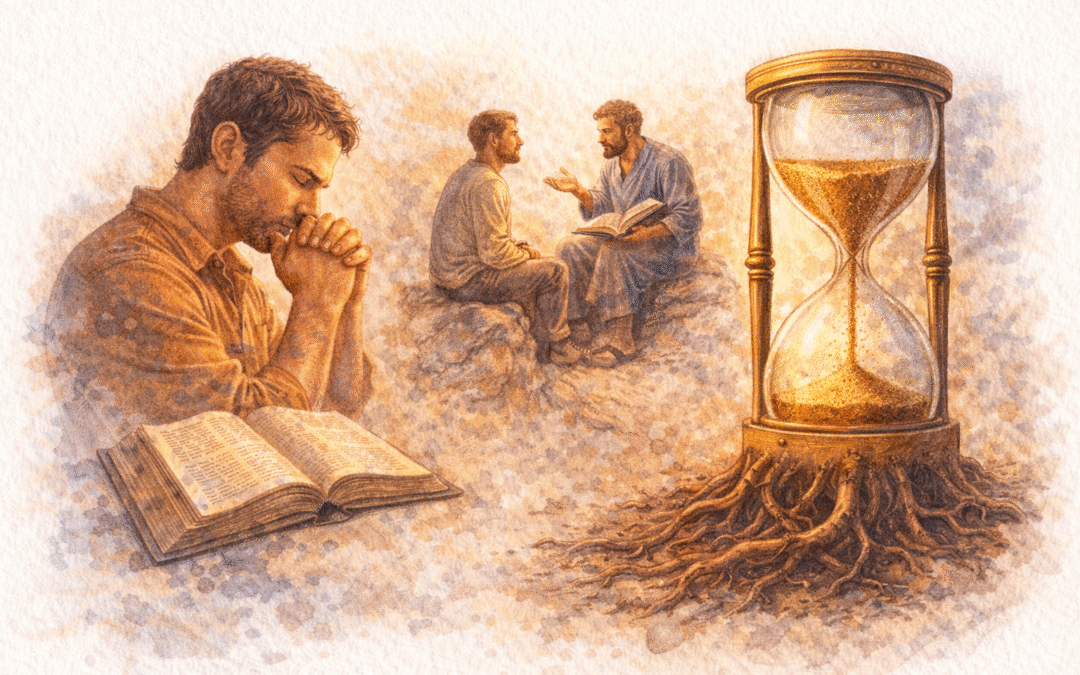
4. Don’t Give Up on the “Evil Day”: There will be days when prayer feels like chewing sand. The heavens will be bronze. You will be tired, irritable, and cold. These are the most important days. Praying when you feel the glory is easy; praying when you feel nothing is Faith. It is on these days that the root of the tree grows downward, in search of deep water. Tell God: “Lord, I feel nothing today. I am dust. But I am here. Because You are worthy, not because I am fine.” This is the prayer that shakes hell. The prayer of raw, naked fidelity.
Conclusion: Consistency is the Language of Love
We end our “Real Life” series with this truth: True love is consistent. Passion fluctuates. Passion has peaks of euphoria and valleys of despair. But love remains.
God is consistent with you. James 1:17 says that in Him “there is no variation or shadow due to change.” Lamentations 3 says that “his mercies are new every morning.” Jesus was consistent all the way to the Cross. He didn’t give up in Gethsemane. He didn’t come down from the cross when it hurt. He went to the end.
Our consistency is just a small response to His gigantic consistency. We don’t seek discipline to “buy” God’s love. We seek discipline because we have already been loved, and we want to live close to that Consuming Fire.
May your Christian life stop being an emotional roller coaster. May you discover the beauty of “a long obedience in the same direction.” May it be that, 10, 20, or 50 years from now, when someone looks at your life, they don’t just see someone who “had an experience with God,” but someone who walked with God until they became His friend.
That is real life. It is waking up every day and saying: “Here I am, Lord. One more day. Me and You.” And that, my brothers and sisters, is enough.
End of Series. The beginning of Practice.
“Therefore, my dear brothers and sisters, stand firm. Let nothing move you. Always give yourselves fully to the work of the Lord, because you know that your labor in the Lord is not in vain.” — 1 Corinthians 15:58
Postagens/Posts/Publicaciones
- “Is It God or Is It Just My Head?” The Ultimate Guide to Stop Guessing and Start Discerning
- “Show Me Your Glory”: The Mystery of the Cleft of the Rock and the Safe Place in Jesus
- Anxiety and Faith: Is it a sin to take medication or go to therapy? What the Bible really says
- Celestial Breaking News: “New Year” Doesn’t Exist in the Bible? A Deep Investigation into the Theology of New Beginnings
- Celestial Breaking News: The Day Heaven Invaded Earth (The True Story of Christmas You Never Heard)
- Christmas Investigation: Does the Bible Reveal the Exact Day Jesus Was Born? (The Mystery of Tabernacles)
- Church or Cult? The Ultimate Biblical Guide for the New Convert to Find a Safe Spiritual Home
- First Steps with Jesus: A Biblical Guide to Start Your Journey of Faith
- From the Pit to the Palace: When God’s Presence Feels Like Absolute Silence
- I Converted, But I Sinned Again: The Liberating Truth About Your Internal Struggle
- I Find Reading the Bible and Praying Boring: How to Overcome Spiritual Boredom and Build Consistency
- Real Life #1: “How to Share Jesus with My Family Without Starting World War III” — The Ultimate Guide to Home Evangelism
- Real Life #2: “Do I Really Need to Get Baptized? What Really Happens in the Water” — The Ultimate Guide to the Public Wedding with Christ
- Real Life #3: “Did God Call Me? How to Discover My Purpose Without Becoming a Pastor” — Ending the Sacred-Secular Divide
- Real Life #4: “Christian Dating vs. Hookup Culture: The Survival Manual for Singles” — Purity, Purpose, and the Physics of Being Unequally Yoked
- Real Life #5: “Tithes and Offerings: Is God Broke or Am I Greedy?” — Money as a Spiritual Thermometer
- Silence in Chaos: Why Having Faith Doesn’t Make You Immune to Anxiety (And How to Find Real Peace)
- Silence is Not Absence: A Deep Guide to Resetting Your Frequency and Finding the Overflow of Purpose
- Spiritual Detox #1: “I Accepted Jesus, Now My Problems Will End” — The Big Lie and the True Promise
- Spiritual Detox #2: “Do I Have to Cut Off Non-Christian Friends?” — The Definitive Guide to the “Holy Bubble”
- Spiritual Detox #3: “Christians Don’t Get Depressed?” — Breaking the Mental Health Taboo in the Church
- Spiritual Detox #4: “Can the Devil Read My Thoughts?” — The End of Paranoia and True Spiritual Authority
- Spiritual Detox #5: “I Don’t Feel God, So He’s Not Listening” — The Danger of Goosebump-Based Faith
- Spiritual Detox #6: “If I Sin, Does God Walk Away and Stop Loving Me?” — The Survival Guide for the “Spiritual Hangover”
- Spiritual Detox #7: “Do I Have to Become a Boring Christian?” — The End of the ‘Do’s and Don’ts’ List and True Holiness
- Start Here: 7 Days to Hear God (Reading John)
- The Anatomy of a Heart: Why Did God Love Such an Imperfect Man So Much?
- The Art of Abiding: Prayer, Discipleship, and the Secret of Consistency
- The Crimson Mystery: The Theology, Legality, and Power of “Pleading the Blood”
- The Eternity Code: Forensic Evidence That the Bible Is the Word of God
- The Final Metanoia: What It Really Means to Have the Mind of Christ
- The Great Discovery of December 31st: The End of Waiting (The Kingdom is Now)
- The Great Plan: The Architecture of Rescue (When the Fall Meets Grace)
- The Great Plan: Understanding the “Exchange” That Changes Everything
- The Incomparable #1: “The Terrorist of Tarsus: How God Turns His Worst Enemy Into His Greatest General”
- The Incomparable #10: The Last Breath — The Death of the Servant vs. The Death of the Atheist (Final Special)
- The Incomparable #2: “The Arabian Desert: Why Does God ‘Hide’ Those He Plans to Use?” — The Secret Power of Anonymity
- The Incomparable #3: The Fight with Barnabas and the Cost of Leadership
- The Incomparable #4: When Heaven Says “No” (The Frequency of the Spirit)
- The Incomparable #5: The Overflow — When the Gospel Faces Culture (Paul in Athens)
- The Incomparable #6: Silence in Chaos — The Theology of the Shipwreck (Paul in Acts 27)
- The Iron Mask: Why We Feel Like a Fraud and How to Cure Spiritual Imposter Syndrome
- The Logic of Blood: Why was Jesus’ death the only solution?
- The Mirror: The Death of the Slave, The Birth of the Son
- The Orphan Syndrome: Why Do You Keep Acting Like a Slave When You Already Have the House Keys?
- The Prince, The Shepherd, and The Deliverer: When the Desert Is the Only School
- The Prison of Resentment: How to forgive someone who never said “I’m sorry”
- The School of Prayer: How to Learn to Speak the Language of Heaven
- The Sound of Silence: What God Was Doing When He Stopped Speaking
- The Upside-Down Kingdom: Why Jesus’ Logic Offends Our Human Logic
- Tongues of Fire or Strange Fire? The Gift of Tongues, Paul, and the Ghost of Montanism
- When Heaven is Silent: A Survival Guide for the “Dark Night of the Soul”