


Series: Deep Dive Specials (Vol. 10 – Final)
Theme: Individual Eschatology and Biblical Anthropology
Scripture Base: Luke 16:19-31 / Hebrews 9:27 / Proverbs 14:32 / Philippians 1:21-23
Estimated Reading Time: 25 minutes (+2,600 words)
There is a statistic that no one can escape: the mortality rate for humans is 100%. One out of every one person dies. We spend billions on gyms, supplements, surgeries, and health insurance to delay the inevitable. Modern society “hides” death. In the past, we held wakes in our living rooms; today, we outsource it to sterile funeral homes because looking at death reminds us of our own expiration date.
But the Bible does not hide death. It stares it in the face. For the materialist (the atheist), death is the “end of the line,” the extinguishing of consciousness, a return to nothingness. It is a period. For the Christian (the servant), death is not a period; it is a colon. It is a transition. It is the moment when the earthly biography ends and the eternal biography begins.
The wise Solomon wrote in Proverbs 14:32 (NIV):
“When calamity comes, the wicked are brought down, but even in death the righteous seek refuge in God.”
Today, we are going to take a trip that science cannot take. Medicine can describe death up to the moment brain activity ceases. But the Bible describes what happens one second later. We will analyze the brutal contrast between the last breath of someone who lived for themselves and the last breath of someone who lived for God.
I. The Biblical Definition of Death: Not the End, but Separation
The first thing we need to correct is our dictionary. In the secular concept, “death” is annihilation. Ceasing to exist. In the biblical concept, “death” (Thanatos) means Separation. It never means annihilation.
The Bible describes three types of death:
- Spiritual Death: The separation between man and God while man is still biologically alive (Ephesians 2:1). The atheist is biologically alive but spiritually dead.
- Physical Death: The separation between the soul/spirit and the physical body. The body returns to the dust (Genesis 3:19) and the spirit returns to God (Ecclesiastes 12:7) for judgment.
- Eternal Death (The Second Death): The definitive and irrevocable separation between man and God in the Lake of Fire (Revelation 20:14).
Therefore, when a person dies in a hospital, they are not “gone.” They have just moved. The soul is indestructible. Believers and atheists, righteous and unrighteous, everyone will live forever. The question is not if they will live, but where they will live and in what condition.
II. The Anatomy of the Atheist’s Death: The Great Shock
Let’s imagine the death of someone who rejected God. It could be a militant atheist, or just a “practical atheist” (someone who claimed to believe in God but lived as if He didn’t exist). He lived for the now. He accumulated wealth, sought pleasure, and ignored eternity. Suddenly, his heart stops.
1. The Surprise of Consciousness
The atheist’s great wager is: “When I die, it’s over. There will be no pain, no memory, no judgment. It will be like sleeping without dreaming.” The first horror the wicked experiences upon dying is discovering that he still exists. In Luke 16, Jesus tells the story of the Rich Man and Lazarus. This is not a parable (Jesus uses proper names, something He doesn’t do in parables); it is a historical account of the spiritual world. Verses 22-23 say:
“…The rich man also died and was buried. In Hades, where he was in torment, he looked up…”
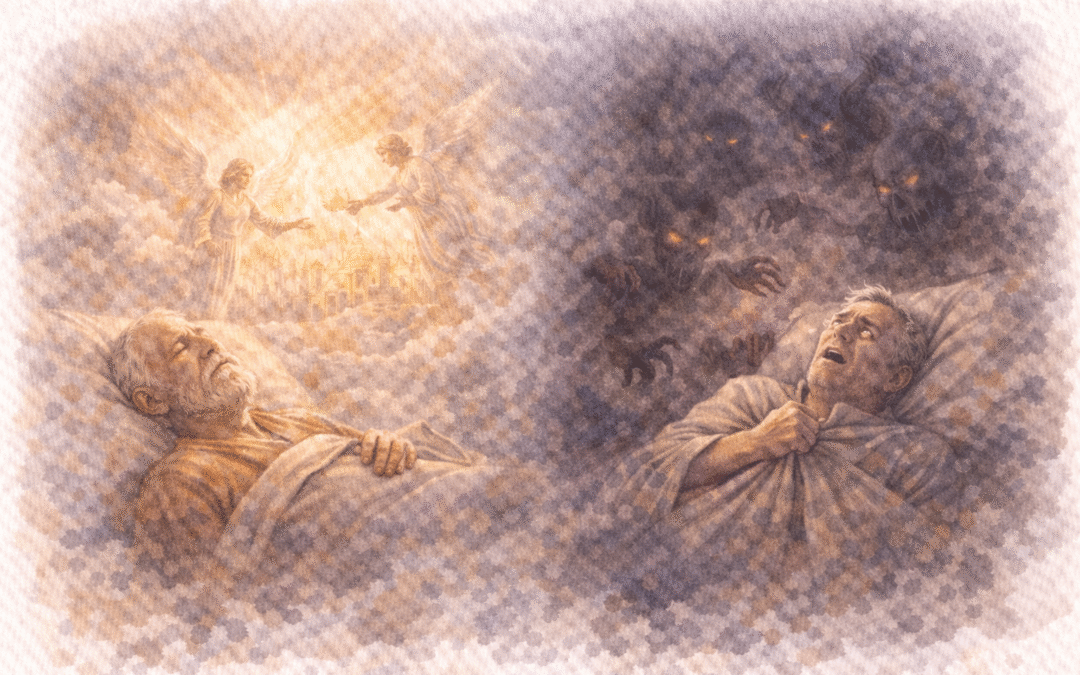
Note the immediate sequence: Died -> Buried -> Looked up. There was no interval. There was no “soul sleep.” At the moment his relatives were crying over his body on earth, he was already “looking” and “feeling” in Hades. The consciousness of the wicked is not erased; it is amplified.
2. The Preservation of Memory
The torment of hell (and Hades) is not just physical/spiritual; it is psychological. Abraham says to the rich man:
“Son, remember…” (Luke 16:25)
This is one of the most frightening phrases in the Bible. In the afterlife, memory works perfectly. The man without God will remember every opportunity he had. He will remember every church service he ignored, every tract he threw away, every time the Holy Spirit touched his heart and he stiffened his neck. Memory is the fuel of eternal remorse. “I could be there, but I chose to be here.”
3. Absolute Loneliness
The atheist often jokes: “I’m going to hell to meet my friends; there will be parties and rock ‘n’ roll.” This is a diabolical lie. Hell (and Hades) is not a place of community; it is a place of isolation. In Luke’s account, the rich man does not ask for his friends who have already died. He is alone in his torment. Evil is selfish. In the place of judgment, there is no friendship, no party, no music. There is only the silence of abandonment and the scream of pain.
For the atheist, death is the King of Terrors (Job 18:14). It is the moment when all his possessions are stripped away and he finds himself naked before the One he denied his entire life.
III. The Anatomy of the Servant’s Death: The Great Promotion
Now, let’s go to the room next door. A servant of God is dying. He might be dying of cancer, in an accident, or of old age. The body is breaking down. But what is happening in the spiritual world?
1. The Metaphor of Sleep (Koimao)
The New Testament rarely uses the word “die” for Christians. It uses the Greek verb Koimao (to sleep).
- Stephen “fell asleep” (Acts 7:60).
- Paul speaks of those who have “fallen asleep in Jesus” (1 Thessalonians 4:14).
Why “sleep”? Because sleep implies two things:
- Rest: Whoever sleeps rests from the fatigue of the day. Death for the believer is the end of the fight against sin, the end of pain, the end of weariness.
- Awakening: Whoever sleeps wakes up. Death is temporary. The body sleeps in the grave, awaiting the trumpet of resurrection, but the spirit is already awake in glory.
2. The Royal Reception (Stephen’s Example)
In Acts 7, we see the death of the first martyr. While the stones were crushing his body, heaven opened.
“Look,” he said, “I see heaven open and the Son of Man standing at the right hand of God.” (Acts 7:56 – NIV)
Generally, the Bible says that Jesus is seated at the right hand of God (a sign of completed work). But, at the moment of a faithful servant’s death, Jesus stands up. It is a sign of honor. The King stands to receive the soldier returning from war. The atheist dies and finds the void or demons; the servant dies and sees Jesus. Stephen’s face looked like “the face of an angel” because he wasn’t looking at death, but at Who was beyond it.
3. The Gain (Paul’s Accounting)
The Apostle Paul, imprisoned and close to death, did the accounting of life in Philippians 1:21:
“For to me, to live is Christ and to die is gain.”
How can death be gain? “Gain” is an economic term. It means you profit more than you lost.
- In death, I lose a sick body, I gain a glorious (future) body.
- I lose a temporary house, I gain an eternal mansion.
- I lose the company of imperfect men, I gain the company of angels and Jesus.
- I lose the fight against sin, I gain perfect holiness.
For the servant, the day of death is better than the day of birth (Ecclesiastes 7:1), because at birth we enter a world of pain, and at death (in Christ) we leave it.
IV. The Geography of the Beyond: Where Do We Go Now?
There is a lot of theological confusion here. When someone dies today, where do they go? The Bible teaches the Intermediate State. It is not yet the end of everything (since the resurrection of the body and the Final Judgment only happen at Jesus’ return), but it is already a definitive state of destiny.
1. The Destiny of the Wicked: Hades (Torment)
In Greek Hades (or Hebrew Sheol). It is the “Holding Cell.” The rich man in Luke 16 went there. It is a place of consciousness, of heat (“I am in agony in this fire”), and of separation. They wait there until the Great White Throne (Revelation 20), when Hades will give up the dead to be judged and thrown into the Lake of Fire (the definitive prison). Therefore, the atheist goes from suffering on earth to greater suffering in Hades, awaiting eternal suffering in the Lake of Fire. It is a progression of darkness.
2. The Destiny of the Servant: Paradise (Comfort)
Jesus told the thief on the cross:
“Truly I tell you, today you will be with me in paradise.” (Luke 23:43)
Paul calls it the “Third Heaven” (2 Corinthians 12:2). Paul says that “to depart and be with Christ… is better by far” (Philippians 1:23). Note that there is no purgatory. There is no unconscious “soul sleep.” It is today. It is immediate. Upon closing their eyes on earth, the servant opens them in the conscious presence of Christ. It is a place of “comfort” (as told to Lazarus). There, the souls of the righteous await the Resurrection, when they will receive their glorified bodies to dwell in the New Jerusalem.
The Great Difference:
- The atheist dies and goes to a place where hope does not enter.
- The servant dies and goes to a place where fear does not enter.
V. The Deathbed Test: Historical Accounts
History is full of accounts of the final moments of famous men. Although not Scripture, they illustrate the biblical truth of Proverbs 14:32.
The Death of Skeptics:
- Voltaire (Atheist Philosopher): It is said he cried out in agony: “I am abandoned by God and man! I will give you half of what I am worth if you will give me six months’ life!”
- Thomas Hobbes (Philosopher): “I am about to take my last voyage, a great leap in the dark.”
- Cesare Borgia: “I have provided for everything in the course of my life, except death; and now, alas! I am to die entirely unprepared.”
The Death of Servants:
- D.L. Moody (Evangelist): “Earth recedes; Heaven opens before me. If this is death, it is sweet! There is no valley here. God is calling me.”
- John Wesley: “The best of all is, God is with us.”
- Stephen (Biblical): “Lord Jesus, receive my spirit.” (Acts 7:59).
There is a supernatural peace in the hospital room of a righteous person that morphine cannot explain. It is the presence of the Shepherd in the Valley of the Shadow of Death (Psalm 23:4). His staff comforts.
VI. Practical Application: How to Prepare for the Trip?
If death is certain and the destinations are opposite, how should we live?
1. The Certainty of the Reservation (Salvation) You don’t go to the airport without a ticket. How dare you walk toward eternity without the assurance of salvation? Religiosity is useless on a deathbed. Good works are useless. The only thing that gives peace at the hour of death is knowing that your sins were washed by the blood of Christ. The thief on the cross had no works, no baptism, no tithe. He had faith: “Jesus, remember me.” And that was enough to change his destination from Hades to Paradise.
2. Investing in the Right Place Jesus said: “Store up for yourselves treasures in heaven” (Matthew 6:20). Why did the rich man in Luke 16 suffer so much? Because he invested everything on earth. When he died, he left 100% of his investment behind. He arrived in Hades bankrupt. The servant invests in lives, in the Kingdom, in the glory of God. When he dies, he doesn’t leave his fortune; he goes to meet his fortune. Jim Elliot, the martyred missionary, said: “He is no fool who gives what he cannot keep to gain what he cannot lose.”
3. Eliminating Fear Hebrews 2:15 says that Jesus came to “free those who all their lives were held in slavery by their fear of death.” The Christian should not be afraid of death. Respect? Yes. Fear? No. Death is the vehicle that takes us to the Wedding. Who fears their wedding day? If you are terrified of death, check your faith. Perhaps you love the world more than Christ.
Conclusion: The Door and the Key
Death is not a wall; it is a door. For the atheist, it is the door to an eternal prison. For the servant, it is the door to a palace.
The key to this door is in Jesus’ hands.
“I am the Living One; I was dead, and now look, I am alive for ever and ever! And I hold the keys of death and Hades.” (Revelation 1:18 – NIV)
It doesn’t matter how you will die (whether sleeping, in pain, or suddenly). What matters is Who will be holding your hand at the moment of crossing. If you are holding the world’s hand, you will sink with it. If you are holding Jesus’ hand, you will hear the sweetest voice in the universe saying: “Come. The Father is waiting. The worst is over. Welcome home.”
May we live in such a way that when our time comes to leave, the only thing we have to do is leave. No unfinished business. No fear. Only with the hope of Glory.
“Where, O death, is your victory? Where, O death, is your sting? … But thanks be to God! He gives us the victory through our Lord Jesus Christ.” — 1 Corinthians 15:55, 57
Postagens/Posts/Publicaciones
- “Is It God or Is It Just My Head?” The Ultimate Guide to Stop Guessing and Start Discerning
- “Show Me Your Glory”: The Mystery of the Cleft of the Rock and the Safe Place in Jesus
- Anxiety and Faith: Is it a sin to take medication or go to therapy? What the Bible really says
- Celestial Breaking News: “New Year” Doesn’t Exist in the Bible? A Deep Investigation into the Theology of New Beginnings
- Celestial Breaking News: The Day Heaven Invaded Earth (The True Story of Christmas You Never Heard)
- Christmas Investigation: Does the Bible Reveal the Exact Day Jesus Was Born? (The Mystery of Tabernacles)
- Church or Cult? The Ultimate Biblical Guide for the New Convert to Find a Safe Spiritual Home
- First Steps with Jesus: A Biblical Guide to Start Your Journey of Faith
- From the Pit to the Palace: When God’s Presence Feels Like Absolute Silence
- I Converted, But I Sinned Again: The Liberating Truth About Your Internal Struggle
- I Find Reading the Bible and Praying Boring: How to Overcome Spiritual Boredom and Build Consistency
- Real Life #1: “How to Share Jesus with My Family Without Starting World War III” — The Ultimate Guide to Home Evangelism
- Real Life #2: “Do I Really Need to Get Baptized? What Really Happens in the Water” — The Ultimate Guide to the Public Wedding with Christ
- Real Life #3: “Did God Call Me? How to Discover My Purpose Without Becoming a Pastor” — Ending the Sacred-Secular Divide
- Real Life #4: “Christian Dating vs. Hookup Culture: The Survival Manual for Singles” — Purity, Purpose, and the Physics of Being Unequally Yoked
- Real Life #5: “Tithes and Offerings: Is God Broke or Am I Greedy?” — Money as a Spiritual Thermometer
- Silence in Chaos: Why Having Faith Doesn’t Make You Immune to Anxiety (And How to Find Real Peace)
- Silence is Not Absence: A Deep Guide to Resetting Your Frequency and Finding the Overflow of Purpose
- Spiritual Detox #1: “I Accepted Jesus, Now My Problems Will End” — The Big Lie and the True Promise
- Spiritual Detox #2: “Do I Have to Cut Off Non-Christian Friends?” — The Definitive Guide to the “Holy Bubble”
- Spiritual Detox #3: “Christians Don’t Get Depressed?” — Breaking the Mental Health Taboo in the Church
- Spiritual Detox #4: “Can the Devil Read My Thoughts?” — The End of Paranoia and True Spiritual Authority
- Spiritual Detox #5: “I Don’t Feel God, So He’s Not Listening” — The Danger of Goosebump-Based Faith
- Spiritual Detox #6: “If I Sin, Does God Walk Away and Stop Loving Me?” — The Survival Guide for the “Spiritual Hangover”
- Spiritual Detox #7: “Do I Have to Become a Boring Christian?” — The End of the ‘Do’s and Don’ts’ List and True Holiness
- Start Here: 7 Days to Hear God (Reading John)
- The Anatomy of a Heart: Why Did God Love Such an Imperfect Man So Much?
- The Art of Abiding: Prayer, Discipleship, and the Secret of Consistency
- The Crimson Mystery: The Theology, Legality, and Power of “Pleading the Blood”
- The Eternity Code: Forensic Evidence That the Bible Is the Word of God
- The Final Metanoia: What It Really Means to Have the Mind of Christ
- The Great Discovery of December 31st: The End of Waiting (The Kingdom is Now)
- The Great Plan: The Architecture of Rescue (When the Fall Meets Grace)
- The Great Plan: Understanding the “Exchange” That Changes Everything
- The Incomparable #1: “The Terrorist of Tarsus: How God Turns His Worst Enemy Into His Greatest General”
- The Incomparable #10: The Last Breath — The Death of the Servant vs. The Death of the Atheist (Final Special)
- The Incomparable #2: “The Arabian Desert: Why Does God ‘Hide’ Those He Plans to Use?” — The Secret Power of Anonymity
- The Incomparable #3: The Fight with Barnabas and the Cost of Leadership
- The Incomparable #4: When Heaven Says “No” (The Frequency of the Spirit)
- The Incomparable #5: The Overflow — When the Gospel Faces Culture (Paul in Athens)
- The Incomparable #6: Silence in Chaos — The Theology of the Shipwreck (Paul in Acts 27)
- The Iron Mask: Why We Feel Like a Fraud and How to Cure Spiritual Imposter Syndrome
- The Logic of Blood: Why was Jesus’ death the only solution?
- The Mirror: The Death of the Slave, The Birth of the Son
- The Orphan Syndrome: Why Do You Keep Acting Like a Slave When You Already Have the House Keys?
- The Prince, The Shepherd, and The Deliverer: When the Desert Is the Only School
- The Prison of Resentment: How to forgive someone who never said “I’m sorry”
- The School of Prayer: How to Learn to Speak the Language of Heaven
- The Sound of Silence: What God Was Doing When He Stopped Speaking
- The Upside-Down Kingdom: Why Jesus’ Logic Offends Our Human Logic
- Tongues of Fire or Strange Fire? The Gift of Tongues, Paul, and the Ghost of Montanism
- When Heaven is Silent: A Survival Guide for the “Dark Night of the Soul”