


Estimated reading time: 20-25 minutes
Series: The Incomparable: The Life of Paul (Episode 2)
Keywords: paul in arabia desert, galatians 1 study, preparation time, paul’s ministry, the desert principle, ananias and saul, escape in a basket, paul’s chronology, waiting on god.
Introduction: The Pressure of “Now” vs. The Silence of God
Have you ever felt like you have a giant calling, but a tiny life? Do you feel that God has placed promises of fire in your heart, whispered dreams of impact and change, yet your current reality is cold, monotonous, and invisible? You look around and see people who seem “less prepared” than you thriving, taking on leadership roles, and standing in the spotlight, while you seem to be forgotten in God’s “waiting room”?
If you feel this way, welcome to the club of the great men and women of the Bible. We live in the era of “Insta-Success.” We want to plant the seed in the morning and eat the fruit in the afternoon. In our celebrity culture, if a famous person converts today, next week we want to give them a microphone, put them on a podcast, and have them lead a revival. We value visibility; God values stability.
In the previous episode, we witnessed the explosive conversion of Saul on the road to Damascus. It was cinematic. A blinding light, a voice from heaven, blindness, and a miraculous healing. Human logic dictates: “Wow! Saul of Tarsus has converted! He is a genius, a Roman citizen, and a Pharisee. Let’s take him to Jerusalem right now, put him on TV, do a testimony tour, and use his influence to win the intellectual world!”
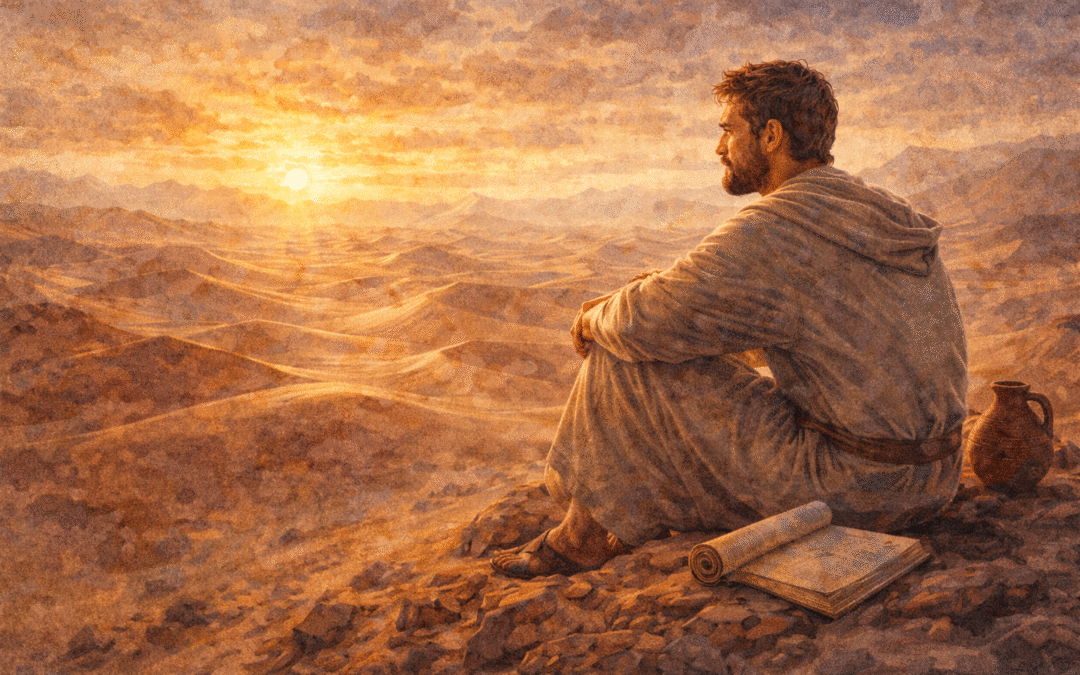
But what did God do? God took the most talented, cultured, and passionate man of his time and hid him. He didn’t go to the stage; he went to the Arabian Desert. And there he stayed for three long, silent years.
Today, we are going to investigate this mysterious period of Paul’s life (which most Bible readers completely ignore or don’t even know exists). We will discover the Principle of Anonymity: the uncomfortable truth that God often needs to work in you in the dark, before He can work through you in the light.
1. The Missing Link: What Happened After Damascus?
Most people read the book of Acts and assume the sequence went like this:
- Saul falls off his horse.
- Ananias prays for him.
- He immediately starts traveling the world preaching and planting churches.
Wrong. There is a “black hole” in the chronology of Acts that is only filled when we read Paul’s personal letter to the Galatians. In the first chapter, Paul opens his heart and tells us exactly what happened right after his eyes were opened.
“But when God… was pleased to reveal his Son in me so that I might preach him among the Gentiles, my immediate response was not to consult any human being. I did not go up to Jerusalem to see those who were apostles before I was, but I went into Arabia. Later I returned to Damascus. Then after three years, I went up to Jerusalem…” (Galatians 1:15-18)
Stop and absorb this. Three years. This is the same amount of time the twelve disciples spent walking with Jesus. Paul didn’t go to the “headquarters” in Jerusalem to learn from Peter and John. He didn’t go to verify his theology with the established leaders. He didn’t go to a seminary. He went to the desert. Alone.
Where was this “Arabia”? We are not talking about modern-day Saudi Arabia with its oil fields. In the first century, “Arabia” referred to the Nabataean Kingdom, a vast desert and rocky region that extended south from Damascus down to the Sinai Peninsula (including the famous city of Petra). It was a harsh place. A place of silence. A place of extremes. A place where there was no audience, no applause, no synagogues packed for debate. Just Saul, the sand, the wind, and the voice of the Jesus he had persecuted.
2. The Geography of the Soul: Why is the Desert Mandatory?
The desert in the Bible is never just a geographical location; it is a theological concept. It is not a punishment; it is a school. If you track the biography of the giants of faith, you will see that they all have a “zip code” in the desert.
- Moses: He was raised in Pharaoh’s palace with the best education in the world. But he needed 40 years in the desert of Midian tending sheep (unlearning his Egyptian pride) before he was ready to lead Israel.
- David: He was anointed king as a teenager, but he spent about 15 years running for his life in caves and deserts before he ever sat on the throne.
- Elijah: He was constantly being sent by God to the desert or to dry ravines (Cherith).
- John the Baptist: “And the child grew and became strong in spirit; and he lived in the wilderness until he appeared publicly to Israel” (Luke 1:80).
- Jesus: Even the Son of God, before beginning His public ministry, was led by the Spirit into the wilderness for 40 days to be tested.
Why does God do this? Because Saul’s talent was too big for his character. Saul was an intellectual genius, a brilliant Pharisee, and a born leader. But he was also arrogant, violent, and self-righteous. If he had started preaching immediately, he would have preached with the strength of his flesh, with the arrogance of his knowledge, and with the violence of his temperament. He would have destroyed the church he was trying to build.
The desert serves to Empty Us. In the desert, your credentials mean nothing. The sheep (or the sand) don’t care if you have a PhD in Law or if you were a student of Gamaliel. God took Saul to Arabia to “kill” the proud Pharisee and give birth to the Apostle of Grace. If you feel hidden today, do not panic: God is killing your pride so He can safely use your life. He is detoxing you from the world so you can be filled with heaven.
3. The Curriculum of Silence: What Did Paul Learn There?
What was Paul doing for three years? He wasn’t on vacation. He wasn’t just mediating on a rock. He was being reprogrammed.
Imagine Paul’s mind. He knew the Old Testament by heart. He knew the Law, the Prophets, the Psalms. But he read it all through the lens of Pharisaism (salvation by works, a political Messiah, Jewish exclusivity). In Arabia, the Holy Spirit sat down with Paul and said: “Saul, let’s re-read everything. But now, let’s read it through the lens of Jesus.”
And the scales continued to fall from his spiritual eyes.
- He read Isaiah 53 (“the suffering servant”) and finally understood: “The Lamb is not an animal; it’s Him! Jesus had to die.”
- He read the story of Abraham and understood: “Justification is by faith, not by circumcision! Abraham was justified before he was circumcised.”
- He read the Law and understood: “The Law is a mirror to show my sin, not a ladder to reach heaven. I can’t climb it.”
It was in Arabia that Paul received what he calls “My Gospel.” In Galatians 1:11-12, he makes a bold claim: “I want you to know, brothers and sisters, that the gospel I preached is not of human origin. I did not receive it from any man, nor was I taught it; rather, I received it by revelation from Jesus Christ.”
Paul didn’t learn the Gospel “second-hand” (hearing Peter tell stories about the fishes and loaves). He learned it straight from the Source. The time of solitude gives us a depth that the time of busyness never will. Do you want to have a message that shakes the world? You need to have time alone with God where the message becomes part of your blood, and not just notes in your notebook. You need a revelation, not just information.
4. The Mount Sinai Connection: Swapping Covenants
There is a fascinating clue in Galatians 4:25, where Paul mentions that “Mount Sinai is in Arabia.” Many scholars believe that during these three years, Paul went on a pilgrimage to Mount Sinai—the very place where Moses received the Law.
Imagine the poetic and theological irony of this scene:
- Moses went up Sinai and came down with the Stone Tablets (the Law that condemns man because we cannot keep it).
- Elijah fled to Sinai when he was depressed and heard the gentle whisper of God.
- Now, Paul goes to Sinai. But he doesn’t go to receive the Law; he goes to realize that the Law has been fulfilled.
Perhaps, at the foot of that mountain where Judaism was born, Paul understood Grace. He realized that the entire system of sacrifices, rules, shadows, and temple rituals had come to an end. It was in the desert that he grasped the mystery that even Peter hadn’t fully understood yet: The Gentiles (non-Jews) are also welcome. It was there that he was commissioned as the “Apostle to the Gentiles.” God needed to take him out of the religious environment of Jerusalem so that he could see the global horizon of Grace. Sometimes, God takes you out of your “church context” or your “comfort zone” to expand your vision. You can’t see the whole picture when you are inside the frame.
5. The Humiliating Return: The Basket Descent (Acts 9:23-25)
After three years of being trained by Jesus Himself in the desert, Paul returns to Damascus. Now he is ready, right? Now he will arrive like a general, preach in the stadium, and be acclaimed by the masses! No.
The Bible tells us that when he returned to preach in Damascus, the Jews plotted to kill him. They watched the city gates day and night to assassinate him. So, how did the great Apostle Paul escape? Did God send a chariot of fire? did an angel blind the soldiers? Did an earthquake open the gates? No.
“But his followers took him by night and lowered him in a basket through an opening in the wall.” (Acts 9:25)
This is deeply humiliating. Saul, the man who had entered Damascus three years earlier with a military escort, with letters of authority from the High Priest, riding high on a horse with his nose in the air… now leaves Damascus hiding, in the middle of the night, curled up inside a dirty laundry basket or a cargo basket, lowered down a wall like a common criminal.
Why the basket? Because God needed to ensure that Saul knew he was weak. In 2 Corinthians 11:30-33, when Paul lists his “credentials” and “glories,” the first thing he remembers is this basket episode. He was saying: “I am a man who had to run away in a fish basket. I am not a superhero. If anything good comes out of me, it is God’s power, not mine.”
The desert and the basket were God’s tools to break Paul’s self-sufficiency. Before God puts you on a stage before kings, He might put you in a basket, fleeing at night, to ensure that you won’t steal His Glory when you are exalted. The way up is down.
6. The Danger of Premature Exposure (The Chinese Bamboo)
Why are we so impatient with our “desert time”? Because we don’t understand the principle of the Chinese Bamboo. They say that when you plant the seed of this bamboo, you see nothing for 5 years. You water it, fertilize it, and nothing happens. The ground looks barren. You feel like a fool watering dirt. But actually, for 5 years, the bamboo is growing downward. It is developing a gigantic and complex root system. Then, in the fifth year, the sprout breaks the surface, and in just 6 weeks, it grows to 80 feet tall.
If the bamboo grew to 80 feet without having 5 years of roots, the first wind would topple it. Saul of Tarsus was an arrogant “shrub.” Paul needed to be an “Oak of Righteousness.” And oaks take time to grow.
If you are in the “root phase” (hidden, working behind the scenes, being faithful in the little things, studying when no one is watching), do not be discouraged. The devil wants to expose you prematurely to burn you out. God hides you to root you. Don’t try to kick down the doors that God has closed. Anonymity is a shield. Enjoy this time to deepen your intimacy, because once the “harvest” begins, you will need every drop of oil you accumulated in the desert.
7. Practical Application: Surviving Your “Arabia”
If you feel like you are in your own Arabian Desert today (unemployed, without a ministry, forgotten, single, or frustrated), here are three practical pieces of advice based on Paul’s life:
1. Don’t Waste the Silence Don’t spend your desert time complaining. Use it to study. Paul came out of Arabia with the Epistle to the Romans “pregnant” in his heart. What are you gestating in this waiting time? Read the entire Bible. Pray for hours. Journal your journey. The desert is the best theological seminary in the world. If you can’t be active out there, be active in here (in your spirit).
2. Stop Seeking Human Approval (“Flesh and Blood”) Paul said: “I did not consult with flesh and blood.” Stop trying to prove your worth to people. Stop trying to get the “apostles in Jerusalem” (the current leaders, the influencers, the gatekeepers) to notice you. If God called you, He Himself will promote you at the right time. Seek the approval of heaven, not likes on earth. When you are truly ready, God will find you, even if you are hiding in a cave.
3. Accept the “Basket” If God allows humiliating situations in your life (having to move back in with your parents, accepting a “lower” job, serving in the background cleaning chairs), accept it with joy. The basket is not the end; it is the transport to the next phase. Humiliation precedes honor. Let God crush your ego so He can liberate your spirit.
Conclusion: The God Who Hides to Reveal
Isaiah 49:2 says a beautiful phrase about the Servant of the Lord (Jesus, and prophetically us):
“He made my mouth like a sharpened sword, in the shadow of his hand he hid me; he made me into a polished arrow and concealed me in his quiver.”
The archer (God) spends a lot of time polishing the arrow. He sands it, aligns it, balances it. While he does this, the arrow is “hidden” in the quiver, in the dark. The arrow could complain: “I was made to fly! I was made to pierce targets! Why am I stuck here in this dark leather bag?” But the archer knows that the more time he spends polishing the arrow, and the further back he pulls the bowstring (tension and waiting), the farther the arrow will fly when it is finally released.
Paul was an arrow that flew all the way to Rome, and all the way to us, 2,000 years later. But that only happened because he accepted being polished in Arabia.
Don’t be in a hurry. Let God polish you. Your time to fly will come.
Hearing Him Org — Appreciating the shadow of God’s hand while He prepares us.
Support Links (CTA)
Are you in this waiting season and want to use this time to deepen your biblical knowledge like Paul did? Don’t waste your desert. Start digging deep roots now. We have created a resource to help you study the Bible not just as a book, but as a conversation with God.
👉 Start your deep Bible Study here
Biblical References Used
- Galatians 1:11-24 (Paul’s account of going to Arabia and not Jerusalem).
- Acts 9:19-25 (Preaching in Damascus and the basket escape).
- 2 Corinthians 11:32-33 (Paul recalls the humiliation of the basket).
- Exodus 2 and 3 (Moses 40 years in the desert).
- Luke 1:80 (John the Baptist in the wilderness).
- Matthew 4 (Jesus in the wilderness).
- Isaiah 49:2 (The polished arrow hidden in the quiver).
- Galatians 4:25 (Mount Sinai in Arabia).
Postagens/Posts/Publicaciones
- “Is It God or Is It Just My Head?” The Ultimate Guide to Stop Guessing and Start Discerning
- “Show Me Your Glory”: The Mystery of the Cleft of the Rock and the Safe Place in Jesus
- Anxiety and Faith: Is it a sin to take medication or go to therapy? What the Bible really says
- Celestial Breaking News: “New Year” Doesn’t Exist in the Bible? A Deep Investigation into the Theology of New Beginnings
- Celestial Breaking News: The Day Heaven Invaded Earth (The True Story of Christmas You Never Heard)
- Christmas Investigation: Does the Bible Reveal the Exact Day Jesus Was Born? (The Mystery of Tabernacles)
- Church or Cult? The Ultimate Biblical Guide for the New Convert to Find a Safe Spiritual Home
- First Steps with Jesus: A Biblical Guide to Start Your Journey of Faith
- From the Pit to the Palace: When God’s Presence Feels Like Absolute Silence
- I Converted, But I Sinned Again: The Liberating Truth About Your Internal Struggle
- I Find Reading the Bible and Praying Boring: How to Overcome Spiritual Boredom and Build Consistency
- Real Life #1: “How to Share Jesus with My Family Without Starting World War III” — The Ultimate Guide to Home Evangelism
- Real Life #2: “Do I Really Need to Get Baptized? What Really Happens in the Water” — The Ultimate Guide to the Public Wedding with Christ
- Real Life #3: “Did God Call Me? How to Discover My Purpose Without Becoming a Pastor” — Ending the Sacred-Secular Divide
- Real Life #4: “Christian Dating vs. Hookup Culture: The Survival Manual for Singles” — Purity, Purpose, and the Physics of Being Unequally Yoked
- Real Life #5: “Tithes and Offerings: Is God Broke or Am I Greedy?” — Money as a Spiritual Thermometer
- Silence in Chaos: Why Having Faith Doesn’t Make You Immune to Anxiety (And How to Find Real Peace)
- Silence is Not Absence: A Deep Guide to Resetting Your Frequency and Finding the Overflow of Purpose
- Spiritual Detox #1: “I Accepted Jesus, Now My Problems Will End” — The Big Lie and the True Promise
- Spiritual Detox #2: “Do I Have to Cut Off Non-Christian Friends?” — The Definitive Guide to the “Holy Bubble”
- Spiritual Detox #3: “Christians Don’t Get Depressed?” — Breaking the Mental Health Taboo in the Church
- Spiritual Detox #4: “Can the Devil Read My Thoughts?” — The End of Paranoia and True Spiritual Authority
- Spiritual Detox #5: “I Don’t Feel God, So He’s Not Listening” — The Danger of Goosebump-Based Faith
- Spiritual Detox #6: “If I Sin, Does God Walk Away and Stop Loving Me?” — The Survival Guide for the “Spiritual Hangover”
- Spiritual Detox #7: “Do I Have to Become a Boring Christian?” — The End of the ‘Do’s and Don’ts’ List and True Holiness
- Start Here: 7 Days to Hear God (Reading John)
- The Anatomy of a Heart: Why Did God Love Such an Imperfect Man So Much?
- The Art of Abiding: Prayer, Discipleship, and the Secret of Consistency
- The Crimson Mystery: The Theology, Legality, and Power of “Pleading the Blood”
- The Eternity Code: Forensic Evidence That the Bible Is the Word of God
- The Final Metanoia: What It Really Means to Have the Mind of Christ
- The Great Discovery of December 31st: The End of Waiting (The Kingdom is Now)
- The Great Plan: The Architecture of Rescue (When the Fall Meets Grace)
- The Great Plan: Understanding the “Exchange” That Changes Everything
- The Incomparable #1: “The Terrorist of Tarsus: How God Turns His Worst Enemy Into His Greatest General”
- The Incomparable #10: The Last Breath — The Death of the Servant vs. The Death of the Atheist (Final Special)
- The Incomparable #2: “The Arabian Desert: Why Does God ‘Hide’ Those He Plans to Use?” — The Secret Power of Anonymity
- The Incomparable #3: The Fight with Barnabas and the Cost of Leadership
- The Incomparable #4: When Heaven Says “No” (The Frequency of the Spirit)
- The Incomparable #5: The Overflow — When the Gospel Faces Culture (Paul in Athens)
- The Incomparable #6: Silence in Chaos — The Theology of the Shipwreck (Paul in Acts 27)
- The Iron Mask: Why We Feel Like a Fraud and How to Cure Spiritual Imposter Syndrome
- The Logic of Blood: Why was Jesus’ death the only solution?
- The Mirror: The Death of the Slave, The Birth of the Son
- The Orphan Syndrome: Why Do You Keep Acting Like a Slave When You Already Have the House Keys?
- The Prince, The Shepherd, and The Deliverer: When the Desert Is the Only School
- The Prison of Resentment: How to forgive someone who never said “I’m sorry”
- The School of Prayer: How to Learn to Speak the Language of Heaven
- The Sound of Silence: What God Was Doing When He Stopped Speaking
- The Upside-Down Kingdom: Why Jesus’ Logic Offends Our Human Logic
- Tongues of Fire or Strange Fire? The Gift of Tongues, Paul, and the Ghost of Montanism
- When Heaven is Silent: A Survival Guide for the “Dark Night of the Soul”