


Biographical Series: Paul | Study 03
Phase: Real Life | Focus: Conflict, Leadership, and Restoration
The Night the Lights Went Out in Antioch
The sound of a slamming door can echo for decades in the history of the Church.
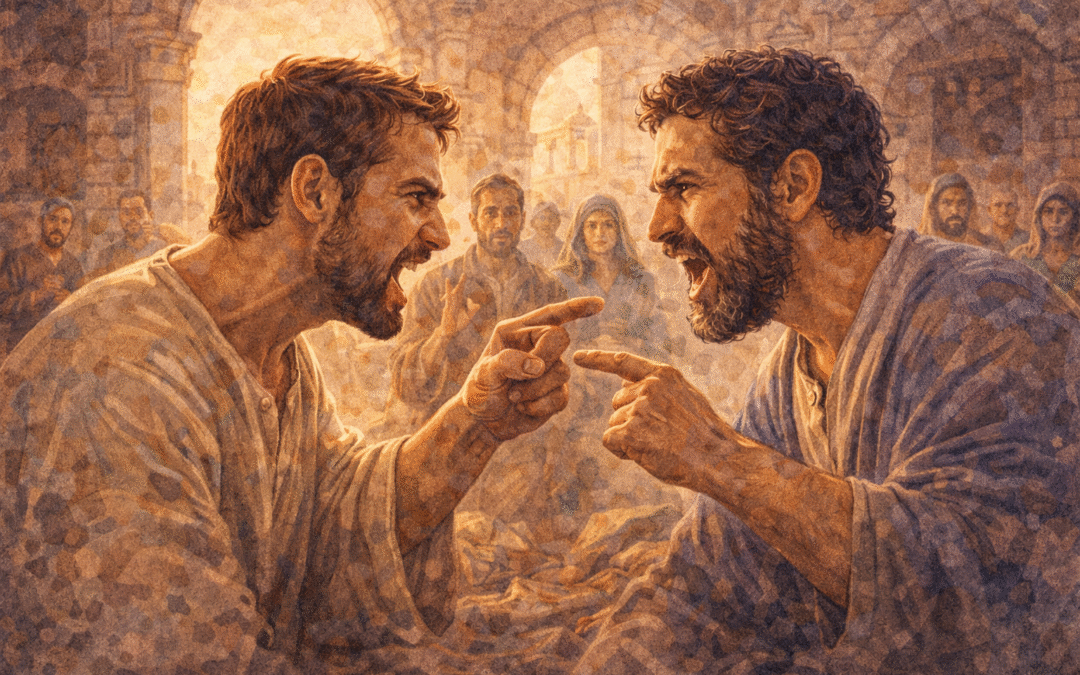
On that hot night in Antioch of Syria, the neuralgic center of Gentile missions, there was no soft sound of hymns, no harmony of prophecies, no reverent silence of the laying on of hands. There was shouting. There were red faces, veins bulging in necks, and fingers pointed in accusation.
Two giants of the Kingdom of God, two generals who had faced demons, sorcerers, Roman governors, and angry mobs side by side, were now facing the most painful enemy of all: each other.
On one side stood Paul. The strategist, the theologian, the visionary, the man for whom the Mission was a sacred and non-negotiable flame consuming his bones. On the other stood Barnabas. The “Son of Encouragement,” the mentor, the man of the dilated heart, for whom People were the true temple of God, sacred and non-negotiable.
Between them, shrinking back, perhaps weeping, or perhaps just looking at the floor with shame burning his ears, was the cause of the discord: John Mark. The young man who had quit. The rich kid from Jerusalem who, faced with real danger and the harshness of Pamphylia on the first journey, packed his bags and went back to the comfort of mommy’s house.
The scenario was the planning of the Second Missionary Journey. The strategy was to revisit the planted churches. The team was being assembled. Barnabas, with his fatherly gaze, placed his hand on Mark’s shoulder and said, “Let’s take him. He needs a second chance.” Paul, with his eagle gaze, hardened his face and said, “No. Absolutely not.”
And it wasn’t a polite “no,” the kind you hear in a church board meeting. The Greek text in Acts 15:39 uses a specific and frightening word: paroxysmos. It is the root of our word “paroxysm.” In medical terms, a paroxysm is the acute stage of a fever or the violent convulsion of a disease. In emotional terms, it means an uncontrollable agitation, a sharp provocation, an explosion of temper.
It was an ugly fight. So ugly, so visceral, and so human that the sacred text does not try to sanitize it: “They had such a sharp disagreement that they parted company.”
Today, through the raw, unfiltered lens of Paul’s life, we will face a reality we rarely post on social media or discuss in Sunday School: What happens when men filled with the Holy Spirit do not agree? What is the cost of leading with the sword of truth in hand, but without the shield of patience? And how does God gather the shards of a broken friendship to build an even greater legacy?
I. The Anatomy of Giants: Why Was the Collision Inevitable?
To understand the depth of this rupture, we cannot look only at the fact (taking Mark or not). We need to look at the soul of those involved. The conflict was not merely logistical; it was a clash of worldviews.
1. Paul: The Mission Above All
Paul was a man of excellence and urgency. Remember who he was: an ex-Pharisee trained at the feet of Gamaliel. His mind was forged in discipline, rigor, and the Law. When he converted, he transferred all that zeal to Christ. For Paul, the Gospel was not a hobby; it was a war. He viewed the mission field as a trench. They were invading enemy territory, casting out demons, facing the Roman Empire. When John Mark abandoned them on the first journey (Acts 13:13), Paul didn’t just see a young man homesick or afraid of mosquitoes. He saw a betrayal of the cause. He saw a fundamental character flaw. He saw a soldier who deserted in the middle of a firefight.
Paul’s reasoning was logical, military, and pragmatic: “If we are going back to the battlefield, where we were already stoned in Lystra and whipped, I cannot afford the luxury of taking a recruit who runs at the first sign of smoke. The team needs to be elite. Silas’s safety and mine depend on who covers our rear. Mark proved he is not reliable. The mission is too important to risk with amateurs or cowards.”
Can you blame Paul? From the standpoint of risk management and strategic leadership, he was absolutely right.
2. Barnabas: The Person Above the Process
Barnabas, on the other hand, operated on another frequency. His original name was Joseph, but the apostles called him Barnabas, which means “Son of Consolation” or “Son of Encouragement.” This wasn’t just an affectionate nickname; it was his anointing, his prophetic identity. Barnabas was the man who sold his land to feed the poor in Jerusalem. More importantly: Barnabas was the man who believed in Paul when no one else did.
When Saul converted and tried to join the disciples in Jerusalem, everyone was afraid of him. They thought he was a spy. It was Barnabas who took him by the hand, led him to the apostles, and staked his reputation on the change of that ex-assassin. Without Barnabas, we might not have the Apostle Paul as we know him.
Barnabas’s logic in Mark’s case was pastoral, relational, and redemptive: “Paul, do you remember when no one wanted you? I gave you a chance. Did Mark fail? Yes. was he weak? Yes. But if we, the Church, discard people when they break, what kind of Gospel are we preaching? The kid has potential. He needs mentorship, not rejection. He needs to see that we believe in him so he can believe in himself.”
Who was right? Theologically? Both. Organizationally? Paul (focus on the task). Relationally? Barnabas (focus on the person).
But in that moment, Paul’s absolute certainty blinded him to Barnabas’s wisdom. Paul was so focused on the efficiency of the work that he forgot the efficacy of grace. He was ready to save the world, but he didn’t have the patience to save the spirit of a young intern.
II. The Deafening Silence of Separation
The fight ended in the worst possible way. There was no gentlemen’s agreement. There was a rupture. The text says Barnabas took Mark and sailed for Cyprus. Paul chose Silas and left for Syria and Cilicia.
The Bible goes on to narrate Paul’s adventures in Acts 16, and Barnabas practically disappears from Luke’s historical record. But make no mistake: that breakup hurt the soul.
Imagine Paul walking on the dusty road with Silas. Silas was a great man, a prophet, a respectable Roman citizen. But he wasn’t Barnabas. He wasn’t the friend who laughed with Paul at life’s ironies. He wasn’t the man who shared bread and tears in the early hard days. Barnabas was Paul’s emotional anchor. They were the “Batman and Robin” of the New Testament, the dynamic duo of the Holy Spirit. And now, because of an argument about an immature youth, they were strangers.
How many times, in the silence of the night, in a cold prison or on a rocking ship, must Paul have thought: “Was I too hard? Is Barnabas okay? I wonder what happened to Mark?”
Leadership has a lonely cost, and Paul was paying the first installment of that price. This episode teaches us a brutal lesson about maturity: Sometimes, your theological or strategic convictions will push away people you love. Paul learned the hard way that being right in an argument doesn’t warm your heart at night. He “won” the argument (he didn’t take Mark, after all), but he lost the friend.
III. The Sovereignty of God in the Chaos of Temperaments
There is a strange beauty in how God deals with our failures. God could have intervened. The Holy Spirit could have made one of the two yield. But God allowed the paroxysmos. Why?
Here we see the Mathematics of Grace: God used division to multiply.
- If they had agreed and gone together, there would be only one missionary team.
- Because of the fight, there were now two teams.
- Barnabas and Mark went to Cyprus (Barnabas’s homeland), strengthening the island churches.
- Paul and Silas went to the continent, and eventually, guided by the Spirit, crossed into Macedonia, taking the Gospel to Europe.
Furthermore, there was a “specialization of care.” Paul needed a war partner like Silas—someone ready to be arrested, whipped, and sing in the dungeon at midnight (as happened in Philippi shortly after). Mark, at that stage, couldn’t have handled Philippi. He would have broken again. Barnabas, in turn, dedicated himself to the slow, artisanal, patient work of restoring Mark’s soul. A job that Paul, with his urgency and impatience, could never have done.
God is a master at writing straight not just with crooked lines, but through crooked temperaments. He used Paul’s rigidity to expand borders and Barnabas’s sweetness to restore the fallen.
IV. The Breaking Process: Time Teaches What Theology Cannot
Years passed. Decades rolled by. Paul was whipped, imprisoned, shipwrecked three times, stoned, and left for dead. He grew old. His eyesight worsened (Galatians 4:15). His back became a map of scars. And his heart, presumably and happily, grew softer.
Life has a peculiar way of humbling us and breaking our perfectionist arrogance. Young Paul, full of vigor, thought the work depended on strength and unshakable courage. Old Paul, “the prisoner of the Lord,” discovered his own weaknesses. He learned about the “thorn in the flesh.” He learned that “God’s power is made perfect in weakness.” He needed the help of Luke, the physician. He was sustained by women like Lydia and Phoebe. He was refreshed by Onesiphorus in chains.
Paul realized that the “Mission” is not made of iron superheroes who never fail, but of broken jars of clay that leak grace.
And somewhere along those decades, Paul started hearing rumors. News coming from Cyprus, or Rome. “Remember Mark? That nephew of Barnabas who ran away? They say he has matured.” “Paul, I heard Mark is serving as Peter’s interpreter in Rome. Peter calls him ‘my son’.” “Paul, did you hear? Mark is compiling Peter’s memories of Jesus’ life into a scroll. He is writing a Gospel.”
Imagine the reality shock. The “deserter” was becoming one of Christ’s biographers. Barnabas’s bet had paid off. The risky investment in the “persona non grata” generated eternal dividends. If it had been up to Paul that night in Antioch, Mark would have been archived in the “useless” department. Thank God for Barnabas’s holy stubbornness.
V. The Redemption: “Bring him with you”
We reach the final act. The setting is no longer vibrant Antioch, but the damp, dark, and fetid Mamertine Dungeon in Rome. Nero is on the throne. Persecution is brutal. Paul knows the end has come. He no longer expects release; he expects the guillotine.
The loneliness is palpable. In his second letter to Timothy, he writes with sadness: “Demas, because he loved this world, has deserted me… Only Luke is with me.”
And then, in chapter 4, verse 11, we read one of the most beautiful, subversive, and healing sentences in the entire Bible. A sentence that undoes decades of hurt and rewrites the history of a mistake:
“Get Mark and bring him with you, because he is helpful to me in my ministry.”
Stop. Read it again. Breathe deep and feel the weight of those words.
Who is Paul asking for? The man he rejected. The cause of the fight that cost him his best friend. The “weak,” the “fearful,” the “inadequate.” Now, at the most critical moment of his life, facing death, whom does Paul want by his side? Not a general. Not a theologian. It is Mark.
This sentence is the greatest trophy of Paul’s maturity. It tells us three fundamental things:
- There Was Real Forgiveness: Paul didn’t just tolerate Mark; he desired him close. The hurt of the “betrayal” in Pamphylia had been washed by the blood of the Lamb and by time.
- There Was Recognition of Error: By saying “he is helpful to me” (or euchrestos in Greek, meaning “of great value,” “profitable”), Paul was implicitly admitting: “Barnabas, you were right. The kid was worth it.”
- There Was Restoration of Trust: Paul trusted Mark to care for him in his final days. He entrusted his vulnerability to the one he once judged to be weak.
In Colossians 4:10, Paul had already instructed the church to welcome Mark. In Philemon 1:24, he lists Mark as a “fellow worker.” The reconciliation was public, notorious, and complete. Grace conquered temperament. “General” Paul learned to love the soldier who limped.
VI. Application: Sacred Monday – Which Leader Are You?
How do we bring this biblical drama into our office, into our church leadership, or to our dinner table on Monday?
Many of us suffer from a dangerous dichotomy. Either we are too hard, or we are too soft.
The Diagnosis: Paul Syndrome vs. Barnabas Syndrome
Do you have Paul Syndrome (The Task Leader)?
- You are focused on results, goals, and excellence.
- You have little patience for repeated mistakes or incompetence.
- When someone fails, your tendency is to “chop off their head” or isolate the person.
- You say: “The work is more important than so-and-so’s ego.”
- The Danger: You may build great projects, but you will leave a trail of wounded bodies along the way. You run the risk of ending up alone.
- The Cure: You need a Barnabas on your team. Someone you respect, who has permission to say: “Calm down. Don’t give up on him yet.” You need to learn that people are the end, not the means.
Do you have Barnabas Syndrome (The People Leader)?
- You see potential in everyone and give second, third, fourth chances.
- You avoid direct confrontation and prioritize team harmony.
- Sometimes, you sacrifice quality or deadlines to avoid hurting someone’s feelings.
- You say: “The important thing is that he has a good heart.”
- The Danger: You can fill your team with immature or incompetent people who never grow because they are never confronted. The mission can stagnate due to a lack of rigor.
- The Cure: You need a Paul by your side. Someone who brings clarity, direction, and high standards. You need to understand that sometimes, the greatest love is telling the hard truth that makes a person grow.
Practical Steps to Resolve “Barnabas Fights” in Your Life:
1. Reevaluate Your “Useless” Ones Who have you discarded from your professional or ministry life in recent years? Who have you labeled as “unfit,” “traitor,” or “weak”? Could it be that God is working on that person away from your eyes? Is the Mark who ran away yesterday not the mature leader of today? The Gospel is the religion of Second Chances. If God didn’t give up on you (and He had reasons to), who are you to decree the end of the line for someone?
2. Normalize Disagreement, but Sanctify the Reaction Paul and Barnabas had a “paroxysm,” but they did not become enemies of the faith. They didn’t create rival sects. They kept preaching the same Jesus. It is possible to disagree strongly about methods and strategies and still honor the anointing and character of the other. If you had a rupture, ensure the bridge wasn’t burned, just that the paths forked. Keep the door unlocked for the future.
3. The Humility of Return Maybe you are the Mark in the story. You failed. You quit. You embarrassed your leader. Mark’s lesson is: Get back to work. He didn’t stay crying in Jerusalem forever. He went to Cyprus. He went to Rome. He served Peter. He wrote the Gospel. He became useful through faithful service. The best way to change a “Paul’s” opinion of you isn’t by arguing, it’s by bearing fruit.
4. The Legacy of Reconciliation Paul’s noblest gesture wasn’t founding churches in Asia Minor; it was having the greatness of soul, on his deathbed, to say: “I need that boy.” This requires a death to self that few leaders achieve. If there is someone you haven’t spoken to in years because of an old disagreement, the Holy Spirit asks you a question today: Do you want to be right, or do you want to be free?
Conclusion: The Great Weaver of Stories
The story of Paul, Barnabas, and Mark is definitive proof that God is a Great Weaver who uses imperfect threads to create a perfect tapestry.
He uses our rigidity and our sweetness. He uses our moments of “shouting” and our moments of embracing. He uses our painful breakups to spread His glory in ways we couldn’t plan.
If you are in the middle of a conflict today, if you feel the pain of a split, breathe. The story isn’t over. Acts Chapter 15 was a sad moment, but it wasn’t the end of the book. The God who reconciled the elderly Paul with the mature Mark is the same One working behind the scenes of your life right now.
The mission is important, yes. The truth is non-negotiable, yes. But in the end, when the lights of life’s stage are dimming, and we are in our own “dungeon” awaiting the meeting with the King, we won’t ask for our productivity reports, nor our follower counts, nor our theological theses. We will ask for the people. We will ask for the friends. We will ask for those we love.
“Bring him with you.”
May we have Paul’s courage to lead with passion, but may God give us Barnabas’s heart to never, ever give up on someone too soon.
“Bear with each other and forgive one another if any of you has a grievance against someone. Forgive as the Lord forgave you. And over all these virtues put on love, which binds them all together in perfect unity.” — Colossians 3:13-14 (Words written by a Paul who learned, with tears and time, the value of a Barnabas).
Postagens/Posts/Publicaciones
- “Is It God or Is It Just My Head?” The Ultimate Guide to Stop Guessing and Start Discerning
- “Show Me Your Glory”: The Mystery of the Cleft of the Rock and the Safe Place in Jesus
- Anxiety and Faith: Is it a sin to take medication or go to therapy? What the Bible really says
- Celestial Breaking News: “New Year” Doesn’t Exist in the Bible? A Deep Investigation into the Theology of New Beginnings
- Celestial Breaking News: The Day Heaven Invaded Earth (The True Story of Christmas You Never Heard)
- Christmas Investigation: Does the Bible Reveal the Exact Day Jesus Was Born? (The Mystery of Tabernacles)
- Church or Cult? The Ultimate Biblical Guide for the New Convert to Find a Safe Spiritual Home
- First Steps with Jesus: A Biblical Guide to Start Your Journey of Faith
- From the Pit to the Palace: When God’s Presence Feels Like Absolute Silence
- I Converted, But I Sinned Again: The Liberating Truth About Your Internal Struggle
- I Find Reading the Bible and Praying Boring: How to Overcome Spiritual Boredom and Build Consistency
- Real Life #1: “How to Share Jesus with My Family Without Starting World War III” — The Ultimate Guide to Home Evangelism
- Real Life #2: “Do I Really Need to Get Baptized? What Really Happens in the Water” — The Ultimate Guide to the Public Wedding with Christ
- Real Life #3: “Did God Call Me? How to Discover My Purpose Without Becoming a Pastor” — Ending the Sacred-Secular Divide
- Real Life #4: “Christian Dating vs. Hookup Culture: The Survival Manual for Singles” — Purity, Purpose, and the Physics of Being Unequally Yoked
- Real Life #5: “Tithes and Offerings: Is God Broke or Am I Greedy?” — Money as a Spiritual Thermometer
- Silence in Chaos: Why Having Faith Doesn’t Make You Immune to Anxiety (And How to Find Real Peace)
- Silence is Not Absence: A Deep Guide to Resetting Your Frequency and Finding the Overflow of Purpose
- Spiritual Detox #1: “I Accepted Jesus, Now My Problems Will End” — The Big Lie and the True Promise
- Spiritual Detox #2: “Do I Have to Cut Off Non-Christian Friends?” — The Definitive Guide to the “Holy Bubble”
- Spiritual Detox #3: “Christians Don’t Get Depressed?” — Breaking the Mental Health Taboo in the Church
- Spiritual Detox #4: “Can the Devil Read My Thoughts?” — The End of Paranoia and True Spiritual Authority
- Spiritual Detox #5: “I Don’t Feel God, So He’s Not Listening” — The Danger of Goosebump-Based Faith
- Spiritual Detox #6: “If I Sin, Does God Walk Away and Stop Loving Me?” — The Survival Guide for the “Spiritual Hangover”
- Spiritual Detox #7: “Do I Have to Become a Boring Christian?” — The End of the ‘Do’s and Don’ts’ List and True Holiness
- Start Here: 7 Days to Hear God (Reading John)
- The Anatomy of a Heart: Why Did God Love Such an Imperfect Man So Much?
- The Art of Abiding: Prayer, Discipleship, and the Secret of Consistency
- The Crimson Mystery: The Theology, Legality, and Power of “Pleading the Blood”
- The Eternity Code: Forensic Evidence That the Bible Is the Word of God
- The Final Metanoia: What It Really Means to Have the Mind of Christ
- The Great Discovery of December 31st: The End of Waiting (The Kingdom is Now)
- The Great Plan: The Architecture of Rescue (When the Fall Meets Grace)
- The Great Plan: Understanding the “Exchange” That Changes Everything
- The Incomparable #1: “The Terrorist of Tarsus: How God Turns His Worst Enemy Into His Greatest General”
- The Incomparable #10: The Last Breath — The Death of the Servant vs. The Death of the Atheist (Final Special)
- The Incomparable #2: “The Arabian Desert: Why Does God ‘Hide’ Those He Plans to Use?” — The Secret Power of Anonymity
- The Incomparable #3: The Fight with Barnabas and the Cost of Leadership
- The Incomparable #4: When Heaven Says “No” (The Frequency of the Spirit)
- The Incomparable #5: The Overflow — When the Gospel Faces Culture (Paul in Athens)
- The Incomparable #6: Silence in Chaos — The Theology of the Shipwreck (Paul in Acts 27)
- The Iron Mask: Why We Feel Like a Fraud and How to Cure Spiritual Imposter Syndrome
- The Logic of Blood: Why was Jesus’ death the only solution?
- The Mirror: The Death of the Slave, The Birth of the Son
- The Orphan Syndrome: Why Do You Keep Acting Like a Slave When You Already Have the House Keys?
- The Prince, The Shepherd, and The Deliverer: When the Desert Is the Only School
- The Prison of Resentment: How to forgive someone who never said “I’m sorry”
- The School of Prayer: How to Learn to Speak the Language of Heaven
- The Sound of Silence: What God Was Doing When He Stopped Speaking
- The Upside-Down Kingdom: Why Jesus’ Logic Offends Our Human Logic
- Tongues of Fire or Strange Fire? The Gift of Tongues, Paul, and the Ghost of Montanism
- When Heaven is Silent: A Survival Guide for the “Dark Night of the Soul”