


Series: The Incomparable (Episode 5)
Scripture Base: Acts 17:15-34
Estimated Reading Time: 20 minutes
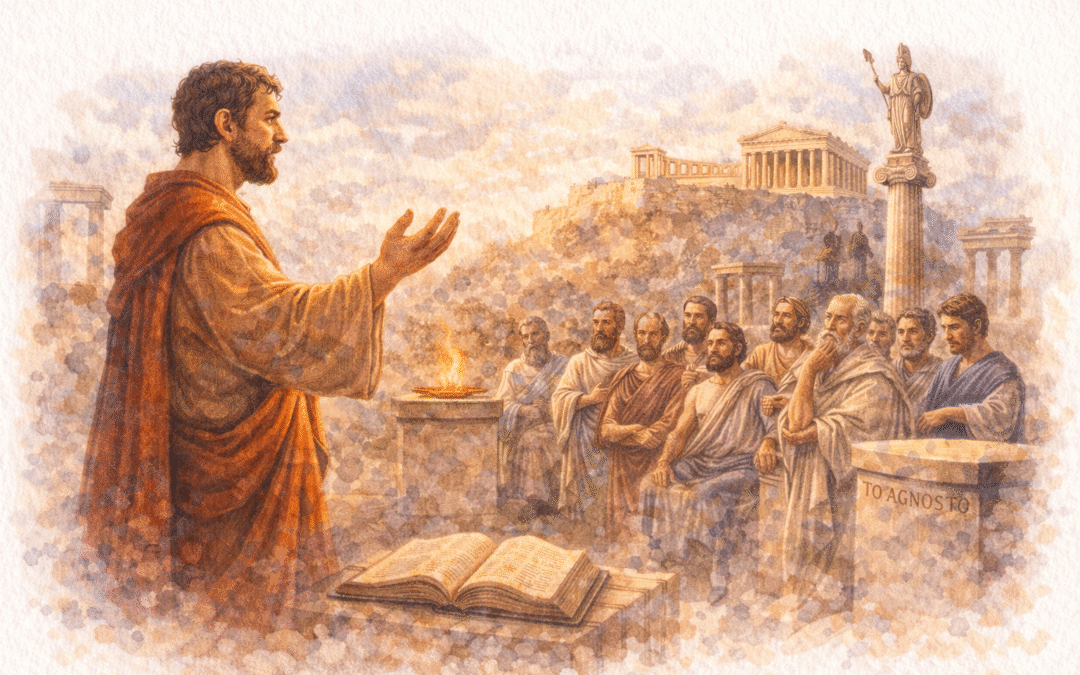
Picture the scene. The year is approximately 50 A.D. A Jewish man—short, balding, possibly with eyesight problems and fresh scars from a beating on his back—disembarks from a ship at the port of Piraeus. He walks about 5 miles until he enters the most famous city of the ancient world: Athens.
If Jerusalem was the capital of religion and Rome the capital of power, Athens was the capital of the intellect. It was the city of Socrates, Plato, and Aristotle. It was the cradle of democracy, logic, art, and beauty. For an educated man like Paul (who spoke fluent Greek and knew the poets), entering Athens must have been an overwhelming experience. He was walking the same streets where Western Philosophy was born. He saw the Parthenon in all its original glory, with its white marble statues gleaming under the Mediterranean sun, painted in vivid colors and adorned with gold.
But Acts 17 reveals something shocking. Paul didn’t act like a dazzled tourist. He didn’t take time to “appreciate the art” or take mental selfies at historical monuments. The text says that, as he walked through the city, something violent happened inside him.
Today, in the fifth episode of our series on the life of Paul, we are going to study the “Sermon on the Areopagus” (Mars Hill). We will discover how the Gospel interacts with culture without selling out to it. We will learn how to preach Jesus to people who don’t believe in the Bible. We will see what happens when the “Foolishness of the Cross” collides head-on with the “Wisdom of the Greeks.”
I. The Diagnosis: The City of Idols and Paul’s “Paroxysm”
Paul was in Athens alone, waiting for Silas and Timothy to arrive from Macedonia. He had free time. But what he saw stole his peace.
“While Paul was waiting for them in Athens, he was greatly distressed to see that the city was full of idols.” (Acts 17:16)
The Greek word Luke uses for “greatly distressed” (or provoked) is Paroxuneto. It is where our medical word “Paroxysm” comes from (a sudden attack, a convulsion, a high fever). Paul didn’t just feel a “religious annoyance.” He felt an attack of physical and spiritual anguish. He had a “paroxysm” in his soul. Why? Because where the world saw “Art,” “Culture,” and “History,” Paul saw Death.
Petronius, a Roman writer of the time, ironically said that “in Athens it is easier to find a god than a man.” There were about 30,000 public statues in the city. There were altars on every corner. For a monotheistic Jew, raised on the strict law of “You shall not make for yourself an image in the form of anything,” this was a nightmare. But, unlike religious Jews who would isolate themselves in disgust, or modern Christians who would merely criticize the culture from afar, Paul did something extraordinary: he went into the midst of them.
He went to the Synagogue (to speak with the religious) and he went to the Agora (the marketplace, the center of public life) to speak with anyone who happened to be there. Paul didn’t hide in the “Gospel bubble.” He took the Gospel to the marketplace, to the center of public debate.
II. The Philosophical Clash: Epicureans and Stoics
In the square, Paul didn’t just meet beggars or merchants; he met the intellectual elite. Acts 17:18 says he debated with Epicureans and Stoics. This is fascinating because these two philosophical schools represent, even today, the two greatest secular alternatives to the Gospel.
- The Epicureans (The God of Pleasure): They were the materialists of the time. Followers of Epicurus. They believed that if gods existed, they were far away and didn’t care about humans. They didn’t believe in a final judgment. Their motto was: “The pursuit of happiness and the absence of pain is the meaning of life.” They are the grandfathers of modern Hedonism and secularism. The Epicurean of today is the one who says: “Life is short, let’s enjoy, eat, drink, and travel, because when you die, it’s all over.” (YOLO).
- The Stoics (The God of Duty): They were pantheists. Followers of Zeno. They believed God was the “soul of the world” (an impersonal force). They valued reason, duty, honor, and the acceptance of fate. They were proud of their moral self-sufficiency. They are the grandfathers of moralistic Humanism and self-help. The Stoic of today is the one who says: “I don’t need religion, I have my conscience, I’m a good person, I endure suffering with my head held high.”
Paul was surrounded: on one side, those who lived for pleasure (sensual); on the other, those who lived for pride (moral). Both looked at Paul and said: “What is this babbler trying to say?” (The Greek word is Spermologos — a bird that picks up seeds from the ground; a slang term for a “picker of scraps,” a pseudo-intellectual).
They took Paul to the Areopagus (Mars Hill). The Areopagus wasn’t just a geographic location; it was the Supreme Council of Athens. It was the court that judged new religions and philosophy. It was the “Harvard University” of the ancient world. They said: “May we know what this new teaching is that you are presenting?”
III. The Strategy of Overflow: The Unknown God
Here begins Paul’s genius. If Paul were in a synagogue, he would start by quoting Moses and the Prophets (as he did in Acts 13). But he was talking to pagans who didn’t know the Bible and didn’t respect Moses. If he said “The Bible says…”, they would laugh.
So, Paul doesn’t start with Scripture; he starts with Culture. This is what we call “Point of Contact Apologetics.”
“People of Athens! I see that in every way you are very religious. For as I walked around and looked carefully at your objects of worship, I even found an altar with this inscription: TO AN UNKNOWN GOD. So you are ignorant of the very thing you worship—and this is what I am going to proclaim to you.” (Acts 17:22-23)
This is brilliant. Paul doesn’t come in kicking down the door; he comes in praising their search (however misguided). He finds a strange altar in the city, dedicated to the Agnostos Theos (Unknown God). The History behind the Altar: It is told that centuries earlier (circa 600 B.C.), there was a plague in Athens. The Athenians sacrificed to all the known gods (Zeus, Hermes, Athena, etc.), but the plague didn’t stop. A Cretan poet named Epimenides suggested: “Perhaps there is a God we don’t know who is offended because we are ignoring Him.” They released sheep on the Areopagus and, where they stopped, they built an altar with no name: “To the Unknown God.” The plague stopped.
Paul takes this cultural story and says: “You have a hole in your theology. You admit that there is something Greek reason hasn’t reached. You admit there is a God beyond the pantheon. Well then, I have come to introduce the Name of that God.”
Lesson in Evangelism: Paul uses their culture to subvert their culture. He doesn’t become worldly, but he understands the world in order to translate heaven.
IV. The Sermon: 4 Strikes Against the Greek Worldview
Now, before the intellectual elite, Paul delivers a short but theoretically dense speech. He attacks the pillars of Greek philosophy without quoting a single Bible verse (although the speech is pure biblical theology).
1. God is the Creator, not the “Created” (vs. Temples)
“The God who made the world and everything in it is the Lord of heaven and earth and does not live in temples built by human hands.” (v. 24)
Imagine Paul saying this while pointing to the Parthenon, the most magnificent temple on Earth, which was right above them on the Acropolis. He was saying: “God is too big to fit in that marble box you built.” This attacked Athenian pride (we build houses for the gods) and the materialist error (God is not matter).
2. God is the Provider, not the “Needy” (vs. Rituals)
“And he is not served by human hands, as if he needed anything…” (v. 25)
The Greeks (and all pagan religions) believed that the gods needed to be “fed” with sacrifices. If you gave food to the god, the god gave you rain. It was a trade. Paul says: “You got it all wrong. God isn’t hungry. God doesn’t need you. You need Him. He is the one who gives life, breath, and everything else.” This inverts religious logic. Religion is man doing things for God. The Gospel is God doing everything for man.
3. God is the Ruler, not the “Accident” (vs. Nationalism)
“From one man he made all the nations… and he marked out their appointed times in history and the boundaries of their lands.” (v. 26)
The Athenians believed they were a superior race, that they sprang from the soil of Attica (autochthonous). They despised the “barbarians.” Paul says: “No. We all came from one man (Adam). We are one family. And it was God who drew the map of the nations.” He attacks their racism and nationalist pride.
4. God is Father, not a “Distant Force” (vs. Pantheism)
Here Paul makes his boldest move. He quotes their poets.
“‘For in him we live and move and have our being.’ As some of your own poets have said, ‘We are his offspring.'” (v. 28)
Paul quotes Epimenides and Aratus (pagan poets). He isn’t validating all the work of these poets, but he is saying: “Even your poets had a glimpse of the truth. If we are ‘God’s offspring,’ as you say, then God cannot be a statue of gold or silver. A living son cannot come from a dead stone father.” With relentless logic, Paul shows that idolatry is an insult to human intelligence itself.
V. The Climax and the Scandal: The Resurrection
Up to this point, the philosophers were listening with curiosity. Paul was talking about a “Supreme God,” which sounded philosophically acceptable to philosophical monotheists. But then, Paul pulls a “U-turn.” He stops talking philosophy and starts talking Judgment and Christ.
“In the past God overlooked such ignorance, but now he commands all people everywhere to repent. For he has set a day when he will judge the world with justice by the man he has appointed. He has given proof of this to everyone by raising him from the dead.” (v. 30-31)
Here the atmosphere changed. By speaking of “Resurrection of the dead” (Anastasis), Paul violated the central dogma of Greek philosophy. For the Greeks (Plato), the body was an evil prison. Salvation was the soul escaping the body forever. The idea that a God would resurrect a body to live eternally was disgusting and absurd to them. It was the “scandal.”
Paul knew this. He could have ended with a motivational message about “knowing the Unknown God.” But Paul never negotiates the Gospel to win applause. He dropped the bomb: Repentance (you are wrong) and Resurrection (Jesus is alive and is the Judge).
VI. The Result: Three Reactions
What happens when we preach the naked truth to the cultural elite? What happened on the Areopagus happens. There were three reactions (v. 32-34):
- Mockery (The Scoffers): “When they heard about the resurrection of the dead, some of them sneered.” For many intellectuals, the Gospel will always be foolishness. Intellectual pride is the hardest barrier to break. They laughed at Paul. They called him crazy.
- Procrastination (The Curious): “But others said, ‘We want to hear you again on this subject.'” These are the polite ones who don’t want to commit. They found it interesting, but not enough to change their lives today. It is the most dangerous reaction: leaving it for later.
- Conversion (The Elect): “Some of the people became followers of Paul and believed. Among them was Dionysius, a member of the Areopagus, also a woman named Damaris…”
Many say Paul failed in Athens because he didn’t found a large church there (like in Corinth or Ephesus). I disagree. Paul caught a “big fish.” Dionysius the Areopagite. Converting a member of the Supreme Court of Athens is no small feat. Dionysius was one of the judges who controlled religion and philosophy. Historical tradition (Eusebius of Caesarea) says Dionysius became the first bishop of Athens and died as a martyr. And Damaris? Probably a high-society woman or an intellectual (hetaera), as common women did not frequent the Areopagus.
The Gospel doesn’t need to convince the crowd; it only needs to reach those whose hearts the Holy Spirit has opened.
VII. The Legacy: How to “Overflow” Today?
What does the Athens episode teach us for the 21st century? We live in a new Athens. Our culture is idolatrous (money, sex, fame), pluralistic (“all truths are valid”), and skeptical.
1. Don’t be afraid of Culture. Paul wasn’t afraid to read their poets. He wasn’t afraid to enter their university. Many Christians today are afraid of “getting contaminated” if they read philosophy or science. Paul teaches us that all truth is God’s truth. We can use art, movies, and literature to build bridges for the Gospel. Don’t isolate; overflow.
2. Find the “Altar to the Unknown God.” In every human heart, even in the most convinced atheist, there is an “empty altar.” There is a longing for meaning, for justice, for eternal love. Our job isn’t to arrive screaming that they are going to hell; it is to arrive showing that what they are desperately seeking in the wrong place (sex, career, politics) can only be found in the Person of Christ. Identify the culture’s idol and show how Jesus is the true answer to that false desire.
3. Don’t negotiate the Cross and the Resurrection. We can be cultural, we can be smart, we can quote movies and series. But in the end, the “overflow” has to lead to the Cross. If our preaching doesn’t speak of sin, repentance, and Jesus’ victory over death, it isn’t Gospel; it’s just a philosophical lecture. We must have Paul’s courage to be called “fools” for the love of Christ.
4. Success is faithfulness. Paul left Athens and went to Corinth. He didn’t see a mass revival in Athens. He was mocked. He left apparently “defeated.” But the seed remained. Dionysius remained. Damaris remained. Don’t measure your success by applause, but by faithfulness to the message. You plant, another waters, but God gives the growth.
Conclusion: The God Who Let Himself Be Known
Athens prided itself on knowing everything, but it was ignorant about the only thing that mattered. Jerusalem prided itself on having the Law, but rejected the Author of the Law. Paul was the bridge man. The man who overflowed.
Today, we are called to be that overflow. Don’t look at the city with hate; look with Paul’s “paroxysm”—a mixture of pain for idolatry and love for lost souls. Study. Read. Understand your times. But above all, know the Unknown God. Because, for us, He is no longer unknown. He has a Name. He has a Face. And He has scars on His hands that prove His love for philosophers and the ignorant, Greeks and Jews.
His name is Jesus. And in Him, we truly live, move, and have our being.
“For the foolishness of God is wiser than human wisdom, and the weakness of God is stronger than human strength.” — 1 Corinthians 1:25
Postagens/Posts/Publicaciones
- “Is It God or Is It Just My Head?” The Ultimate Guide to Stop Guessing and Start Discerning
- “Show Me Your Glory”: The Mystery of the Cleft of the Rock and the Safe Place in Jesus
- Anxiety and Faith: Is it a sin to take medication or go to therapy? What the Bible really says
- Celestial Breaking News: “New Year” Doesn’t Exist in the Bible? A Deep Investigation into the Theology of New Beginnings
- Celestial Breaking News: The Day Heaven Invaded Earth (The True Story of Christmas You Never Heard)
- Christmas Investigation: Does the Bible Reveal the Exact Day Jesus Was Born? (The Mystery of Tabernacles)
- Church or Cult? The Ultimate Biblical Guide for the New Convert to Find a Safe Spiritual Home
- First Steps with Jesus: A Biblical Guide to Start Your Journey of Faith
- From the Pit to the Palace: When God’s Presence Feels Like Absolute Silence
- I Converted, But I Sinned Again: The Liberating Truth About Your Internal Struggle
- I Find Reading the Bible and Praying Boring: How to Overcome Spiritual Boredom and Build Consistency
- Real Life #1: “How to Share Jesus with My Family Without Starting World War III” — The Ultimate Guide to Home Evangelism
- Real Life #2: “Do I Really Need to Get Baptized? What Really Happens in the Water” — The Ultimate Guide to the Public Wedding with Christ
- Real Life #3: “Did God Call Me? How to Discover My Purpose Without Becoming a Pastor” — Ending the Sacred-Secular Divide
- Real Life #4: “Christian Dating vs. Hookup Culture: The Survival Manual for Singles” — Purity, Purpose, and the Physics of Being Unequally Yoked
- Real Life #5: “Tithes and Offerings: Is God Broke or Am I Greedy?” — Money as a Spiritual Thermometer
- Silence in Chaos: Why Having Faith Doesn’t Make You Immune to Anxiety (And How to Find Real Peace)
- Silence is Not Absence: A Deep Guide to Resetting Your Frequency and Finding the Overflow of Purpose
- Spiritual Detox #1: “I Accepted Jesus, Now My Problems Will End” — The Big Lie and the True Promise
- Spiritual Detox #2: “Do I Have to Cut Off Non-Christian Friends?” — The Definitive Guide to the “Holy Bubble”
- Spiritual Detox #3: “Christians Don’t Get Depressed?” — Breaking the Mental Health Taboo in the Church
- Spiritual Detox #4: “Can the Devil Read My Thoughts?” — The End of Paranoia and True Spiritual Authority
- Spiritual Detox #5: “I Don’t Feel God, So He’s Not Listening” — The Danger of Goosebump-Based Faith
- Spiritual Detox #6: “If I Sin, Does God Walk Away and Stop Loving Me?” — The Survival Guide for the “Spiritual Hangover”
- Spiritual Detox #7: “Do I Have to Become a Boring Christian?” — The End of the ‘Do’s and Don’ts’ List and True Holiness
- Start Here: 7 Days to Hear God (Reading John)
- The Anatomy of a Heart: Why Did God Love Such an Imperfect Man So Much?
- The Art of Abiding: Prayer, Discipleship, and the Secret of Consistency
- The Crimson Mystery: The Theology, Legality, and Power of “Pleading the Blood”
- The Eternity Code: Forensic Evidence That the Bible Is the Word of God
- The Final Metanoia: What It Really Means to Have the Mind of Christ
- The Great Discovery of December 31st: The End of Waiting (The Kingdom is Now)
- The Great Plan: The Architecture of Rescue (When the Fall Meets Grace)
- The Great Plan: Understanding the “Exchange” That Changes Everything
- The Incomparable #1: “The Terrorist of Tarsus: How God Turns His Worst Enemy Into His Greatest General”
- The Incomparable #10: The Last Breath — The Death of the Servant vs. The Death of the Atheist (Final Special)
- The Incomparable #2: “The Arabian Desert: Why Does God ‘Hide’ Those He Plans to Use?” — The Secret Power of Anonymity
- The Incomparable #3: The Fight with Barnabas and the Cost of Leadership
- The Incomparable #4: When Heaven Says “No” (The Frequency of the Spirit)
- The Incomparable #5: The Overflow — When the Gospel Faces Culture (Paul in Athens)
- The Incomparable #6: Silence in Chaos — The Theology of the Shipwreck (Paul in Acts 27)
- The Iron Mask: Why We Feel Like a Fraud and How to Cure Spiritual Imposter Syndrome
- The Logic of Blood: Why was Jesus’ death the only solution?
- The Mirror: The Death of the Slave, The Birth of the Son
- The Orphan Syndrome: Why Do You Keep Acting Like a Slave When You Already Have the House Keys?
- The Prince, The Shepherd, and The Deliverer: When the Desert Is the Only School
- The Prison of Resentment: How to forgive someone who never said “I’m sorry”
- The School of Prayer: How to Learn to Speak the Language of Heaven
- The Sound of Silence: What God Was Doing When He Stopped Speaking
- The Upside-Down Kingdom: Why Jesus’ Logic Offends Our Human Logic
- Tongues of Fire or Strange Fire? The Gift of Tongues, Paul, and the Ghost of Montanism
- When Heaven is Silent: A Survival Guide for the “Dark Night of the Soul”