


Series: The Incomparable (Episode 6)
Scripture Base: Acts 27:1-44
Estimated Reading Time: 20 minutes
The Christian life is not a vacation cruise; often, it is a cargo ship facing a hurricane. Many preachers sell the idea that if Jesus is in the boat, the storm will not come. But the Bible shows the opposite: often, the storm comes exactly because we are on the route of God’s will.
It is the year 59 A.D. The Apostle Paul, now an elderly prisoner, is being taken to Rome to be judged by Caesar. He is not the captain of the ship. He is not the owner of the cargo. He is just a chained prisoner, a piece of human cargo insignificant in the eyes of the Roman Empire. But when the winds blow and the human structure collapses, hierarchies are reversed. The captain panics, the shipowner despairs, the soldiers tremble. And the only man left standing is the prisoner.
Acts chapter 27 is a narrative masterpiece written by Luke (who was on board). He describes with nautical precision the terror of 14 days of total darkness in the Mediterranean Sea. Today, we are going to board that boat. We are going to smell the salt and feel the nausea of fear. And we are going to learn how to maintain mental and spiritual sanity when everything around us is sinking.
I. The Anatomy of a Bad Decision: Why Do We Enter the Storm?
Before the ship broke, there was a decision. Many of the storms we face in life are not “attacks from the devil” nor “mysterious trials from God”; they are simply consequences of decisions made against wisdom.
In Acts 27:9-12, we see the scenario. The ship was in a harbor called Fair Havens. Winter was coming. Sailing was dangerous. Paul, who had already been shipwrecked three times before (2 Corinthians 11:25), received a spiritual and practical perception:
“Men, I can see that our voyage is going to be disastrous and bring great loss to ship and cargo, and to our own lives also.” (v. 10 – NIV)
Paul warned: “Don’t go. It will go wrong.” But the centurion Julius, who made the decisions, ignored Paul. Why? Luke gives us three reasons that explain why we make wrong decisions that lead us into chaos:
- The Voice of the Specialist (The Pilot): “But the centurion, instead of listening to what Paul said, followed the advice of the pilot and of the owner of the ship” (v. 11). The pilot understood maps, winds, and tides. Paul was a theologian. Logic said: “Listen to science, ignore faith.” But technical knowledge without spiritual discernment is blind. Sometimes the “specialist” (the economist, the doctor, the lawyer) says it’s safe, but the Holy Spirit says “Don’t go.”
- The Voice of the Majority (Democracy): “Since the harbor was unsuitable to winter in, the majority decided that we should sail on…” (v. 12). The majority voted to go. But the majority is rarely aligned with God’s will. The narrow path is lonely; the broad path is popular. Never make life decisions based on “what everyone else is doing.”
- The Voice of Comfort (Convenience): They wanted to reach Phoenix to spend the winter because it was a more comfortable harbor. Fair Havens was safe, but it was boring and uncomfortable. Phoenix had nightlife and protection. They risked their lives (security) in exchange for a more pleasant winter (comfort). How many times do we shipwreck because we can’t stand waiting in the discomfort of “Fair Havens” and run risks to get to the comfort of “Phoenix”?
They weighed anchor. A gentle south wind began to blow (v. 13). They thought: “See? Paul was wrong! The weather is great.” The devil always sends a gentle breeze right after you disobey God, to make you think that disobedience pays off. But the south wind is a trap. Right after it, came the Euroclydon.
II. The Euroclydon: When Hope Disappears
Suddenly, the wind changed. A typhoon (called Euroclydon, or the Northeaster) hit the ship. Luke describes the progression of despair:
- Loss of Control: “The ship was caught by the storm and could not head into the wind; so we gave way to it and were driven along” (v. 15). The first thing a crisis does is take the steering wheel out of your hand. You no longer drive; you are driven.
- Loss of Resources: They began to throw the cargo overboard. Then, they threw the ship’s tackle (v. 18-19). That which was precious (the profit, the cargo) suddenly becomes garbage in the face of death. Crisis readjusts priorities.
- Loss of Light: “When neither sun nor stars appeared for many days…” (v. 20). In those days, they navigated by the stars. Without stars, there is no map. They didn’t know where they were, nor where they were going. This is Depression. It is the darkness of the soul where you lose the reference of the future.
- Loss of Hope: “…we finally gave up all hope of being saved” (v. 20). This is rock bottom. When experienced sailors say “we are going to die,” it’s because it’s over.
Have you been there? In the place where prayer seems not to work, the sky is black, and logic says “there is no way out”? It was at that exact moment, when human hope died, that divine hope stood up.
III. The Intervention: The Voice in the Darkness
In verse 21, Paul stands up in the midst of the chaos. Imagine the scene: the boat rocking violently, waves crashing on the deck, men vomiting and crying. And an old prisoner stands up and asks to speak. He starts with a holy rebuke: “Men, you should have taken my advice…” (v. 21). This isn’t arrogance; it is establishing prophetic authority. He needed to show that his Word was trustworthy.
But right after, he brings the turnaround:
“But now I urge you to keep up your courage, because not one of you will be lost; only the ship will be destroyed.” (v. 22)
How did he know? Did he consult the barometer? No.
“Last night an angel of the God to whom I belong and whom I serve stood beside me and said, ‘Do not be afraid, Paul… God has graciously given you the lives of all who sail with you’.” (v. 23-24)
Here are Paul’s three theological anchors in the storm:
1. Identity (“To whom I belong”)
Paul knew who his Owner was. The ship belonged to a shipowner from Alexandria; the storm belonged to nature; but Paul belonged to God. If you belong to God, the storm needs to ask your Owner for permission to touch you. You are not an orphan in the chaos.
2. Service (“Whom I serve”)
Paul wasn’t just property; he was a servant on a mission. The angel said: “You must stand trial before Caesar”. This is powerful. If God has a purpose for you in Rome, you don’t die in the Mediterranean. Your purpose is your greatest protection. You are immortal until your mission on earth is done. The devil cannot sink a man who has an appointment with God’s destiny.
3. Influence (“Given you the lives”)
God saved 276 pagans because of one believer. This is the theology of intercession. The presence of a man of God in a workplace, a family, or a nation brings a covering of grace over the wicked around him. The world doesn’t know it, but often it doesn’t sink because of the Church inside the boat.
IV. The Four Anchors: What to Do While Daybreak Doesn’t Come
Paul said no one would die, but the storm didn’t stop immediately. They still had to wait 14 nights. In verse 29, it says they “dropped four anchors from the stern and prayed for daylight”.
What do we do when we have the promise, but we are still in the storm? We drop anchors and wait for the day. What are the “Four Spiritual Anchors” that keep the Christian from crashing into the rocks of apostasy during a crisis?
- The Anchor of the Word: “I have faith in God that it will happen just as he told me” (v. 25). It’s not what I see, it’s what was said.
- The Anchor of Fellowship: Paul stopped the sailors from fleeing in the lifeboat (v. 30-32). He said: “Unless these men stay with the ship, you cannot be saved.” In a crisis, the tendency is to isolate oneself (take the boat and run). But salvation is in the body, in unity. “Stay together!”
- The Anchor of Gratitude: In the middle of the hurricane, Paul took bread, gave thanks, and ate (v. 35). This is a “Holy Communion” in the middle of hell. Giving thanks when everything is going wrong is the greatest weapon of spiritual warfare. Gratitude stabilizes the soul. When Paul ate, “they were all encouraged” (v. 36). The calm of a leader is contagious to the team.
- The Anchor of Detachment: They threw the grain into the sea (v. 38). For the ship to reach the beach, it needed to be light. In the final crisis, you discover that you can live without many things you thought were essential. Throw the weight away to save the soul.
V. Shipwreck as Salvation: When the Boat Breaks
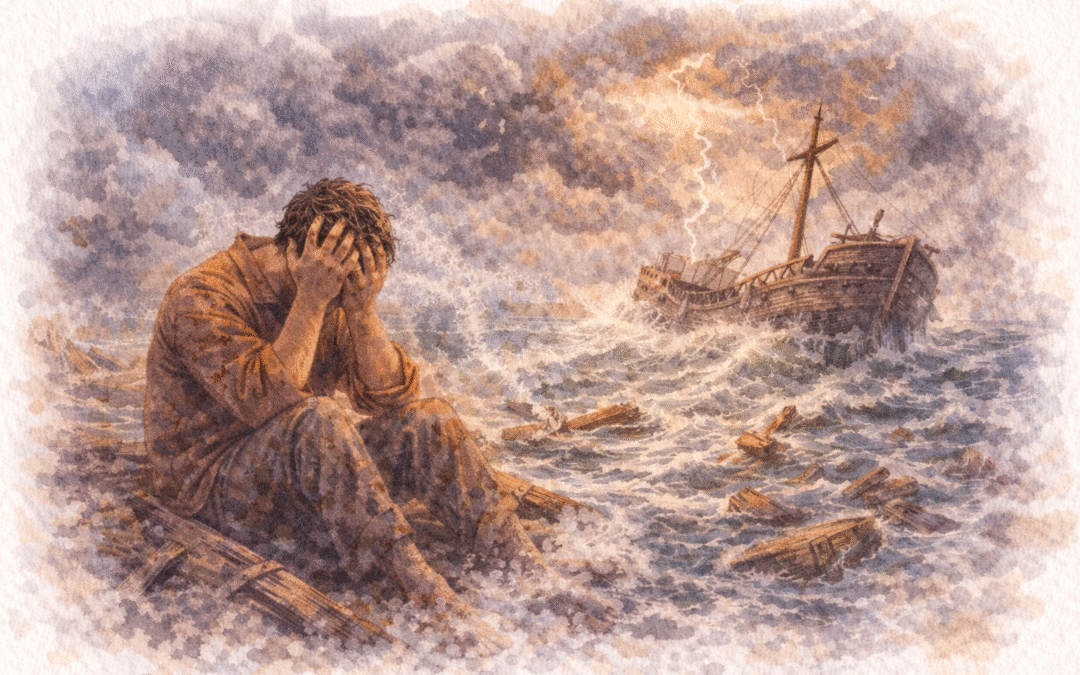
The end of the chapter is paradoxical. The ship ran aground on a sandbar. The stern was broken to pieces by the pounding of the surf. The centurion ordered everyone to swim.
“The rest were to get there on planks or on other pieces of the ship. In this way everyone reached land in safety.” (v. 44)
Wait a minute. Didn’t God promise to save? Yes. But He didn’t promise to save the ship; He promised to save the lives.
Here is the hardest lesson of Acts 27: Sometimes, God breaks the ship to save the passenger. The ship might be your business, your marriage, your ministry, your financial reputation, your career dream. We cling to the structure. We love the ship. And when the ship starts to break, we scream: “God, save the ship!” And God says: “No. The ship will sink. But I will give you a plank. Grab the plank and swim.”
Arriving at the beach wet, exhausted, and clinging to a piece of wood doesn’t look like a “great victory” in the eyes of gospel triumphalism. But, in the theology of the cross, being alive is the victory. Maybe you lost the company (the ship), but you didn’t lose your family or your faith (the life). God is an expert at making us reach our destination (Rome) using means we would never choose (shipwreck planks).
VI. Malta: The Post-Shipwreck and the Snakebite
They arrive at the island of Malta (Chapter 28). They are cold and wet. The natives build a fire. Paul, always serving, goes to gather brushwood to help. And what happens? A venomous snake comes out because of the heat and fastens itself on Paul’s hand.
This seems like a bad joke. The man survived 14 days of a hurricane, survived the shipwreck, swam to the beach… only to be bitten by a snake? The natives thought: “Divine justice has pursued him. He is a murderer. The sea didn’t kill him, but the snake will” (Acts 28:4).
Sometimes, when you think the fight is over, comes the “final bite.” The devil attempts the coup de grâce when you are tired and vulnerable on the beach. But look at Paul’s reaction:
“But Paul shook the snake off into the fire and suffered no ill effects.” (Acts 28:5)
He didn’t scream. He didn’t pray desperately. He didn’t make a drama. He just shook off the snake. Why? Because he who has a promise (“You are going to Rome”) knows he won’t die in Malta because of a reptile. Paul’s immunity wasn’t magic; it was purpose. The poison of gossip, slander, or envy cannot kill the one who has the antidote of God’s will running in their veins.
The result? The healing of Publius’ father and revival on the island of Malta. The shipwreck, which looked like a disaster, was God’s strategy to evangelize an entire island that otherwise would never hear the Gospel. Paul’s “accident” was God’s “agenda.”
VII. Practical Application: How to Lead in Your Storm
You might be reading this in the middle of your own Euroclydon. The medical diagnosis was bad. The layoff came. The child left home. Depression hit. The sun and stars disappeared. What to do?
1. Take the Spiritual Helm: The world around you may be in panic, but you have the Holy Spirit. Don’t join the chorus of despair. Stand up like Paul. Be the voice that says: “Take courage.” Your family needs to see that you have a connection with a God who is above the storm.
2. Stop Listening to the “Majority”: If the majority says “it’s the end,” stop listening to the majority. Go back to what the Angel of the Lord told you in the dark. Faith comes by hearing the Word of God, not CNN news.
3. Eat in the Midst of Chaos: Don’t go on a spiritual hunger strike. If the crisis is big, your feeding on the Word must be bigger. Break bread. Celebrate the Lord’s Supper. Give thanks. Strengthen your body and soul, because you will need energy to swim.
4. Accept the “Planks”: If God allows the ship (the structure) to break, don’t collapse. Don’t worship the ship. If you have to start over from scratch, clinging to a plank, start over. The God who took you to Fair Havens is the same one who will meet you in Malta and take you to Rome.
5. Shake Off the Snake: If, after everything, a vile and venomous attack still comes, don’t let it enter your blood. Shake it off into the fire. Don’t waste time arguing with the snake. You have a destiny to fulfill.
Conclusion: The God of the Storm
God’s silence during the 14 days without sun did not mean absence. God was as present in the dark as He was in the light. He was working on the sailors’ endurance, on Paul’s faith, and on the salvation of Malta.
If your ship is breaking today, remember: Captain Jesus has never lost a passenger. You might arrive wet. You might arrive without luggage. But you will arrive.
Rome awaits you. Shake off the snake, dry your clothes, and keep walking.
“We are hard pressed on every side, but not crushed; perplexed, but not in despair; persecuted, but not abandoned; struck down, but not destroyed.” — 2 Corinthians 4:8-9
Postagens/Posts/Publicaciones
- “Is It God or Is It Just My Head?” The Ultimate Guide to Stop Guessing and Start Discerning
- “Show Me Your Glory”: The Mystery of the Cleft of the Rock and the Safe Place in Jesus
- Anxiety and Faith: Is it a sin to take medication or go to therapy? What the Bible really says
- Celestial Breaking News: “New Year” Doesn’t Exist in the Bible? A Deep Investigation into the Theology of New Beginnings
- Celestial Breaking News: The Day Heaven Invaded Earth (The True Story of Christmas You Never Heard)
- Christmas Investigation: Does the Bible Reveal the Exact Day Jesus Was Born? (The Mystery of Tabernacles)
- Church or Cult? The Ultimate Biblical Guide for the New Convert to Find a Safe Spiritual Home
- First Steps with Jesus: A Biblical Guide to Start Your Journey of Faith
- From the Pit to the Palace: When God’s Presence Feels Like Absolute Silence
- I Converted, But I Sinned Again: The Liberating Truth About Your Internal Struggle
- I Find Reading the Bible and Praying Boring: How to Overcome Spiritual Boredom and Build Consistency
- Real Life #1: “How to Share Jesus with My Family Without Starting World War III” — The Ultimate Guide to Home Evangelism
- Real Life #2: “Do I Really Need to Get Baptized? What Really Happens in the Water” — The Ultimate Guide to the Public Wedding with Christ
- Real Life #3: “Did God Call Me? How to Discover My Purpose Without Becoming a Pastor” — Ending the Sacred-Secular Divide
- Real Life #4: “Christian Dating vs. Hookup Culture: The Survival Manual for Singles” — Purity, Purpose, and the Physics of Being Unequally Yoked
- Real Life #5: “Tithes and Offerings: Is God Broke or Am I Greedy?” — Money as a Spiritual Thermometer
- Silence in Chaos: Why Having Faith Doesn’t Make You Immune to Anxiety (And How to Find Real Peace)
- Silence is Not Absence: A Deep Guide to Resetting Your Frequency and Finding the Overflow of Purpose
- Spiritual Detox #1: “I Accepted Jesus, Now My Problems Will End” — The Big Lie and the True Promise
- Spiritual Detox #2: “Do I Have to Cut Off Non-Christian Friends?” — The Definitive Guide to the “Holy Bubble”
- Spiritual Detox #3: “Christians Don’t Get Depressed?” — Breaking the Mental Health Taboo in the Church
- Spiritual Detox #4: “Can the Devil Read My Thoughts?” — The End of Paranoia and True Spiritual Authority
- Spiritual Detox #5: “I Don’t Feel God, So He’s Not Listening” — The Danger of Goosebump-Based Faith
- Spiritual Detox #6: “If I Sin, Does God Walk Away and Stop Loving Me?” — The Survival Guide for the “Spiritual Hangover”
- Spiritual Detox #7: “Do I Have to Become a Boring Christian?” — The End of the ‘Do’s and Don’ts’ List and True Holiness
- Start Here: 7 Days to Hear God (Reading John)
- The Anatomy of a Heart: Why Did God Love Such an Imperfect Man So Much?
- The Art of Abiding: Prayer, Discipleship, and the Secret of Consistency
- The Crimson Mystery: The Theology, Legality, and Power of “Pleading the Blood”
- The Eternity Code: Forensic Evidence That the Bible Is the Word of God
- The Final Metanoia: What It Really Means to Have the Mind of Christ
- The Great Discovery of December 31st: The End of Waiting (The Kingdom is Now)
- The Great Plan: The Architecture of Rescue (When the Fall Meets Grace)
- The Great Plan: Understanding the “Exchange” That Changes Everything
- The Incomparable #1: “The Terrorist of Tarsus: How God Turns His Worst Enemy Into His Greatest General”
- The Incomparable #10: The Last Breath — The Death of the Servant vs. The Death of the Atheist (Final Special)
- The Incomparable #2: “The Arabian Desert: Why Does God ‘Hide’ Those He Plans to Use?” — The Secret Power of Anonymity
- The Incomparable #3: The Fight with Barnabas and the Cost of Leadership
- The Incomparable #4: When Heaven Says “No” (The Frequency of the Spirit)
- The Incomparable #5: The Overflow — When the Gospel Faces Culture (Paul in Athens)
- The Incomparable #6: Silence in Chaos — The Theology of the Shipwreck (Paul in Acts 27)
- The Iron Mask: Why We Feel Like a Fraud and How to Cure Spiritual Imposter Syndrome
- The Logic of Blood: Why was Jesus’ death the only solution?
- The Mirror: The Death of the Slave, The Birth of the Son
- The Orphan Syndrome: Why Do You Keep Acting Like a Slave When You Already Have the House Keys?
- The Prince, The Shepherd, and The Deliverer: When the Desert Is the Only School
- The Prison of Resentment: How to forgive someone who never said “I’m sorry”
- The School of Prayer: How to Learn to Speak the Language of Heaven
- The Sound of Silence: What God Was Doing When He Stopped Speaking
- The Upside-Down Kingdom: Why Jesus’ Logic Offends Our Human Logic
- Tongues of Fire or Strange Fire? The Gift of Tongues, Paul, and the Ghost of Montanism
- When Heaven is Silent: A Survival Guide for the “Dark Night of the Soul”