


Phase 1: The Foundations | Study
The street was called Straight, but his world was crooked.
Saul of Tarsus sat on the cold stone floor of Judas’ house in Damascus. He hadn’t eaten for three days. He hadn’t touched water. But the physical thirst was irrelevant compared to the drought devastating his soul.
He was blind. That light on the road hadn’t just scorched his retinas; it had incinerated his identity.
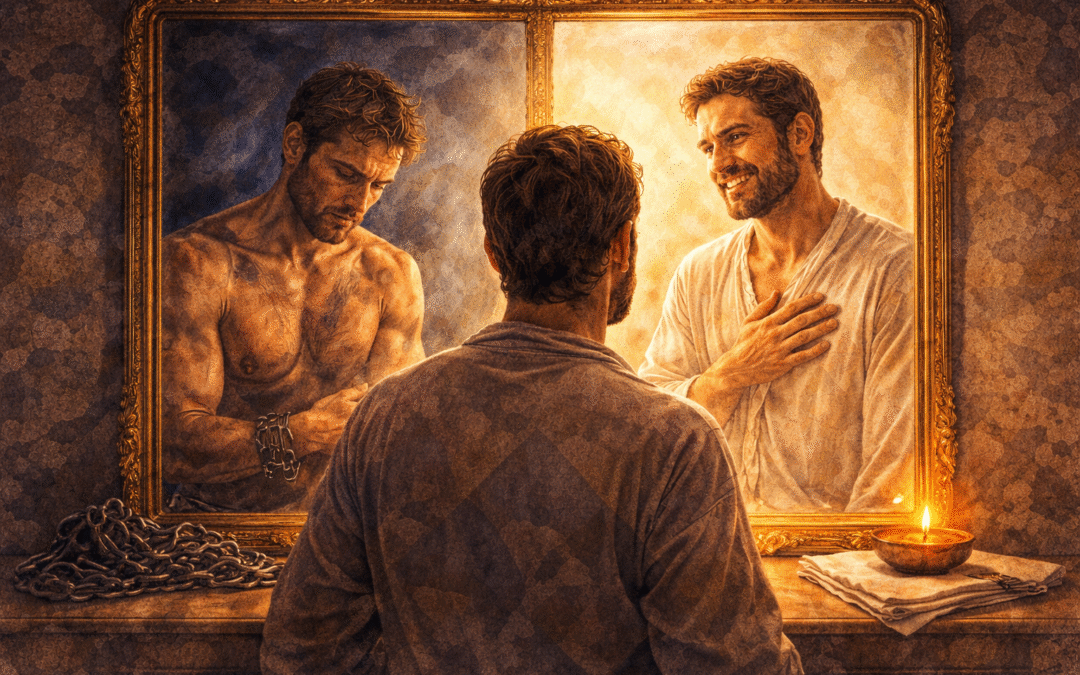
For his entire life, Saul had looked in the mirror and seen a giant. He saw a “Hebrew of Hebrews,” a blameless Pharisee, a guardian of morality, a man defending God with his own sword. Saul’s mirror reflected his achievements, his pedigree, his zeal, and his moral perfection.
But on the road to Damascus, when the voice sounding like rushing waters asked, “Why do you persecute me?”, Saul’s mirror shattered.
In the darkness of those three days, Saul was forced to look inward without the filter of his religious accolades. And what he saw terrified him. He didn’t see a beloved son of God. He saw a slave. An angry, tired, murderous slave trying to buy Heaven’s love with the currency of human effort.
It was there, in the dark, that Saul died so Paul could be born. It was there that the identity of Slave was exchanged for the identity of Son.
Today, we will use this man’s life to understand the most fundamental battle of human existence: Who are you when the lights go out and the performance ends?
I. The Anatomy of the Slave (The Mirror of Performance)
Before becoming the apostle of Grace, Saul was the slave of the Law. It is crucial to understand that “slave,” in this spiritual context, does not refer to someone who doesn’t work for God, but to someone whose identity depends on their work.
Saul operated in the merit system. The “Slave Spirit” has very specific characteristics, and perhaps you will recognize yourself in some of them, even if you’ve been attending church for years.
1. The Anxiety of Perfection
The slave lives under the crushing weight of “it is never enough.” For Saul, the Law was not a guide of wisdom; it was an infinite ladder he needed to climb to ensure God wouldn’t reject him. The slave wakes up every day in debt. He owes obedience, he owes holiness, he owes results. His emotional account is always in the red, and he runs all day trying to break even. There is no rest in the slave’s soul, because rest is a prize for those who finish the work, and the work of self-justification never ends.
2. The Zeal that Kills
Why was Saul so violent? Why did he breathe threats and murder against Christians? The spiritual psychology here is fascinating: The slave hates the son’s freedom. When Saul saw Stephen or the other disciples full of joy, peace, and assurance of salvation without having fulfilled all the Pharisaic rigidity, it deeply offended him. “How dare they feel loved by God without having suffered as much as I suffered to obey?” The slave’s religiosity generates bitterness. If you serve God but deep down feel envy of those who “enjoy life” or anger at those who receive grace “too easily,” beware. You might be looking into the slave’s mirror.
3. External Identity
In Philippians 3, Paul lists what used to be his “profit”: circumcised on the eighth day, of the people of Israel, of the tribe of Benjamin, a Pharisee… Notice that these are all badges. The slave doesn’t know who he is on the inside; he only knows what he wears on the outside. Strip away the title, the ministry, the reputation of a “good Christian,” and the slave collapses. He is not a son in the Father’s house; he is an employee in God’s company. And employees can be fired.
II. Breaking the Mirror (The Encounter)
Paul’s conversion wasn’t just a change of religion (from Judaism to Christianity). It was a change of species. He ceased to be a creature that does and became a creature that is.
The decisive moment wasn’t just the light, but the revelation of his own wretchedness. In Romans 7, Paul describes (possibly reflecting on his experience under the Law) the agony: “For what I want to do I do not do, but what I hate I do… What a wretched man I am!”
The slave believes that if he tries harder, he will succeed. The son discovers he cannot, and that is why he needs a Savior.
When Jesus appears to Ananias and commands him to pray for Saul, He says: “This man is my chosen instrument” (or vessel). Notice the language. Not a “hired worker,” but a “vessel.”
- The worker has value for what he produces.
- The vessel has value for what it contains.
In that dark room in Damascus, God was emptying the vessel of all pride, of all the “self-righteousness” Saul considered profit, and turning it into what Paul would later call “dung” (skubalon). It was necessary to clean the vessel of the debris of performance to fill it with the wine of Grace.
III. The Metamorphosis: The Desert of Sonship
Many think Paul fell off his horse and immediately started writing epistles. Not so. Galatians 1 tells us he went to Arabia and later returned to Damascus, a process that took about three years.
What happened in Arabia? It was the deconstruction of the Slave and the construction of the Son.
Imagine Paul, with Torah scrolls in the desert, rereading everything he had memorized since childhood. Only now, he wasn’t reading through the lens of “obligation,” but through the lens of Jesus. He saw that Abraham was not justified because he was good, but because he believed. He saw that David was not loved because he was perfect, but because God’s heart is merciful.
In the desert, the Mirror changed. Paul stopped looking at himself (his performance) and started looking at Christ. And the Bible says that as we contemplate the Lord’s glory, “we are being transformed into his image with ever-increasing glory” (2 Corinthians 3:18).
This is the secret of the mirror: You become what you behold.
- The slave beholds the Law and sees himself as filthy.
- The son beholds the Father and sees himself as loved.
IV. The Anatomy of the Son (The Mirror of Grace)
When Paul re-emerges, he is a transformed man. He writes to the Romans (8:15): “The Spirit you received does not make you slaves, so that you live in fear again; rather, the Spirit you received brought about your adoption to sonship. And by him we cry, ‘Abba, Father’.”
Let’s dissect the mind of this “Son” Paul became.
1. The Security of Inheritance
The slave works for wages. If he fails, he doesn’t get paid. The son works out of gratitude because the inheritance is already his. Paul worked harder than all the other apostles (1 Corinthians 15:10), but the motivation was the opposite. He didn’t work to be accepted; he worked because he had already been accepted. The slave’s fuel is fear. The son’s fuel is love. Fear burns and exhausts (burnout). Love renews and propels.
2. Freedom in Weakness
This is the biggest shift in Paul’s mirror. The old Saul would hide any flaw, as flaws are unacceptable to a perfectionist. The new Paul writes openly: “That is why, for Christ’s sake, I delight in weaknesses… For when I am weak, then I am strong.” The son knows the Father’s love implies no prerequisite of strength. He doesn’t need to maintain a “super-spiritual” pose. He can admit his “thorn in the flesh.” Can you imagine the freedom of no longer having to pretend you are perfect? That is being a son. The son can come home covered in mud, crying, and knows he will be hugged, not fired.
3. Access to Intimacy (Abba)
The word “Abba” is Aramaic for something close to “Daddy” or “Papa.” It is the babbling of a child. The slave has rituals, protocols, and liturgy to approach the Master. The son has access. Paul learned that in the middle of a shipwreck, or chained in a Roman dungeon, he didn’t need to send a formal request to the Throne. He whispered “Abba,” and the God of the Universe was there. Sonship removes the bureaucratic distance between us and Heaven.
V. The Great Test: The Mirror in Prison
How do we know if we have truly made the transition from Slave to Son? The test happens when everything goes wrong.
Put a “Slave” in prison unjustly. What happens? He goes into crisis. “God, I served You! I did everything right! I kept holy! I tithed! Why is this happening to me? This is unfair! I quit!” The slave feels God broke the contract because his mindset is transactional: I give obedience, You give blessings.
Now, look at Paul and Silas in the prison at Philippi. Backs torn by the whip. Feet in stocks. Sewage running along the floor. Midnight. What are they doing? Complaining? Charging God? They are singing hymns.
Why? Because Paul’s identity was not in comfort, nor in the success of his ministry, nor in the fairness of circumstances. His identity was in being a Son. And nothing—neither trouble nor hardship nor persecution nor famine nor nakedness nor danger nor sword—can separate a Son from the love of God.
The slave sings when he gets paid. The son sings because the Father is listening, even in the dark.
VI. Application: Which Mirror Are You Using?
Right now, we need to bring this to the “Sacred Monday” (as we will see later in the project). You, reading this, likely oscillate between these two mirrors.
Many of us are dysfunctional “hybrids.” Theologically, we know we are sons. Emotionally, we live like slaves.
Signs the “Slave Mirror” has returned:
- Defensiveness: When someone criticizes you, do you feel your existence is being attacked? Sons accept correction; slaves defend their reputation at all costs.
- Comparison: Do you look at someone else’s calling and feel inferior or superior? Slaves compete for crumbs of attention. Sons know there is room for everyone at the table.
- Paralyzing Guilt: When you sin, do you run from God or run to God? The slave hides (like Adam) fearing punishment. The son runs to the Father to be cleaned.
- Bargaining Prayer: Do your prayers sound like business negotiations? “Lord, if I do this fast, will You give me that job?” This is market language, not family language.
The Exchange Exercise (The Way of Paul)
How, practically, do we break the slave’s mirror?
1. The Confession of Inefficiency Stop trying to prove you are good. Do as Paul did: consider your “self-righteousness” as loss. Admit: “I cannot sustain this mask.” Freedom begins in surrender.
2. The Contemplation of the Cross The Cross is the document of manumission (freedom). Every time the voice of accusation says “You haven’t done enough,” you point to the Cross and say: “It’s true, I haven’t. But He did. And it is finished.” The slave’s mantra is: Do to Be. The son’s mantra is: It is Done, therefore I Am.
3. Repositioning the Voice You need to learn to hear the right voice. “The Frequency” (our next study) deals with this, but it starts here. The slave’s voice screams: “Work harder!” The Son’s voice whispers: “Come to me, all you who are weary… and I will give you rest.”
Conclusion: The Final Reflection
Tradition says Paul died by beheading in Rome on Nero’s orders. Imagine that final moment. The man who once breathed death now faces death. The executioner raises the sword.
If Paul were still Saul the Pharisee, that would be a moment of absolute terror. “Did I do enough? Did I miss a rule? Is God angry?”
But that was Paul. The Son. He had already written his final words to Timothy: “I have fought the good fight, I have finished the race, I have kept the faith.” He wasn’t talking about winning a game. He was talking about finishing the run and rushing into the Father’s arms.
When the blade came down, Paul didn’t see darkness. The earthly mirror shattered for the last time, and he saw, face to face, the One who loved him and gave Himself for him.
The “Hearing Him” invitation to you today is simple, yet terrifying: Drop the slave’s mirror. Stop polishing your image. Stop trying to impress God. He doesn’t want your performance; He wants your presence. You are not what you do. You are not your worst mistake. You are not your greatest success.
You are who He says you are. And He says: “You are my beloved son, in whom I am well pleased.”
Believe this, and the slavery ends. Life begins.
Postagens/Posts/Publicaciones
- “Is It God or Is It Just My Head?” The Ultimate Guide to Stop Guessing and Start Discerning
- “Show Me Your Glory”: The Mystery of the Cleft of the Rock and the Safe Place in Jesus
- Anxiety and Faith: Is it a sin to take medication or go to therapy? What the Bible really says
- Celestial Breaking News: “New Year” Doesn’t Exist in the Bible? A Deep Investigation into the Theology of New Beginnings
- Celestial Breaking News: The Day Heaven Invaded Earth (The True Story of Christmas You Never Heard)
- Christmas Investigation: Does the Bible Reveal the Exact Day Jesus Was Born? (The Mystery of Tabernacles)
- Church or Cult? The Ultimate Biblical Guide for the New Convert to Find a Safe Spiritual Home
- First Steps with Jesus: A Biblical Guide to Start Your Journey of Faith
- From the Pit to the Palace: When God’s Presence Feels Like Absolute Silence
- I Converted, But I Sinned Again: The Liberating Truth About Your Internal Struggle
- I Find Reading the Bible and Praying Boring: How to Overcome Spiritual Boredom and Build Consistency
- Real Life #1: “How to Share Jesus with My Family Without Starting World War III” — The Ultimate Guide to Home Evangelism
- Real Life #2: “Do I Really Need to Get Baptized? What Really Happens in the Water” — The Ultimate Guide to the Public Wedding with Christ
- Real Life #3: “Did God Call Me? How to Discover My Purpose Without Becoming a Pastor” — Ending the Sacred-Secular Divide
- Real Life #4: “Christian Dating vs. Hookup Culture: The Survival Manual for Singles” — Purity, Purpose, and the Physics of Being Unequally Yoked
- Real Life #5: “Tithes and Offerings: Is God Broke or Am I Greedy?” — Money as a Spiritual Thermometer
- Silence in Chaos: Why Having Faith Doesn’t Make You Immune to Anxiety (And How to Find Real Peace)
- Silence is Not Absence: A Deep Guide to Resetting Your Frequency and Finding the Overflow of Purpose
- Spiritual Detox #1: “I Accepted Jesus, Now My Problems Will End” — The Big Lie and the True Promise
- Spiritual Detox #2: “Do I Have to Cut Off Non-Christian Friends?” — The Definitive Guide to the “Holy Bubble”
- Spiritual Detox #3: “Christians Don’t Get Depressed?” — Breaking the Mental Health Taboo in the Church
- Spiritual Detox #4: “Can the Devil Read My Thoughts?” — The End of Paranoia and True Spiritual Authority
- Spiritual Detox #5: “I Don’t Feel God, So He’s Not Listening” — The Danger of Goosebump-Based Faith
- Spiritual Detox #6: “If I Sin, Does God Walk Away and Stop Loving Me?” — The Survival Guide for the “Spiritual Hangover”
- Spiritual Detox #7: “Do I Have to Become a Boring Christian?” — The End of the ‘Do’s and Don’ts’ List and True Holiness
- Start Here: 7 Days to Hear God (Reading John)
- The Anatomy of a Heart: Why Did God Love Such an Imperfect Man So Much?
- The Art of Abiding: Prayer, Discipleship, and the Secret of Consistency
- The Crimson Mystery: The Theology, Legality, and Power of “Pleading the Blood”
- The Eternity Code: Forensic Evidence That the Bible Is the Word of God
- The Final Metanoia: What It Really Means to Have the Mind of Christ
- The Great Discovery of December 31st: The End of Waiting (The Kingdom is Now)
- The Great Plan: The Architecture of Rescue (When the Fall Meets Grace)
- The Great Plan: Understanding the “Exchange” That Changes Everything
- The Incomparable #1: “The Terrorist of Tarsus: How God Turns His Worst Enemy Into His Greatest General”
- The Incomparable #10: The Last Breath — The Death of the Servant vs. The Death of the Atheist (Final Special)
- The Incomparable #2: “The Arabian Desert: Why Does God ‘Hide’ Those He Plans to Use?” — The Secret Power of Anonymity
- The Incomparable #3: The Fight with Barnabas and the Cost of Leadership
- The Incomparable #4: When Heaven Says “No” (The Frequency of the Spirit)
- The Incomparable #5: The Overflow — When the Gospel Faces Culture (Paul in Athens)
- The Incomparable #6: Silence in Chaos — The Theology of the Shipwreck (Paul in Acts 27)
- The Iron Mask: Why We Feel Like a Fraud and How to Cure Spiritual Imposter Syndrome
- The Logic of Blood: Why was Jesus’ death the only solution?
- The Mirror: The Death of the Slave, The Birth of the Son
- The Orphan Syndrome: Why Do You Keep Acting Like a Slave When You Already Have the House Keys?
- The Prince, The Shepherd, and The Deliverer: When the Desert Is the Only School
- The Prison of Resentment: How to forgive someone who never said “I’m sorry”
- The School of Prayer: How to Learn to Speak the Language of Heaven
- The Sound of Silence: What God Was Doing When He Stopped Speaking
- The Upside-Down Kingdom: Why Jesus’ Logic Offends Our Human Logic
- Tongues of Fire or Strange Fire? The Gift of Tongues, Paul, and the Ghost of Montanism
- When Heaven is Silent: A Survival Guide for the “Dark Night of the Soul”