


Theme: The Intertestamental Period and the Fullness of Time
Scripture Base: Amos 8:11 / Galatians 4:4
Close your Bible at the Old Testament. The last page is the book of the prophet Malachi. Now, open the first page of the New Testament. The Gospel of Matthew. Between these two pages of incredibly thin paper, which you turn in less than a second, lies a historical abyss.
There is a “black hole” of about 400 years. Four centuries. Ten generations. Four hundred years without a prophet. Four hundred years without a “Thus says the Lord.” Four hundred years when the heavens seemed made of bronze and the earth of iron.
Theologians call this the “Intertestamental Period.” The Jewish people called it “The Great Darkness.” Imagine the anguish. The people were used to miracles. They had the memory of the Red Sea, the Manna, Elijah calling down fire, Isaiah seeing God’s throne. And suddenly… nothing. Just the ancient scrolls and the echo of unfulfilled promises.
Many of us are living in a personal intertestamental period. You have a promise (Old Testament), but you haven’t seen the fulfillment yet (New Testament). And in between, there is silence. The question that echoes in the soul is: “Has God forgotten? Has God abandoned the ship?”
Today, we are going to dive into history and theology to discover an overwhelming truth: God’s silence does not mean God’s inactivity. While heaven was quiet, the hands of the Almighty were moving empires, drawing maps, and creating languages to prepare the “Fullness of Time.” God was not late; He was setting the stage for history’s greatest triumphal entry.
I. The Closing of the Curtains: The Final Prophecy
“See, I will send the prophet Elijah to you before that great and dreadful day of the Lord comes…” (Malachi 4:5)
These were the last words. Malachi closes his book with a pending promise and a conditional curse. And then, the Spirit of prophecy ceased. There were no more visions. The Urim and Thummim (used by priests to consult God) stopped working.
The prophet Amos had already foreseen this terrible time:
“The days are coming,’ declares the Sovereign Lord, ‘when I will send a famine through the land—not a famine of food or a thirst for water, but a famine of hearing the words of the Lord. People will stagger from sea to sea and wander from north to east, searching for the word of the Lord, but they will not find it.'” (Amos 8:11-12)
Imagine the spiritual hunger. Israel, who had always been guided by the Voice, now had to be guided only by Memory. Silence has a pedagogical purpose: it reveals what is in the heart. Without the constant voice of the prophets, Israel divided. Some became legalists (Pharisees), others skeptics (Sadducees), and others isolated themselves in the desert (Essenes). Silence tested Israel’s faith as fire tests gold. Who would remain faithful only with what was already written?
II. Backstage of Providence: The Three Layers of Preparation
While Israel mourned the silence, God was working frantically in world geopolitics. For the Gospel to spread rapidly (“go into all the world”), the world needed to change. The Old Testament world was tribal, slow, and divided. The world needed to be globalized before Christ was born.
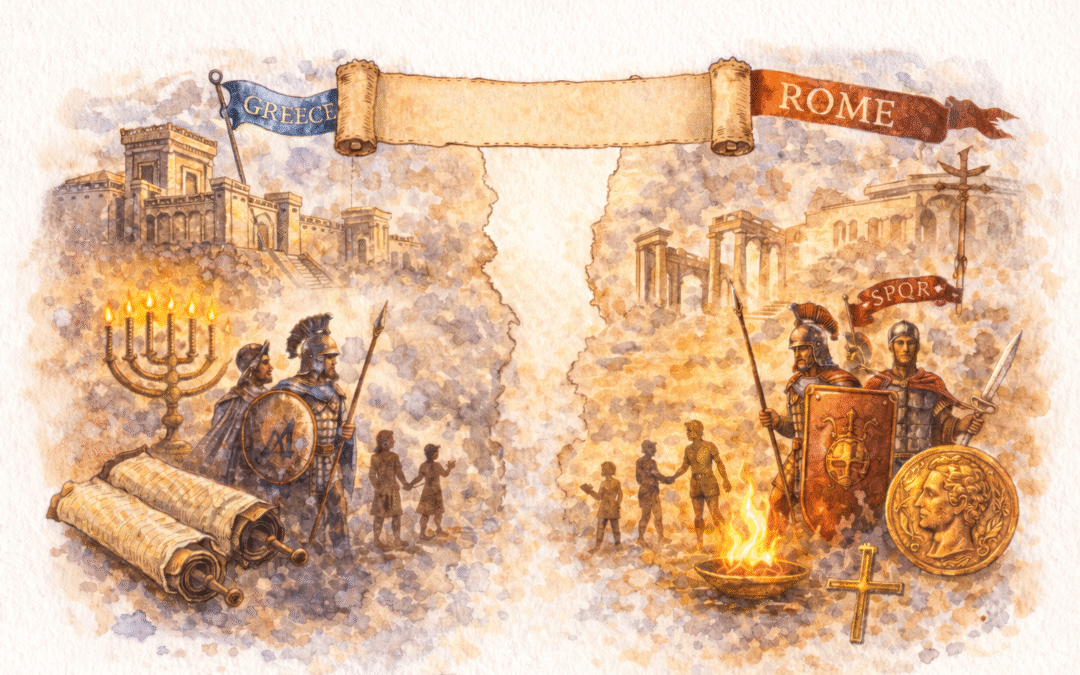
God used three civilizations to prepare Jesus’ cradle. The prophetic silence in Israel coincided with the noise of history building by the Gentiles.
1. The Greek Contribution: One Mind and One Language (Intellect)
During the silence, Alexander the Great emerged. Prophesied by Daniel (as the swift leopard or the goat with a notable horn in Daniel 8), Alexander conquered the known world in record time. But Alexander didn’t just want lands; he wanted to “Hellenize” the world. He imposed Greek culture and language.
Why was this God acting? Imagine if Jesus had been born before Alexander. If the apostles wanted to preach in India, Spain, or Egypt, they would have had to learn dozens of different languages and deal with insurmountable cultural barriers. God allowed Greece to give the world Koine Greek—a universal language. When Paul wrote the Letter to the Romans, he didn’t write in Latin or Hebrew; he wrote in Greek, and the whole educated world understood. The silence in Jerusalem allowed Athens to build antiquity’s “internet”: a common language for the Gospel to run on.
Furthermore, it was during this period (circa 250 B.C.) that the Hebrew Bible was translated into Greek (Septuagint) in Egypt. For the first time, Gentiles could read “In the beginning God created…”. The stage was set.
2. The Roman Contribution: One Road and One Peace (Infrastructure)
After the Greeks, came the Romans. The “terrible beast” of Daniel 7. Rome was brutal, but it was organized. They implemented the Pax Romana (Roman Peace). They ended constant tribal wars and cleared the Mediterranean of pirates. And, most importantly, they built roads. “All roads lead to Rome.”
Why was this God acting? If Jesus had been born before Rome, traveling from Jerusalem to Rome would have taken years and been suicide. Bandits, closed borders, wars. But when Paul traveled, he used paved Roman roads and the protection of Roman law. God used the iron empire to build the “runway” for the missionaries. God’s silence allowed Caesar’s engineers to prepare the way for the beautiful feet of those who bring good news (Isaiah 52:7).
3. The Jewish Contribution: One Longing and One Synagogue (Spirituality)
During the exile and the silence, the Jews lost the Temple (which was destroyed and later rebuilt, but without the Ark of the Covenant). Without a Temple and scattered across the world (Diaspora), they invented the Synagogue. The synagogue was not a place of sacrifice, but of teaching the Word.
Why was this God acting? When Paul arrived in a Gentile city (like Corinth or Ephesus), where did he start preaching? In the local synagogue! The synagogue was the “bridgehead.” God scattered the Jews across the world and had them build Bible study centers in every pagan city. When the Gospel arrived, there was already a base of operations ready in every metropolis of the empire.
III. The Fullness of Time: God’s Clock
“But when the set time had fully come, God sent his Son, born of a woman, born under the law…” (Galatians 4:4)
This expression—Fullness of Time (Pleroma)—is fascinating. It means “when time got pregnant,” “when the cup filled to the brim.” It wasn’t random. Jesus wasn’t born in year 0 (or 4 B.C.) by lottery. He was born in the only moment in human history when:
- There was a universal language to communicate the message (Greek).
- There were safe roads and open borders to travel with the message (Rome).
- There was a desperate messianic expectation due to oppression (Jews).
The 400 years of silence weren’t God taking a nap; they were a gestation. God was aligning the stars, the kings, the laws, and the cultures. Israel’s suffering under successive empires (Babylon, Persia, Greece, Rome, Seleucids) served to crush any hope in human politics. If Jesus had come in the time of David or Solomon, Israel would have been rich and powerful, and perhaps wouldn’t have felt the need for a suffering Savior. But after 400 years of silence and slavery, Israel knew: “We can’t do it alone. We need the Messiah.” Silence generated the hunger necessary for the Bread of Life.
IV. Breaking the Silence: The Cry in the Desert
And then, on an ordinary day, the silence of four centuries was torn apart. Not in the Temple in Jerusalem. Not in Herod’s palace. Not in the Senate of Rome. But in the desert.
A man dressed in camel’s hair, eating locusts, raised his voice. John the Baptist. Luke 3:2 makes a point of giving the political context (Tiberius Caesar, Pontius Pilate, Herod, Annas, Caiaphas) to say: amidst all this human noise, “the word of God came to John son of Zechariah in the wilderness.”
The silence ended. The bridge between Malachi and Matthew was built. John didn’t bring a new philosophy. He brought the fulfillment: “I am the voice of one calling in the wilderness, ‘Make straight the way for the Lord'” (Isaiah 40:3).
And shortly after the Voice, came the Word. “The Word became flesh and made his dwelling among us” (John 1:14). God didn’t just start talking again; God came to be the Message. The God who was silent for 400 years was now crying as a baby in Bethlehem. The “deafening” silence turned into the cry of a child who would split history into Before and After.
V. Application: Your Silence Is Not the End
What do we learn from the “400 Years of Silence” for our real life today?
1. God works the night shift. Just because you don’t see God acting doesn’t mean He is standing still. The seed underground grows in absolute silence and darkness. If God is silent in your life, He may be preparing the “infrastructure” (your character, your circumstances, the people around you) to bear the weight of the glory to come. Do not confuse silence with absence.
2. Waiting prepares the heart. If God answered all our prayers instantly, we would be spoiled children, not mature sons. The intertestamental period served to purify the faith of the faithful remnant (like Simeon and Anna, who waited for the consolation of Israel in the Temple). Waiting rips out our idols and focuses our hope solely on Him.
3. The Fullness of Time is real for you. God has a Kairos for your life. Maybe you are forcing a door that won’t open. Maybe you are frustrated with the delay of marriage, ministry, healing. Remember: God is never late. He arrives when the set is ready. If Jesus had come 50 years earlier, there would be no Pax Romana. If He had come 50 years later, Jerusalem would be destroyed (A.D. 70). Trust God’s clock. Your miracle has a scheduled date on eternity’s agenda.
Conclusion
The 400 years of silence were not an editing error in the history of salvation. They were the necessary preface to Grace. God shut the mouths of the prophets to open the way for the Son.
If today the heavens seem like bronze to you, if your prayers seem to hit the ceiling and bounce back, pick up your Bible. Look at that blank page between the Old and New Testaments. Run your finger over it. And remember: It was in that silence that God prepared the world to receive the Savior. It is in your silence that God is preparing you to receive your purpose.
Silence is not the end of the story. It is just God’s deep breath before saying: “Let there be Light.” Hold on. The Word is on the way.
“I waited patiently for the Lord; he turned to me and heard my cry.” — Psalm 40:1
Postagens/Posts/Publicaciones
- “Is It God or Is It Just My Head?” The Ultimate Guide to Stop Guessing and Start Discerning
- “Show Me Your Glory”: The Mystery of the Cleft of the Rock and the Safe Place in Jesus
- Anxiety and Faith: Is it a sin to take medication or go to therapy? What the Bible really says
- Celestial Breaking News: “New Year” Doesn’t Exist in the Bible? A Deep Investigation into the Theology of New Beginnings
- Celestial Breaking News: The Day Heaven Invaded Earth (The True Story of Christmas You Never Heard)
- Christmas Investigation: Does the Bible Reveal the Exact Day Jesus Was Born? (The Mystery of Tabernacles)
- Church or Cult? The Ultimate Biblical Guide for the New Convert to Find a Safe Spiritual Home
- First Steps with Jesus: A Biblical Guide to Start Your Journey of Faith
- From the Pit to the Palace: When God’s Presence Feels Like Absolute Silence
- I Converted, But I Sinned Again: The Liberating Truth About Your Internal Struggle
- I Find Reading the Bible and Praying Boring: How to Overcome Spiritual Boredom and Build Consistency
- Real Life #1: “How to Share Jesus with My Family Without Starting World War III” — The Ultimate Guide to Home Evangelism
- Real Life #2: “Do I Really Need to Get Baptized? What Really Happens in the Water” — The Ultimate Guide to the Public Wedding with Christ
- Real Life #3: “Did God Call Me? How to Discover My Purpose Without Becoming a Pastor” — Ending the Sacred-Secular Divide
- Real Life #4: “Christian Dating vs. Hookup Culture: The Survival Manual for Singles” — Purity, Purpose, and the Physics of Being Unequally Yoked
- Real Life #5: “Tithes and Offerings: Is God Broke or Am I Greedy?” — Money as a Spiritual Thermometer
- Silence in Chaos: Why Having Faith Doesn’t Make You Immune to Anxiety (And How to Find Real Peace)
- Silence is Not Absence: A Deep Guide to Resetting Your Frequency and Finding the Overflow of Purpose
- Spiritual Detox #1: “I Accepted Jesus, Now My Problems Will End” — The Big Lie and the True Promise
- Spiritual Detox #2: “Do I Have to Cut Off Non-Christian Friends?” — The Definitive Guide to the “Holy Bubble”
- Spiritual Detox #3: “Christians Don’t Get Depressed?” — Breaking the Mental Health Taboo in the Church
- Spiritual Detox #4: “Can the Devil Read My Thoughts?” — The End of Paranoia and True Spiritual Authority
- Spiritual Detox #5: “I Don’t Feel God, So He’s Not Listening” — The Danger of Goosebump-Based Faith
- Spiritual Detox #6: “If I Sin, Does God Walk Away and Stop Loving Me?” — The Survival Guide for the “Spiritual Hangover”
- Spiritual Detox #7: “Do I Have to Become a Boring Christian?” — The End of the ‘Do’s and Don’ts’ List and True Holiness
- Start Here: 7 Days to Hear God (Reading John)
- The Anatomy of a Heart: Why Did God Love Such an Imperfect Man So Much?
- The Art of Abiding: Prayer, Discipleship, and the Secret of Consistency
- The Crimson Mystery: The Theology, Legality, and Power of “Pleading the Blood”
- The Eternity Code: Forensic Evidence That the Bible Is the Word of God
- The Final Metanoia: What It Really Means to Have the Mind of Christ
- The Great Discovery of December 31st: The End of Waiting (The Kingdom is Now)
- The Great Plan: The Architecture of Rescue (When the Fall Meets Grace)
- The Great Plan: Understanding the “Exchange” That Changes Everything
- The Incomparable #1: “The Terrorist of Tarsus: How God Turns His Worst Enemy Into His Greatest General”
- The Incomparable #10: The Last Breath — The Death of the Servant vs. The Death of the Atheist (Final Special)
- The Incomparable #2: “The Arabian Desert: Why Does God ‘Hide’ Those He Plans to Use?” — The Secret Power of Anonymity
- The Incomparable #3: The Fight with Barnabas and the Cost of Leadership
- The Incomparable #4: When Heaven Says “No” (The Frequency of the Spirit)
- The Incomparable #5: The Overflow — When the Gospel Faces Culture (Paul in Athens)
- The Incomparable #6: Silence in Chaos — The Theology of the Shipwreck (Paul in Acts 27)
- The Iron Mask: Why We Feel Like a Fraud and How to Cure Spiritual Imposter Syndrome
- The Logic of Blood: Why was Jesus’ death the only solution?
- The Mirror: The Death of the Slave, The Birth of the Son
- The Orphan Syndrome: Why Do You Keep Acting Like a Slave When You Already Have the House Keys?
- The Prince, The Shepherd, and The Deliverer: When the Desert Is the Only School
- The Prison of Resentment: How to forgive someone who never said “I’m sorry”
- The School of Prayer: How to Learn to Speak the Language of Heaven
- The Sound of Silence: What God Was Doing When He Stopped Speaking
- The Upside-Down Kingdom: Why Jesus’ Logic Offends Our Human Logic
- Tongues of Fire or Strange Fire? The Gift of Tongues, Paul, and the Ghost of Montanism
- When Heaven is Silent: A Survival Guide for the “Dark Night of the Soul”