


Corinth: Sacred Monday (Tentmaker’s Work)
Series: Hearing Him
Biblical Text: 1 Corinthians 9:1-18, Acts 18:1-4
Estimated Reading Time: 15 minutes
Cinematic Introduction (The Hook)
Imagine the scene.
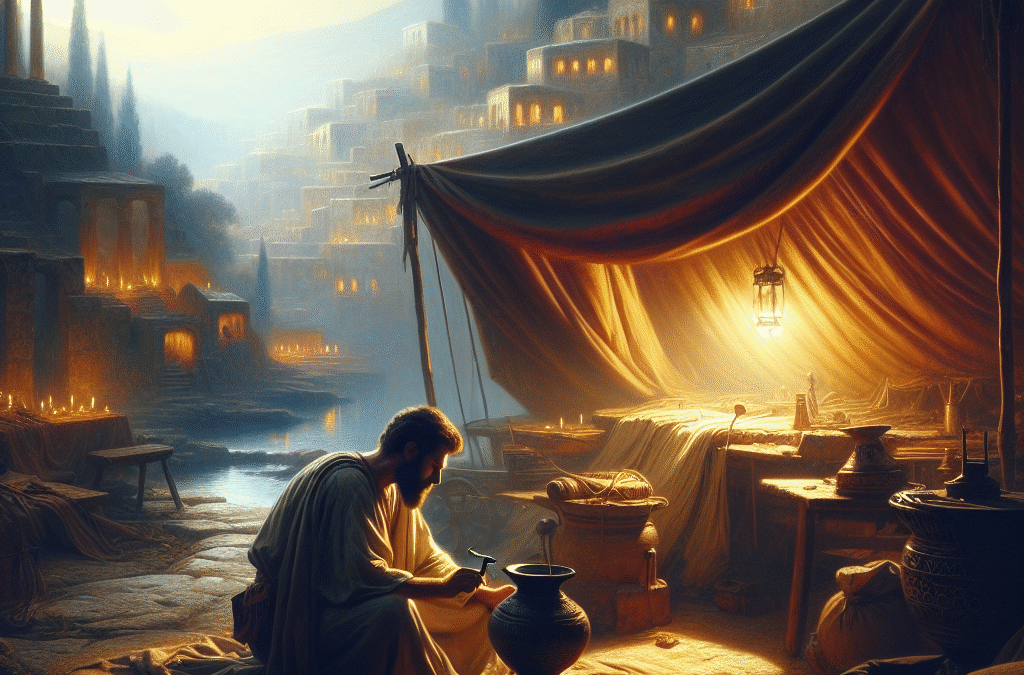
The Mediterranean sun beats down on the limestone streets of Roman Corinth. The air smells of salt from the nearby port, dust from the road, and the acrid scent of leather and dye from the workshops lining the agora. In a small, sunlit shop, a man with worn hands and a focused gaze works. His tools are simple: a needle, thread, sharp knives. He cuts and stitches heavy goat-hair cloth, forming the rough, durable shelters known as tents. Sweat beads on his forehead, mixing with the dust. This is not a philosopher in a shaded colonnade. This is a laborer. Yet, on the Sabbath, this same man stands in the synagogue, his voice ringing with authority as he argues from the Scriptures that the crucified Jesus is the Messiah. The man is Paul, apostle to the Gentiles. And his workshop is his pulpit. His bench is his desk. His labor is his liturgy.
Here lies the tension: the sacred versus the secular. The spiritual versus the material. The pulpit versus the marketplace. We feel it still. We compartmentalize. Sunday worship is holy. Monday work is… necessary. We speak of “full-time ministry” as if other work is part-time in God’s economy. We chase a sense of calling that often feels disconnected from the daily grind of emails, spreadsheets, carpentry, and childcare.
Today, we study the theology of sacred work. We will discover how Paul’s tentmaking in Corinth dismantles our sacred-secular divide and reveals how every honest labor, offered to Christ, becomes an act of worship that funds mission, models integrity, and manifests the presence of God in the ordinary.
Theological Development
I. The Corinthian Context: Where Philosophy Met Commerce
To understand Paul’s radical action, we must step into his world. Corinth was a city of stark contrasts and potent symbolism.
1. A City Reborn in Hubris.
Old Corinth had been famously destroyed by the Romans in 146 BC. In 44 BC, Julius Caesar refounded it as a Roman colony. Its very existence was a monument to human power and ambition. Its population was a transient mix of freedmen, veterans, merchants, and slaves—all seeking fortune. This was not a city of ancient traditions but of new money and self-made identities. The cultural air was not pious conservatism but pragmatic opportunism. Into this soil, Paul planted the Gospel.
2. The Athenian Hangover: Contempt for Manual Labor.
While Roman in administration, Corinth was saturated with Greek culture and philosophy. The Greek intellectual tradition, stemming from Plato and Aristotle, held a deep-seated contempt for banausos—manual labor. Such work was seen as demeaning, fit only for slaves and the lower classes, because it engaged the body and supposedly crippled the mind and spirit. The ideal was the scholē (leisure), the freedom to pursue philosophy, politics, and the arts. A true teacher, a philosopher, would be supported by patrons or his own wealth. To work with one’s hands for pay was to lose moral and intellectual authority.
3. The Apostolic Counter-Culture.
Paul arrived in Corinth around AD 50, “in weakness and fear, and with much trembling” (1 Cor. 2:3). He found a Jewish couple, Aquila and Priscilla, who were skēnopoioi—tentmakers or leatherworkers (Acts 18:2-3). He joined them in their trade. This was not a fallback plan. It was a strategic, theological statement. In the heart of a city that worshipped commerce and despised manual labor, the apostle of Jesus Christ took up a needle and awl. He submitted the Greco-Roman worldview to the Gospel. The Messiah he proclaimed was a carpenter. The God he served created the world with the work of His hands. Paul’s practice declared: The Gospel dignifies all labor done in faithfulness.
II. Deep Exegesis: The Defense of a Working Apostle (1 Corinthians 9)
Paul’s tentmaking becomes a major point of controversy in Corinth. By the time he writes 1 Corinthians, some are using his manual labor to undermine his authority. “A real apostle,” they imply, “would exercise his rights and be supported by the church.” 1 Corinthians 9 is Paul’s profound, layered defense.
1. The Apostolic Right (Exousia).
Paul begins by vigorously asserting his rights (exousia). “Don’t we have the right to food and drink? Don’t we have the right to take a believing wife along with us, as do the other apostles and the Lord’s brothers and Cephas? Or is it only I and Barnabas who lack the right to not work for a living?” (1 Cor. 9:4-6, NIV). He grounds this right in the Law (Deut. 25:4), the temple system, and the command of Jesus himself (Luke 10:7). The point is unassailable: Those who preach the Gospel should get their living from the Gospel (1 Cor. 9:14). This is God’s ordained pattern.
2. The Voluntary Renunciation (Katachraomai).
Then comes the stunning pivot. “But I have not used any of these rights… What then is my reward? Just this: that in preaching the gospel I may offer it free of charge, and so not make full use of my rights as a preacher of the gospel” (1 Cor. 9:15, 18). The Greek here is powerful. He says he does not katachraomai his rights—a compound verb meaning to “use to the full,” even “abuse.” He voluntarily lays down a God-given right. Why?
3. The Theology of Oikonomia: Stewardship of the Gospel.
Paul explains his motivation: “Though I am free and belong to no one, I have made myself a slave to everyone, to win as many as possible… I have become all things to all people so that by all possible means I might save some. I do all this for the sake of the gospel, that I may share in its blessings” (1 Cor. 9:19, 22-23). This is not about personal preference. It is a missional strategy rooted in stewardship (oikonomia—household management). His self-support:
- Removed a Barrier: In a city skeptical of itinerant philosophers seeking money, Paul’s free preaching gave the Gospel credibility.
- Identified with the Listeners: He was not a detached intellectual but a fellow laborer, sharing in the daily struggles of the Corinthian artisans.
- Protected the Gospel’s Integrity: No one could accuse him of peddling God’s word for profit (2 Cor. 2:17).
Paul’s work was not a negation of ministry but an extension of it. His tentmaking funded his mission, modeled his message, and manifested his freedom in Christ. He turned the world’s contempt for labor on its head, making it a platform for authentic witness.
III. Worldview Analysis: The Gospel Versus Competing Frameworks
Paul’s practice in Corinth confronts not only the ancient world but also modern secular alternatives to a theology of work.
1. Versus Hedonism (Work as a Necessary Evil).
The Corinthian motto, captured by their cultural practice, was “Everything is permissible for me” (1 Cor. 6:12). A hedonistic worldview sees work as a meaningless drudgery endured to fund pleasure and leisure. Work has no intrinsic value; it is a transaction. Paul counters this by infusing work with telos (purpose). His tentmaking had a holy aim: the advance of the Gospel. He did not work merely to live; he lived to work for Christ’s kingdom. Our labor is not a curse to escape but a domain to steward for God’s glory.
2. Versus Stoicism (Work as Duty/Discipline).
Stoicism, prevalent in the Roman world, taught apathy (apatheia)—freedom from passion by accepting one’s fate. Work was a duty to be performed with grim resolve. It bred a cold, impersonal professionalism. Paul’s labor was fueled not by dispassionate duty but by passionate love—for Christ and for the Corinthians (2 Cor. 5:14, 12:15). His work was relational, a form of sacrificial service. Christian work is duty warmed by devotion, discipline fueled by love.
3. Versus Moralistic Therapeutic Deism (Work as Self-Actualization).
This modern framework sees work primarily as a path to personal fulfillment, identity, and happiness. “Follow your passion” is its creed. When work fails to satisfy this need, it is discarded. Paul’s model is radically different. His identity was not “tentmaker” or “apostle” but “slave of Christ” (Rom. 1:1). His fulfillment came from faithfulness to his Master, not from the nature of the task itself. This freed him to do any honest work with excellence, as unto the Lord (Col. 3:23-24). Our primary calling is not to a specific job, but to faithfulness to Christ in any job.
IV. Theology of Overflow: From Sacred Monday to Integrated Life
Paul’s example in Corinth gives us a “Theology of Overflow.” His faith did not create a separate spiritual compartment; it overflowed into and sanctified every part of his life, especially his work.
1. Work as Incarnational Witness.
Just as the Word became flesh and dwelt among us (John 1:14), Paul’s theology became tangible in his workshop. His integrity in business, the quality of his tents, his treatment of customers and partners—all preached a silent sermon. In an age obsessed with oratory, Paul demonstrated that the most powerful apologetic may be a well-made product and a fair price. Our daily work is a primary platform for incarnating Christ’s character.
2. Work as Spiritual Discipline.
The repetitive cutting, stitching, and sewing were not wasted time. They could have been moments of prayer, meditation on Scripture, and intercession for the city passing by his door. Manual labor has a unique way of grounding theology in reality, of teaching dependence, patience, and perseverance—the very fruits of the Spirit. The workshop can be a cloister. The office can be a sanctuary. The commute can be a prayer walk.
3. Work as Kingdom Proclamation.
Paul’s labor funded the mission. It made the Gospel financially accessible to the poor. It declared that the Kingdom of God is not a spiritual abstraction but a reality that transforms economics, social relations, and daily toil. By refusing payment, Paul proclaimed a Gospel of grace, not transaction. Our work, by funding our lives and our generosity, actively builds Christ’s kingdom in the material world.
Application & Closing
How do we live this on Monday morning? How do we transform our work from a secular necessity into a Sacred Monday? Here are four “Legacy Protocols” drawn from Corinth.
Legacy Protocol 1: Re-narrate Your Work.
Begin by changing your internal story. Stop saying, “I’m just a…” Your work is a God-assigned post. Whether you are a CEO, a teacher, a parent, or a student, your labor is a primary means of loving your neighbor and stewarding God’s world. Before you start your task, offer a simple prayer: “Lord, this work is for You. Use my hands, my mind, and my interactions for Your glory today.”
Legacy Protocol 2: Integrate Your Ethics.
Let the Gospel dictate your conduct in the marketplace. Be scrupulously honest. Meet deadlines. Go the extra mile. Speak with kindness. Refuse to gossip. Pay invoices promptly. In a world of cut corners, let your work ethic be a beacon of integrity. Ask: “If my co-workers read the Gospels, would they see its principles alive in my daily work?”
Legacy Protocol 3: Fund the Mission.
See your paycheck through a missional lens. Your labor generates resources. Budget intentionally to be generous. Support your local church and gospel works globally. View your financial planning not just as security but as stewardship for kingdom advance. Like Paul, let your work fund the proclamation of Christ.
Legacy Protocol 4: Sanctify the Ordinary.
Find God in the routine. Turn repetitive tasks into prayers. Use your lunch break to read Scripture. See a difficult colleague as someone Christ died for. View a problem to solve as an opportunity to exercise God-given wisdom. Do not wait for a sacred moment; consecrate the mundane moment.
Epic Conclusion
The story of Corinth’s tentmaker points us to the ultimate Worker. Jesus of Nazareth spent most of His earthly life in a carpenter’s shop. The hands that formed yokes for oxen would one day be nailed to a cross, taking the yoke of our sin upon Himself. The Creator of the universe submitted to the daily grind of manual labor, sanctifying it from within.
He is the true Tentmaker. In His incarnation, He pitched His tent among us (John 1:14, skēnoō). Through His death and resurrection, He is preparing an eternal dwelling for us, not made with hands. And now, by His Spirit, He is at work in us, shaping us, stitching together the fabric of our lives into a tapestry that displays His glory.
Our work matters, not because of its title or prestige, but because we do it in union with Him. We are not just making a living. We are participating in His ongoing work of redemption, restoration, and creation. On this Sacred Monday, and every day, may we labor with the profound awareness that we are co-workers with Christ (1 Cor. 3:9), and our sweat, our focus, and our faithfulness are a fragrant offering to Him.
“Whatever you do, work at it with all your heart, as working for the Lord, not for human masters, since you know that you will receive an inheritance from the Lord as a reward. It is the Lord Christ you are serving.”
— Colossians 3:23-24 (NIV)
Postagens/Posts/Publicaciones
- “Is It God or Is It Just My Head?” The Ultimate Guide to Stop Guessing and Start Discerning
- “Show Me Your Glory”: The Mystery of the Cleft of the Rock and the Safe Place in Jesus
- A Kenosis: The Emptying of Glory (Philippians 2)
- Anxiety and Faith: Is it a sin to take medication or go to therapy? What the Bible really says
- Celestial Breaking News: “New Year” Doesn’t Exist in the Bible? A Deep Investigation into the Theology of New Beginnings
- Celestial Breaking News: The Day Heaven Invaded Earth (The True Story of Christmas You Never Heard)
- Christmas Investigation: Does the Bible Reveal the Exact Day Jesus Was Born? (The Mystery of Tabernacles)
- Church or Cult? The Ultimate Biblical Guide for the New Convert to Find a Safe Spiritual Home
- Corinth: Sacred Monday (Tentmaker’s Work)
- Ephesus: The Theater of Shadows (Spiritual War and Culture)
- Ephesus: The Theater of Shadows (Spiritual Warfare and Culture)
- First Steps with Jesus: A Biblical Guide to Start Your Journey of Faith
- From Failure to Rock: The Denial and Restoration of Peter.
- From the Pit to the Palace: When God’s Presence Feels Like Absolute Silence
- Fruit vs. Gifts: The Priority of Character
- God’s Radar: Integrity and the Gaze of God (2 Chr 16:9)
- Grace in Lo-debar: The King’s Call (Mephibosheth / 2 Samuel 9)
- I Converted, But I Sinned Again: The Liberating Truth About Your Internal Struggle
- I Find Reading the Bible and Praying Boring: How to Overcome Spiritual Boredom and Build Consistency
- Jerusalem/Rome: The Compass (The End of the Race)
- Justification: The Courtroom of Grace
- Melchizedek: The King Without Genealogy
- Nicodemus: The Theologian in Darkness (The New Birth)
- Real Life #1: “How to Share Jesus with My Family Without Starting World War III” — The Ultimate Guide to Home Evangelism
- Real Life #2: “Do I Really Need to Get Baptized? What Really Happens in the Water” — The Ultimate Guide to the Public Wedding with Christ
- Real Life #3: “Did God Call Me? How to Discover My Purpose Without Becoming a Pastor” — Ending the Sacred-Secular Divide
- Real Life #4: “Christian Dating vs. Hookup Culture: The Survival Manual for Singles” — Purity, Purpose, and the Physics of Being Unequally Yoked
- Real Life #5: “Tithes and Offerings: Is God Broke or Am I Greedy?” — Money as a Spiritual Thermometer
- Silence in Chaos: Why Having Faith Doesn’t Make You Immune to Anxiety (And How to Find Real Peace)
- Silence is Not Absence: A Deep Guide to Resetting Your Frequency and Finding the Overflow of Purpose
- Spiritual Detox #1: “I Accepted Jesus, Now My Problems Will End” — The Big Lie and the True Promise
- Spiritual Detox #2: “Do I Have to Cut Off Non-Christian Friends?” — The Definitive Guide to the “Holy Bubble”
- Spiritual Detox #3: “Christians Don’t Get Depressed?” — Breaking the Mental Health Taboo in the Church
- Spiritual Detox #4: “Can the Devil Read My Thoughts?” — The End of Paranoia and True Spiritual Authority
- Spiritual Detox #5: “I Don’t Feel God, So He’s Not Listening” — The Danger of Goosebump-Based Faith
- Spiritual Detox #6: “If I Sin, Does God Walk Away and Stop Loving Me?” — The Survival Guide for the “Spiritual Hangover”
- Spiritual Detox #7: “Do I Have to Become a Boring Christian?” — The End of the ‘Do’s and Don’ts’ List and True Holiness
- Start Here: 7 Days to Hear God (Reading John)
- The Abyss of Glory: The Depth of the Riches (Romans 11:33).
- The Anatomy of a Heart: Why Did God Love Such an Imperfect Man So Much?
- The Art of Abiding: Prayer, Discipleship, and the Secret of Consistency
- The Art of Provocation: Communion and Mutual Encouragement in Hebrews 10:24
- The Art of Provocation: Communion and Mutual Encouragement in Hebrews 10:24
- The Crimson Mystery: The Theology, Legality, and Power of “Pleading the Blood”
- The Dungeon: The Winter of the Soul (Solitude/2 Timothy)
- The Emmaus Bread: Eyes Opened in Communion (Luke 24).
- The Eternity Code: Forensic Evidence That the Bible Is the Word of God
- The Final Metanoia: What It Really Means to Have the Mind of Christ
- The Great Discovery of December 31st: The End of Waiting (The Kingdom is Now)
- The Great Plan: The Architecture of Rescue (When the Fall Meets Grace)
- The Great Plan: Understanding the “Exchange” That Changes Everything
- The Importunate Friend: A Theology of Persistence
- The Incomparable #1: “The Terrorist of Tarsus: How God Turns His Worst Enemy Into His Greatest General”
- The Incomparable #10: The Last Breath — The Death of the Servant vs. The Death of the Atheist (Final Special)
- The Incomparable #2: “The Arabian Desert: Why Does God ‘Hide’ Those He Plans to Use?” — The Secret Power of Anonymity
- The Incomparable #3: The Fight with Barnabas and the Cost of Leadership
- The Incomparable #4: When Heaven Says “No” (The Frequency of the Spirit)
- The Incomparable #5: The Overflow — When the Gospel Faces Culture (Paul in Athens)
- The Incomparable #6: Silence in Chaos — The Theology of the Shipwreck (Paul in Acts 27)
- The Incomparable #7: The Art of Letting Go — The Radical Theology of Forgiveness (Paul and Philemon)
- The Invitation of the Maimed: The Parable of the Great Banquet
- The Invitation of the Maimed: The Parable of the Great Banquet
- The Iron Mask: Why We Feel Like a Fraud and How to Cure Spiritual Imposter Syndrome
- The Judgment of the Nations: The Sheep and the Goats
- The Kairos of God: Sovereignty Over Time in Eternity
- The Logic of Blood: Why was Jesus’ death the only solution?
- The Mirror: The Death of the Slave, The Birth of the Son
- The Orphan Syndrome: Why Do You Keep Acting Like a Slave When You Already Have the House Keys?
- The Place of the Sinner: The Alabaster Jar (Luke 7).
- The Prince, The Shepherd, and The Deliverer: When the Desert Is the Only School
- The Prison of Resentment: How to forgive someone who never said “I’m sorry”
- The Rich Young Ruler: The Tragedy of Almost-Salvation
- The Samaritan Woman: The Forgotten Jar at the Well
- The School of Prayer: How to Learn to Speak the Language of Heaven
- The Seal of the Spirit: Pledge and Property
- The Secret of the Secret Place: The Intimacy that Pleases God (Martha and Mary)
- The Shrewd Manager: Investing in Eternity
- The Sound of Silence: What God Was Doing When He Stopped Speaking
- The Tabernacle: The Engineering of Presence
- The Table in the Wilderness: The Valley of the Shadow (Psalm 23).
- The Table of Betrayal: The Dipped Bread (Judas and Rejected Grace)
- The Table of Betrayal: The Dipped Bread (Judas and Rejected Grace)
- The Ten Virgins: The Danger of Borrowed Oil
- The Terror of God (The Invisible War)
- The Upside-Down Kingdom: Why Jesus’ Logic Offends Our Human Logic
- The Widow of Nain: When Two Processions Meet
- Tongues of Fire or Strange Fire? The Gift of Tongues, Paul, and the Ghost of Montanism
- When Heaven is Silent: A Survival Guide for the “Dark Night of the Soul”
- Zacchaeus: The Tree of Curiosity