


A Study of Grace in Lo-debar: The King’s Call (Mephibosheth / 2 Samuel 9)
Introduction: The Geography of Grace
The narrative of 2 Samuel 9 stands as one of the most poignant and theologically rich portraits of divine grace in the Hebrew Scriptures. At first glance, it is a simple historical account: King David, secure in his throne, seeks to show kindness to any remaining house of Saul for the sake of his covenant with Jonathan. The object of this search is Mephibosheth, Jonathan’s son, who is discovered living in obscurity and disability in a place called Lo-debar. The story that unfolds—of a forgotten, broken man summoned to the king’s table—transcends its historical particulars to become a powerful paradigm for God’s sovereign, covenant-based kindness toward broken humanity. This study will explore the profound theology of grace embedded in this narrative, examining how God calls individuals out of their personal “Lo-debars”—places of shame, brokenness, and forgetfulness—to seat them at His table, not because of their merit, but because of a covenant sealed by another.
Historical and Literary Context: Thrones, Covenants, and Hidden Heirs
To appreciate the radical nature of David’s act, one must understand the perilous political context. The story occurs after David has consolidated his rule over a united Israel (2 Samuel 5-8). Typically, in ancient Near Eastern dynastic successions, the new king would systematically exterminate the former ruling family to eliminate any potential rivals or claimants to the throne. Saul’s house was not only a former royal line but one that had pursued David relentlessly, seeking his life. By every political calculation, Mephibosheth, as Saul’s grandson and Jonathan’s son, represented a threat. His very existence was a danger to him and an invitation for rebellion against David.
Furthermore, the location of Lo-debar is significant. The name לוֹ דְבָר (Lô ḏəḇār) likely means “no pasture” or “no word,” suggesting a place of barrenness, obscurity, and lack. It was a town east of the Jordan, in the region of Gilead, remote from the centers of power and influence in Jerusalem. It was a fitting place to hide a crippled heir of a deposed dynasty.
The narrative is also framed by the covenant between David and Jonathan, recorded in 1 Samuel 18:1-4 and 20:14-17. This was not a mere pact of friendship but a solemn, oath-bound covenant before Yahweh, involving promises of loyal love (ḥesed) that would extend to their descendants. David’s inquiry, “Is there still anyone left of the house of Saul, that I may show him kindness for Jonathan’s sake?” (2 Samuel 9:1), is driven by this covenant obligation. The Hebrew word for “kindness” here is ḥesed—a rich term denoting covenantal loyalty, steadfast love, mercy, and grace. David’s motivation is not political expediency or sentimental nostalgia; it is covenant faithfulness.
Exegesis: A Narrative of Sovereign Initiative and Transformative Grace
The chapter can be divided into a powerful, four-act drama of grace.
Act 1: The Sovereign Inquiry (v. 1-4)
The action begins entirely with David: “David asked…” There is no petition from Mephibosheth, no intermediary pleading his case. The initiative is 100% the king’s. This mirrors the divine initiative in salvation: “We love because he first loved us” (1 John 4:19). David’s question reveals the heart of his search: to show ḥesed. Ziba, a former servant of Saul, is summoned and reveals the existence of Mephibosheth, who is “crippled in both feet” (v. 3). The detail of his disability is repeated four times in the chapter, emphasizing his condition. His lameness resulted from a childhood accident after the news of Saul and Jonathan’s deaths (2 Samuel 4:4), a permanent physical reminder of tragedy, loss, and fallen dynasty.
Act 2: The Summons from Lo-debar (v. 5)
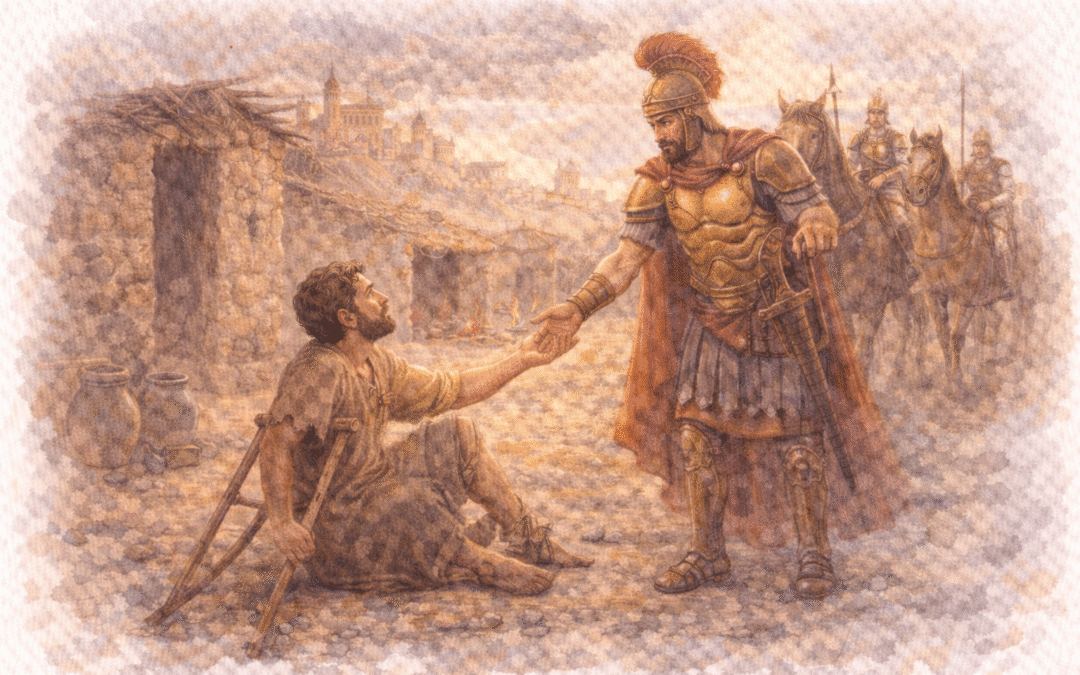
“So King David sent for him and brought him from Lo-debar.” The king’s command breaches the isolation of Lo-debar. Mephibosheth does not hobble to Jerusalem on his own; he is brought. One can imagine his terror upon receiving the summons. To be brought before a king whose throne you could, by blood, claim, could mean only one thing: execution. Grace, when unexpected, can be terrifying.
Act 3: The Grace-Filled Encounter (v. 6-8)
Mephibosheth’s posture is one of absolute submission and fear: “He fell on his face and prostrated himself.” His first words are, “Here is your servant!” acknowledging David’s sovereignty. David’s response is a masterpiece of gospel-like proclamation:
1. Reassurance: “Do not fear.” Grace dispels terror.
2. The Ground of Grace:
“I will surely show you kindness for the sake of your father Jonathan.” The basis is not Mephibosheth’s character, his potential, or his loyalty, but for the sake of another. This is a pure covenant transaction.
3. The Restoration of Identity: “I will restore to you all the land of Saul your grandfather.” What was lost through judgment and circumstance is restored by grace.
4. The Ultimate Privilege: “You shall eat at my table always.” This is the climax. He is not just given property and dismissed; he is given perpetual access to the king’s presence and provision.
Mephibosheth’s stunned reply reveals his self-perception: “What is your servant, that you should show regard for a dead dog such as I?” (v. 8). “Dead dog” was a profound term of self-abasement, indicating worthlessness and insignificance (cf. 1 Samuel 24:14). He saw himself only through the lens of his brokenness and his family’s disgrace. Grace redefines identity.
Act 4: The New Reality (v. 9-13)
David formalizes the restoration of Saul’s estate, appointing Ziba and his household to work the land for Mephibosheth’s benefit. The narrative concludes with the enduring image of the covenant’s fulfillment: “So Mephibosheth lived in Jerusalem, for he ate always at the king’s table. Now he was lame in both his feet” (v. 13, ESV). This final clause is crucial. His lameness was not healed. He was brought to the table as he was, brokenness and all. Grace accommodates our disability but does not let it define our place. He was given the status of a king’s son (v. 11), while remaining physically lame.
Theological Synthesis: The Covenant Kindness of God
This narrative provides a profound typology that illuminates core doctrines of grace.
1. The Nature of God’s Ḥesed God’s kindness is covenant-based, promissory, and steadfast. It is an act of His sovereign will, rooted in His own faithful character and the mediation of a covenant representative (in the ultimate sense, Christ). As David acted “for Jonathan’s sake,” God acts “for Christ’s sake” (Ephesians 4:32). Our blessing is founded on Another’s merit.
2. The Human Condition: Life in Lo-debar. Lo-debar represents the spiritual state of humanity apart from God’s call:
A Place of Barrenness (“No Pasture”): Spiritually fruitless, lacking the sustenance of true life (John 10:10).
A Place of Obscurity (“No Word”): Distant from the King’s voice and presence.
A Place of Crippling Brokenness: Mephibosheth’s lameness symbolizes the universal human condition of being crippled by sin—our spiritual disability, our moral inability to save ourselves or walk rightly before God (Romans 3:10-12).
A Place of Fear and Shame: Living under the shadow of a fallen legacy (Saul’s disobedience) and personal tragedy.
3. The Divine Initiative in Salvation: The king sought. The king sent. The king brought. This is the unilateral action of God in redemption. “No one seeks for God” (Romans 3:11). The Father draws us to the Son (John 6:44).
4. Justification and Adoption: David’s actions illustrate both declarative and relational grace.
Restoration of Inheritance: Analogous to justification, where we are declared righteous and granted an inheritance in Christ (Romans 8:17; Ephesians 1:11).
A Seat at the Table: Analogous to adoption, where we are brought into God’s family and granted intimate fellowship. Eating at the king’s table signified peace, reconciliation, provision, and belonging (Psalm 23:5; Revelation 3:20).
5. Sanctification: Lame, Yet at the Table. Mephibosheth remained lame. This is a vital truth. Our brokenness, our “thorn in the flesh,” is not always removed in this life. Yet, it does not disqualify us from the King’s presence or provision. In fact, grace is perfected in weakness (2 Corinthians 12:9). We are seated at the table while the process of healing and transformation continues. Our place is secure not because of our wholeness, but because of the covenant.
6. The Eschatological Feast: The perpetual table fellowship points forward to the Messianic banquet (Isaiah 25:6-8; Luke 14:15; Revelation 19:9), where all the redeemed from every nation will feast in the presence of the King. Mephibosheth’s story is a foretaste of that ultimate gathering.
Pastoral Application: Leaving Our Lo-debar
This text speaks powerfully to the contemporary believer and seeker.
1. For Those Feeling Forgotten and Broken: You may be in a personal Lo-debar—a place defined by shame, past failure, family dysfunction, chronic struggle (physical, mental, or emotional), or simple obscurity. The message of 2 Samuel 9 is that the King is asking about you. Your brokenness is not hidden from Him, nor does it repel Him. His call is based on His covenant, not your condition. Hear the summons: “Do not fear.” You are called to leave the identity of a “dead dog” and accept the identity of a welcomed guest, even a child of the King.
2. For the Church: Embodying Covenant Kindness. The church is to be the community that actively seeks out the modern-day Mephibosheths—the broken, the marginalized, those hiding in shame—and brings them to the King’s table. Our ministry should be marked by David-like initiative, not waiting for the “worthy” to approach. We are to proclaim a grace that restores dignity (“all the land of Saul”) and offers perpetual fellowship (“eat at my table always”).
3. The Centrality of the Covenant Meal: The Lord’s Supper is our ongoing, tangible participation in this reality. At Communion, we, the lame and broken, are reminded that we eat at the King’s table solely because of the covenant sealed by the blood of Christ, our Jonathan. It is a meal of remembrance, present grace, and future hope.
4. Living from the Table, Not for It: Mephibosheth’s life was fundamentally reoriented. His security, provision, and identity now flowed from his place at the king’s table. So for the Christian, our daily life is to be lived from the secure position of being “in Christ,” already accepted and seated with Him (Ephesians 2:6). We work from grace, not for grace.
5. A Warning Against the Ziba Spirit: Later, in 2 Samuel 16, Ziba will slander Mephibosheth to curry favor. The text warns us against those who would exploit the broken or distort grace for personal gain. It also reminds us that our standing is secured by the king’s word, not the servant’s gossip.
Conclusion: The Unending Kindness of the King
The story of Mephibosheth does not end with chapter 9. After Absalom’s rebellion, he is slandered and temporarily loses his land (2 Samuel 16:1-4; 19:24-30). In a moving postscript, when David offers full restoration, Mephibosheth’s response reveals how grace had transformed him: “Let him take it all, since my lord the king has come safely home.” His concern was not the property but the king himself. Grace had produced loyal love.
This is the ultimate end of God’s grace: to bring broken, hiding, shame-filled people out of their Lo-debars, to seat them permanently at His table, and to transform their hearts so that they love the King more than His gifts. The table is set. The covenant, sealed in the blood of the true Son of David and the greater Jonathan, stands irrevocable. The summons goes out to all in the barren places: “The King calls for you.” The response is to come as we are, lameness and all, and receive the ḥesed—the steadfast, covenant-keeping grace—that promises, “You shall eat at my table always.” In this, we find the end of shame and the beginning of everlasting fellowship.
Postagens/Posts/Publicaciones
- “Is It God or Is It Just My Head?” The Ultimate Guide to Stop Guessing and Start Discerning
- “Show Me Your Glory”: The Mystery of the Cleft of the Rock and the Safe Place in Jesus
- A Kenosis: The Emptying of Glory (Philippians 2)
- Anxiety and Faith: Is it a sin to take medication or go to therapy? What the Bible really says
- Celestial Breaking News: “New Year” Doesn’t Exist in the Bible? A Deep Investigation into the Theology of New Beginnings
- Celestial Breaking News: The Day Heaven Invaded Earth (The True Story of Christmas You Never Heard)
- Christmas Investigation: Does the Bible Reveal the Exact Day Jesus Was Born? (The Mystery of Tabernacles)
- Church or Cult? The Ultimate Biblical Guide for the New Convert to Find a Safe Spiritual Home
- Corinth: Sacred Monday (Tentmaker’s Work)
- Ephesus: The Theater of Shadows (Spiritual War and Culture)
- Ephesus: The Theater of Shadows (Spiritual Warfare and Culture)
- First Steps with Jesus: A Biblical Guide to Start Your Journey of Faith
- From Failure to Rock: The Denial and Restoration of Peter.
- From the Pit to the Palace: When God’s Presence Feels Like Absolute Silence
- Fruit vs. Gifts: The Priority of Character
- God’s Radar: Integrity and the Gaze of God (2 Chr 16:9)
- Grace in Lo-debar: The King’s Call (Mephibosheth / 2 Samuel 9)
- I Converted, But I Sinned Again: The Liberating Truth About Your Internal Struggle
- I Find Reading the Bible and Praying Boring: How to Overcome Spiritual Boredom and Build Consistency
- Jerusalem/Rome: The Compass (The End of the Race)
- Justification: The Courtroom of Grace
- Melchizedek: The King Without Genealogy
- Nicodemus: The Theologian in Darkness (The New Birth)
- Real Life #1: “How to Share Jesus with My Family Without Starting World War III” — The Ultimate Guide to Home Evangelism
- Real Life #2: “Do I Really Need to Get Baptized? What Really Happens in the Water” — The Ultimate Guide to the Public Wedding with Christ
- Real Life #3: “Did God Call Me? How to Discover My Purpose Without Becoming a Pastor” — Ending the Sacred-Secular Divide
- Real Life #4: “Christian Dating vs. Hookup Culture: The Survival Manual for Singles” — Purity, Purpose, and the Physics of Being Unequally Yoked
- Real Life #5: “Tithes and Offerings: Is God Broke or Am I Greedy?” — Money as a Spiritual Thermometer
- Silence in Chaos: Why Having Faith Doesn’t Make You Immune to Anxiety (And How to Find Real Peace)
- Silence is Not Absence: A Deep Guide to Resetting Your Frequency and Finding the Overflow of Purpose
- Spiritual Detox #1: “I Accepted Jesus, Now My Problems Will End” — The Big Lie and the True Promise
- Spiritual Detox #2: “Do I Have to Cut Off Non-Christian Friends?” — The Definitive Guide to the “Holy Bubble”
- Spiritual Detox #3: “Christians Don’t Get Depressed?” — Breaking the Mental Health Taboo in the Church
- Spiritual Detox #4: “Can the Devil Read My Thoughts?” — The End of Paranoia and True Spiritual Authority
- Spiritual Detox #5: “I Don’t Feel God, So He’s Not Listening” — The Danger of Goosebump-Based Faith
- Spiritual Detox #6: “If I Sin, Does God Walk Away and Stop Loving Me?” — The Survival Guide for the “Spiritual Hangover”
- Spiritual Detox #7: “Do I Have to Become a Boring Christian?” — The End of the ‘Do’s and Don’ts’ List and True Holiness
- Start Here: 7 Days to Hear God (Reading John)
- The Abyss of Glory: The Depth of the Riches (Romans 11:33).
- The Anatomy of a Heart: Why Did God Love Such an Imperfect Man So Much?
- The Art of Abiding: Prayer, Discipleship, and the Secret of Consistency
- The Art of Provocation: Communion and Mutual Encouragement in Hebrews 10:24
- The Art of Provocation: Communion and Mutual Encouragement in Hebrews 10:24
- The Crimson Mystery: The Theology, Legality, and Power of “Pleading the Blood”
- The Dungeon: The Winter of the Soul (Solitude/2 Timothy)
- The Emmaus Bread: Eyes Opened in Communion (Luke 24).
- The Eternity Code: Forensic Evidence That the Bible Is the Word of God
- The Final Metanoia: What It Really Means to Have the Mind of Christ
- The Great Discovery of December 31st: The End of Waiting (The Kingdom is Now)
- The Great Plan: The Architecture of Rescue (When the Fall Meets Grace)
- The Great Plan: Understanding the “Exchange” That Changes Everything
- The Importunate Friend: A Theology of Persistence
- The Incomparable #1: “The Terrorist of Tarsus: How God Turns His Worst Enemy Into His Greatest General”
- The Incomparable #10: The Last Breath — The Death of the Servant vs. The Death of the Atheist (Final Special)
- The Incomparable #2: “The Arabian Desert: Why Does God ‘Hide’ Those He Plans to Use?” — The Secret Power of Anonymity
- The Incomparable #3: The Fight with Barnabas and the Cost of Leadership
- The Incomparable #4: When Heaven Says “No” (The Frequency of the Spirit)
- The Incomparable #5: The Overflow — When the Gospel Faces Culture (Paul in Athens)
- The Incomparable #6: Silence in Chaos — The Theology of the Shipwreck (Paul in Acts 27)
- The Incomparable #7: The Art of Letting Go — The Radical Theology of Forgiveness (Paul and Philemon)
- The Invitation of the Maimed: The Parable of the Great Banquet
- The Invitation of the Maimed: The Parable of the Great Banquet
- The Iron Mask: Why We Feel Like a Fraud and How to Cure Spiritual Imposter Syndrome
- The Judgment of the Nations: The Sheep and the Goats
- The Kairos of God: Sovereignty Over Time in Eternity
- The Logic of Blood: Why was Jesus’ death the only solution?
- The Mirror: The Death of the Slave, The Birth of the Son
- The Orphan Syndrome: Why Do You Keep Acting Like a Slave When You Already Have the House Keys?
- The Place of the Sinner: The Alabaster Jar (Luke 7).
- The Prince, The Shepherd, and The Deliverer: When the Desert Is the Only School
- The Prison of Resentment: How to forgive someone who never said “I’m sorry”
- The Rich Young Ruler: The Tragedy of Almost-Salvation
- The Samaritan Woman: The Forgotten Jar at the Well
- The School of Prayer: How to Learn to Speak the Language of Heaven
- The Seal of the Spirit: Pledge and Property
- The Secret of the Secret Place: The Intimacy that Pleases God (Martha and Mary)
- The Shrewd Manager: Investing in Eternity
- The Sound of Silence: What God Was Doing When He Stopped Speaking
- The Tabernacle: The Engineering of Presence
- The Table in the Wilderness: The Valley of the Shadow (Psalm 23).
- The Table of Betrayal: The Dipped Bread (Judas and Rejected Grace)
- The Table of Betrayal: The Dipped Bread (Judas and Rejected Grace)
- The Ten Virgins: The Danger of Borrowed Oil
- The Terror of God (The Invisible War)
- The Upside-Down Kingdom: Why Jesus’ Logic Offends Our Human Logic
- The Widow of Nain: When Two Processions Meet
- Tongues of Fire or Strange Fire? The Gift of Tongues, Paul, and the Ghost of Montanism
- When Heaven is Silent: A Survival Guide for the “Dark Night of the Soul”
- Zacchaeus: The Tree of Curiosity