


Series: The Unseen Warfare
Biblical Text: Genesis 35:5; Judges 7:22; 1 Samuel 14:15; 2 Kings 7:6 (NIV)
Estimated Reading Time: 15 minutes
The Introduction: The Sound of Unseen Chariots
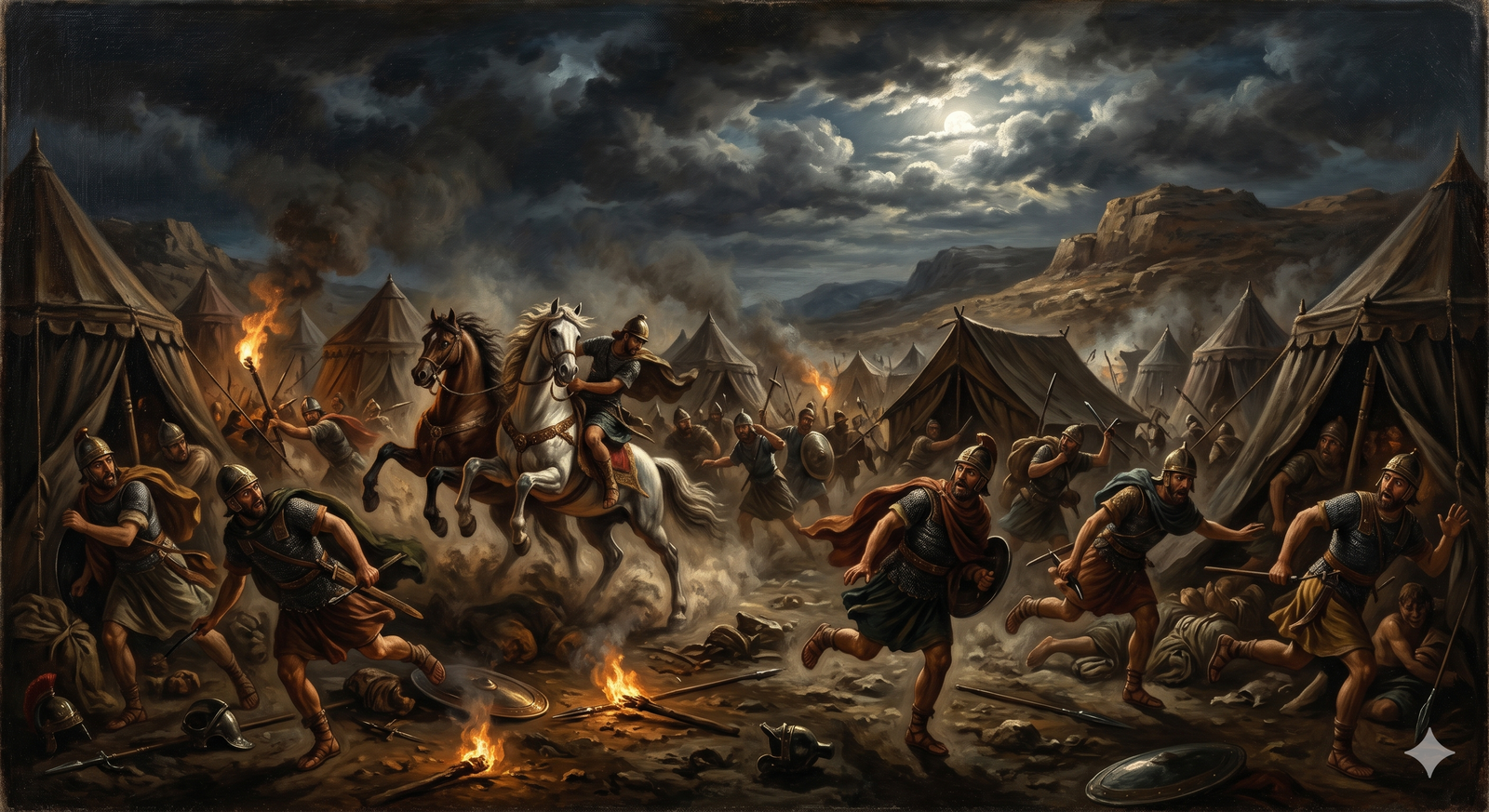
Imagine the scene. A suffocating, deathly, and heavy silence hangs over the valley of Samaria. Inside the Syrian (Aramean) camp, thousands of battle-hardened soldiers rest, their weapons gleaming under the cold moonlight. They have laid a relentless siege against the capital of Israel. They have cut off all supply routes, strangled the city’s economy, and forced a famine of such grotesque and terrifying proportions that, behind the walls, mothers are resorting to the unthinkable just to survive (2 Kings 6:29). The Syrian king, lying in his tent, knows that victory is not a probability; it is an unquestionable, mathematical certainty. Israel is starving, broken, besieged, and hopeless.
Then, in the dead of night, the air begins to vibrate. The ground trembles slightly at first. The sound starts as a low, distant rumble, but within seconds it amplifies into a deafening roar. It is the unmistakable thunder of thousands of iron chariots, the furious gallop of warhorses, and the rhythmic, heavy march of a colossal, unnumbered army. The Syrian commanders scramble out of their tents, their eyes wide with horror. Panic slices through the cold night air. They look at each other and scream in despair: “Look, the king of Israel has hired the Hittite and Egyptian kings to attack us!” (2 Kings 7:6). In a matter of minutes, an entire military superpower, armed to the teeth, disintegrates into absolute chaos without Israel firing a single arrow. They flee to save their lives, abandoning gold, silver, armor, horses, and tons of food.
But when the sun rises and illuminates the horizon, the battlefield reveals the most terrifying truth of all: the horizon is completely empty. There were no Hittites. There were no Egyptians. There was no physical army whatsoever.
What the Syrians experienced that night was the raw, naked, and unadulterated manifestation of The Terror of God.
Today, we will study this majestic, terrifying, and often forgotten dimension of Divine Sovereignty. We will discover how, throughout biblical history, when God proclaims that He has “delivered the enemy into our hands,” He is frequently not just providing us with physical strength; He is actively invading, destabilizing, and neutralizing the psychology, cognition, and mind of our adversary.
Section I: The Exegesis of Divine Panic
To understand the structural mechanics of biblical warfare, we must first dismantle our modern, sanitized view of spiritual conflict. In our contemporary vocabulary, “fear” is treated purely as a human psychological defect—a chemical reaction in the amygdala in the face of danger. In the ancient Hebrew worldview, however, profound panic can be an instrument of sovereign judicial administration.
The human mind is not an autonomous, impenetrable fortress; it is an open structure, fully transparent and accessible to the Creator. God does not only govern over kings and nations; He governs over synapses, auditory perceptions, and heartbeats.
1. The Geopolitical Shield and Paralyzing Panic (Genesis 35:5)
When Jacob and his sons departed from the region of Shechem, they were a highly vulnerable, walking target. His sons (Simeon and Levi) had just committed a diplomatic atrocity: they slaughtered the entire male population of the city of Shechem in a vengeful fury over the dishonor of their sister Dinah. Historically, this action shattered all local treaties. Logically, the neighboring Canaanite city-states should have formed an immediate coalition to hunt down and annihilate Jacob’s family. Jacob himself recognized the lethal risk, saying: “You have brought trouble on me by making me obnoxious to the Canaanites… We are few in number, and if they join forces against me and attack me, I and my household will be destroyed” (Gen 34:30).
Yet, the text of Genesis 35:5 declares: “Then they set out, and the terror of God fell on the towns all around them so that no one pursued them.”
The Hebrew word used here for “terror” is Chittah (חִתָּה). This is not the common word for natural fear (yare). Chittah means a prostrating dread, a crushing panic that breaks and paralyzes action. It derives from the root chathath, which means to be shattered, dismantled, or dismayed. What happened here was not a natural political apprehension. It was the imposition of an invisible barrier.
God injected a psychological paralysis into the minds of the Canaanite warlords. Their cognitive ability to formulate a military strategy, to raise their weapons, or to organize a counter-attack was literally “turned off” by an oppressive sense of the divine presence. The terror of God functioned as a missile defense shield in the minds of the enemies, protecting the patriarchal lineage through the sovereign manipulation of the human will of those who wished to destroy them.
2. The Sound Wave of Confusion (2 Kings 7:6)
In the case of the Syrian siege we saw in the introduction, the divine mechanics were different: a flawless auditory deception. The text says that the Lord caused them to hear the “sound” (Kol – קְוֹל, voice, noise, roar) of chariots.
The most fascinating detail here is the psychological precision of the miracle. Syria (Aram) was a formidable nation, but it had two great geopolitical fears at that time: the Hittite Empire to the north and the Egyptian Empire to the south. God did not just generate a random noise. He synthesized and inserted into the collective mind of that army the exact sound of their worst strategic nightmares. God invaded the enemy’s auditory perception. In modern military science, this is known as Psychological Operations (PSYOPs), but here executed to a degree of absolute perfection by the Creator of the universe. They were defeated by a sovereignly architected illusion.
Section II: Sovereignty in the Internal Realm
When the Christian faces overwhelming battles, the first reaction is to calculate. We count our money, our strength, our influence, and measure them against the mountain of problems. But the Bible shows us, repeatedly, that the mathematics of human warfare is irrelevant before the psychology of divine warfare.
3. The Symphony of Self-Destruction (Judges 7:22)
The story of Gideon is the pinnacle of asymmetrical warfare. Three hundred men of Israel against one hundred and thirty-five thousand Midianites. The ratio was 450 enemies for every 1 Israelite. They were in the valley, thick as locusts.
Gideon’s strategy was not a conventional tactical assault. They surrounded the camp at night, shattered jars, revealed flaming torches, and blew three hundred trumpets (Shofars) simultaneously. There was brilliant psychology behind this: in antiquity, only battalion commanders carried trumpets. When the Midianites, freshly awoken and groggy from sleep, heard 300 trumpets, their minds automatically projected that there were 300 massive armies surrounding them.
But Gideon’s human genius would not be enough to annihilate 135,000 men. The miracle occurs in verse 22: “When the three hundred trumpets sounded, the Lord caused the men throughout the camp to turn on each other with their swords.” The Hebrew phrase Vayasem YHWH et-cherev ish bere’ehu (And the LORD set every man’s sword against his companion) indicates that God took active control of the chaos. In the pitch darkness, amplified by the echo of the trumpets and the sudden fire, the Midianite camp suffered a total collapse of situational awareness. God turned their defensive instinct into a weapon of mass self-destruction. The enemy army did not fall by the physical strength of Israel; they were crushed under the weight of their own undeniable panic, instigated by the Terror of God. Victory was won when God broke the enemy’s ability to distinguish who the true adversary was.
4. The Cosmic Tremor and the Divine Signature (1 Samuel 14:15)
Jonathan and his armor-bearer decided to launch a suicide attack against a Philistine outpost in Mikmash. Two men scaling a cliff (between the crags of Bozez and Seneh) against an armed military post. What should have been a minor, easily contained skirmish turned into a macroeconomic disaster for the entire Philistine empire.
The text narrates: “Then panic struck the whole army—those in the camp and field, and those in the outposts and raiding parties—and the ground shook. It was a panic sent by God.”
Here, the anatomy of terror reaches its most comprehensive level. The word translated as panic or trembling is Charadah (חֲרָדָה), which denotes an uncontrollable shuddering, a chattering of teeth, a physical and visceral dread. The sacred author adds the definitive theological descriptor: Charedat Elohim — a Trembling of God, meaning a panic whose exclusive author is Yahweh Himself.
To ensure that the panic would be absolute and irreversible, God synchronized the internal chemical terror of the soldiers with an external geological validation. The phrase “and the ground shook” (Vattirgaz ha’arets) shows that the very soil beneath the Philistines’ feet began to reject their presence. When the mind trembles and the planet trembles simultaneously, the human spirit suffers an irremediable collapse. God delivered them into Jonathan’s hands not by giving the young prince larger muscles, but by sending a shockwave of terror that dissolved the morale of the enemy army.
Section III: Worldview Analysis – The Secular World vs. The God Who Governs the Mind
Secular history and military science frequently attempt to explain these biblical phenomena (and similar events in human history) through the lenses of “mass hysteria,” “battle fatigue,” “friendly fire,” or “nighttime disorientation.” While these psychological states are real and clinically cataloged, the Scriptures expose the First Cause behind the secondary symptoms.
Secularism views the human psyche as a closed system, governed solely by biology, environment, trauma, and social conditioning. If an army panics, the secular historian looks for factors like lack of sleep, poor leadership, or food shortages.
However, the Theology of Overflow demonstrates that the spiritual realm irrevocably dictates the stability of the material realm. The human mind does not have the capacity to maintain its own sanity, courage, or strategic brilliance if the Creator decides to withdraw His spirit of stability.
The courage of the wicked is a temporary illusion. As Proverbs 28:1 warns us: “The wicked flee though no one pursues, but the righteous are as bold as a lion.” Courage is not an inherent, unshakable personality trait; it is a temporary loan from the Almighty. When God decides to judge a nation, an arrogant system, or an enemy of His people, He does not necessarily need to rain fire from heaven; He simply removes their mental clarity. He allows the demons of paranoia, distrust, and blind terror to take the reins of their decisions. The ruin of God’s enemies begins inside their own heads.
Section IV: The Protocols of Radical Trust (The “Monday Morning” Application)
How do we translate the terrifying majesty of Pachad Elohim into our contemporary struggles? Today, we do not fight Midianites in the valley, nor Syrian armies besieging our city. However, we confront unjust corporate structures, violent institutional opposition, ancestral spiritual warfare, and economic or family scenarios that feel like an asphyxiating siege around our lives.
Here are the application protocols for your practical life:
1. The Protocol of Mathematical Disregard (Stop Counting the Chariots)
When you look at the problems surrounding your life, your default defense mechanism is to count the size of the enemy. You calculate their financial power, their lawyers, their social influence. Gideon had to reduce his numbers from 32,000 down to just 300 men. Why? Because numerical equations are completely irrelevant to a God who fights through internal destabilization. The size of the obstacle in front of you means nothing when God can cause that obstacle to collapse under the weight of its own panic.
2. The Protocol of the Invisible Shield (The Obviousness of Protection)
Often, you walk through dark valleys and situations of extreme vulnerability (like Jacob departing from Shechem) expecting to be attacked at any moment, but the attack never comes. The phone doesn’t ring. The retaliation doesn’t happen. The boss who was going to destroy you backs down. Do not confuse this with “luck.” Recognize that the Chittah (the terror of God) operated as an invisible shield in the minds of those who wished you harm. God paralyzed their intention before it turned into action. Be grateful for the battles God fought in the minds of your enemies while you merely walked in obedience.
3. The Protocol of Praise as a Weapon of War
Israel’s primary responsibility in these passages was never to execute a physically perfect military strategy; it was to obey radically. Gideon’s men did not throw spears; they blew trumpets and shattered jars. Jonathan climbed the rock using his hands and feet, trusting that the Lord had already gone before him. Your victory is achieved when you stop trying to manipulate outcomes with your own strength and begin to operate under the worshipful authority of the Kingdom of God. When you raise your voice in worship amidst the chaos, God releases the sound of unseen chariots over your circumstances.
4. The Protocol of Rest in the Midst of the Siege
You may be feeling besieged today, like the city of Samaria. With no resources, no apparent way out. Understand this: the God you serve has the power to make hell listen to the noise of its own defeat. While you are resting in the Lord, the enemy is already hearing the footsteps of the Army of the King of Kings marching against him. Rest. Panic does not belong in the house of the righteous; panic is the portion reserved for the gates of hell.
Conclusion: The Great Day of Terror and the Triumph of the Cross
Ultimately, this manifestation of the Terror of God finds its definitive, eschatological, and soteriological execution in the Person, Work, and Victory of Jesus Christ.
For centuries, Satan and the principalities of darkness held humanity under a brutal siege, using the fear of death as an unbreakable iron chain (Hebrews 2:14-15). The forces of hell believed they had achieved the ultimate tactical victory when they nailed the Son of God to the Roman cross. The cross seemed like the pinnacle of weakness—the equivalent of 300 men with clay jars against a global empire of darkness.
But the cross was the greatest psychological ambush in cosmic history.
When Jesus Christ cried out “It is finished,” and descended into the depths of Hades, the true Pachad Elohim invaded the enemy’s camp. He did not ask for permission. He did not negotiate our release. The Apostle Paul tells us exactly what He did: “And having disarmed the powers and authorities, he made a public spectacle of them, triumphing over them by the cross” (Colossians 2:15).
The cross generated the Charedat Elohim, the Trembling of God, at the gates of hell. Jesus dismantled the spiritual authorities, exposed their lies, and turned the “wisdom” of darkness into its own destruction. The enemy tasted absolute terror seeing the keys of death and hell being torn from his hands by the King of Glory.
Therefore, Christian, you no longer need to live under the siege of fear, anxiety, depression, or the feeling of imminent defeat. The King who commands the unseen armies has already marched into your valley. Terror belongs to those who oppose the Throne of Grace. Stand firm, raise your torch, sound the trumpet of your faith, and watch the walls of opposition crumble from the inside. The Lord of Hosts has already delivered the victory into your hands!
“The Lord is my light and my salvation—whom shall I fear? The Lord is the stronghold of my life—of whom shall I be afraid? When the wicked advance against me to devour me, it is my enemies and my foes who will stumble and fall. Though an army besiege me, my heart will not fear; though war break out against me, even then I will be confident.” — Psalm 27:1-3 (NIV)
Postagens/Posts/Publicaciones
- “Is It God or Is It Just My Head?” The Ultimate Guide to Stop Guessing and Start Discerning
- “Show Me Your Glory”: The Mystery of the Cleft of the Rock and the Safe Place in Jesus
- A Kenosis: The Emptying of Glory (Philippians 2)
- Anxiety and Faith: Is it a sin to take medication or go to therapy? What the Bible really says
- Celestial Breaking News: “New Year” Doesn’t Exist in the Bible? A Deep Investigation into the Theology of New Beginnings
- Celestial Breaking News: The Day Heaven Invaded Earth (The True Story of Christmas You Never Heard)
- Christmas Investigation: Does the Bible Reveal the Exact Day Jesus Was Born? (The Mystery of Tabernacles)
- Church or Cult? The Ultimate Biblical Guide for the New Convert to Find a Safe Spiritual Home
- Corinth: Sacred Monday (Tentmaker’s Work)
- Ephesus: The Theater of Shadows (Spiritual War and Culture)
- Ephesus: The Theater of Shadows (Spiritual Warfare and Culture)
- First Steps with Jesus: A Biblical Guide to Start Your Journey of Faith
- From Failure to Rock: The Denial and Restoration of Peter.
- From the Pit to the Palace: When God’s Presence Feels Like Absolute Silence
- Fruit vs. Gifts: The Priority of Character
- God’s Radar: Integrity and the Gaze of God (2 Chr 16:9)
- Grace in Lo-debar: The King’s Call (Mephibosheth / 2 Samuel 9)
- I Converted, But I Sinned Again: The Liberating Truth About Your Internal Struggle
- I Find Reading the Bible and Praying Boring: How to Overcome Spiritual Boredom and Build Consistency
- Jerusalem/Rome: The Compass (The End of the Race)
- Justification: The Courtroom of Grace
- Melchizedek: The King Without Genealogy
- Nicodemus: The Theologian in Darkness (The New Birth)
- Real Life #1: “How to Share Jesus with My Family Without Starting World War III” — The Ultimate Guide to Home Evangelism
- Real Life #2: “Do I Really Need to Get Baptized? What Really Happens in the Water” — The Ultimate Guide to the Public Wedding with Christ
- Real Life #3: “Did God Call Me? How to Discover My Purpose Without Becoming a Pastor” — Ending the Sacred-Secular Divide
- Real Life #4: “Christian Dating vs. Hookup Culture: The Survival Manual for Singles” — Purity, Purpose, and the Physics of Being Unequally Yoked
- Real Life #5: “Tithes and Offerings: Is God Broke or Am I Greedy?” — Money as a Spiritual Thermometer
- Silence in Chaos: Why Having Faith Doesn’t Make You Immune to Anxiety (And How to Find Real Peace)
- Silence is Not Absence: A Deep Guide to Resetting Your Frequency and Finding the Overflow of Purpose
- Spiritual Detox #1: “I Accepted Jesus, Now My Problems Will End” — The Big Lie and the True Promise
- Spiritual Detox #2: “Do I Have to Cut Off Non-Christian Friends?” — The Definitive Guide to the “Holy Bubble”
- Spiritual Detox #3: “Christians Don’t Get Depressed?” — Breaking the Mental Health Taboo in the Church
- Spiritual Detox #4: “Can the Devil Read My Thoughts?” — The End of Paranoia and True Spiritual Authority
- Spiritual Detox #5: “I Don’t Feel God, So He’s Not Listening” — The Danger of Goosebump-Based Faith
- Spiritual Detox #6: “If I Sin, Does God Walk Away and Stop Loving Me?” — The Survival Guide for the “Spiritual Hangover”
- Spiritual Detox #7: “Do I Have to Become a Boring Christian?” — The End of the ‘Do’s and Don’ts’ List and True Holiness
- Start Here: 7 Days to Hear God (Reading John)
- The Abyss of Glory: The Depth of the Riches (Romans 11:33).
- The Anatomy of a Heart: Why Did God Love Such an Imperfect Man So Much?
- The Art of Abiding: Prayer, Discipleship, and the Secret of Consistency
- The Art of Provocation: Communion and Mutual Encouragement in Hebrews 10:24
- The Art of Provocation: Communion and Mutual Encouragement in Hebrews 10:24
- The Crimson Mystery: The Theology, Legality, and Power of “Pleading the Blood”
- The Dungeon: The Winter of the Soul (Solitude/2 Timothy)
- The Emmaus Bread: Eyes Opened in Communion (Luke 24).
- The Eternity Code: Forensic Evidence That the Bible Is the Word of God
- The Final Metanoia: What It Really Means to Have the Mind of Christ
- The Great Discovery of December 31st: The End of Waiting (The Kingdom is Now)
- The Great Plan: The Architecture of Rescue (When the Fall Meets Grace)
- The Great Plan: Understanding the “Exchange” That Changes Everything
- The Importunate Friend: A Theology of Persistence
- The Incomparable #1: “The Terrorist of Tarsus: How God Turns His Worst Enemy Into His Greatest General”
- The Incomparable #10: The Last Breath — The Death of the Servant vs. The Death of the Atheist (Final Special)
- The Incomparable #2: “The Arabian Desert: Why Does God ‘Hide’ Those He Plans to Use?” — The Secret Power of Anonymity
- The Incomparable #3: The Fight with Barnabas and the Cost of Leadership
- The Incomparable #4: When Heaven Says “No” (The Frequency of the Spirit)
- The Incomparable #5: The Overflow — When the Gospel Faces Culture (Paul in Athens)
- The Incomparable #6: Silence in Chaos — The Theology of the Shipwreck (Paul in Acts 27)
- The Incomparable #7: The Art of Letting Go — The Radical Theology of Forgiveness (Paul and Philemon)
- The Invitation of the Maimed: The Parable of the Great Banquet
- The Invitation of the Maimed: The Parable of the Great Banquet
- The Iron Mask: Why We Feel Like a Fraud and How to Cure Spiritual Imposter Syndrome
- The Judgment of the Nations: The Sheep and the Goats
- The Kairos of God: Sovereignty Over Time in Eternity
- The Logic of Blood: Why was Jesus’ death the only solution?
- The Mirror: The Death of the Slave, The Birth of the Son
- The Orphan Syndrome: Why Do You Keep Acting Like a Slave When You Already Have the House Keys?
- The Place of the Sinner: The Alabaster Jar (Luke 7).
- The Prince, The Shepherd, and The Deliverer: When the Desert Is the Only School
- The Prison of Resentment: How to forgive someone who never said “I’m sorry”
- The Rich Young Ruler: The Tragedy of Almost-Salvation
- The Samaritan Woman: The Forgotten Jar at the Well
- The School of Prayer: How to Learn to Speak the Language of Heaven
- The Seal of the Spirit: Pledge and Property
- The Secret of the Secret Place: The Intimacy that Pleases God (Martha and Mary)
- The Shrewd Manager: Investing in Eternity
- The Sound of Silence: What God Was Doing When He Stopped Speaking
- The Tabernacle: The Engineering of Presence
- The Table in the Wilderness: The Valley of the Shadow (Psalm 23).
- The Table of Betrayal: The Dipped Bread (Judas and Rejected Grace)
- The Table of Betrayal: The Dipped Bread (Judas and Rejected Grace)
- The Ten Virgins: The Danger of Borrowed Oil
- The Terror of God (The Invisible War)
- The Upside-Down Kingdom: Why Jesus’ Logic Offends Our Human Logic
- The Widow of Nain: When Two Processions Meet
- Tongues of Fire or Strange Fire? The Gift of Tongues, Paul, and the Ghost of Montanism
- When Heaven is Silent: A Survival Guide for the “Dark Night of the Soul”
- Zacchaeus: The Tree of Curiosity