


Series: The Incomparable (Episode 7)
Scripture Base: Philemon 1-25 (Full Letter)
Estimated Reading Time: 20 minutes
We arrive at a singular moment in the life of the Apostle Paul. Generally, we imagine Paul as the great theologian preaching to crowds on the Areopagus or writing dense doctrinal treatises like the Letter to the Romans. But here, in the small note to Philemon (only 335 words in the original Greek), we see Paul acting not as the “Apostle to the Nations,” but as a Conflict Mediator.
This is the only private letter of Paul that made it into the Biblical Canon. It was not written to a church, but to a man, about a specific domestic problem: a runaway slave, a theft, and a betrayal. Why would the Holy Spirit preserve a “personal email” in the Holy Bible? Because Philemon is the practical demonstration of everything Paul taught theoretically. It is easy to preach about “grace” and “forgiveness” from the pulpit; the hard part is applying grace when someone steals your money, runs away from your house, and breaks your trust.
Today, we are going to learn the “Art of Letting Go.” We will discover that true Christianity is not measured by how much Bible we know, but by the speed with which we forgive those who have hurt us.
I. The Scenario: A Triangle of Tension
To understand the ticking time bomb that is this letter, we need to know the three characters and the legal context of Rome in 60 A.D.
1. Philemon (The Offended Creditor): He was a wealthy man from the city of Colossae. Probably converted by Paul himself (v. 19). He was a church leader; the church met in his house. Philemon is the “good guy” Christian, generous, who loves the saints. But he was betrayed. He represents Wounded Justice. Someone who has been wronged and has, by law, the right to demand reparation.
2. Onesimus (The Fugitive Debtor): He was Philemon’s slave. The name Onesimus means “Useful.” But he became “useless.” He not only ran away (which was a capital crime), but he likely stole money from Philemon to fund his escape (v. 18). He fled to Rome, the metropolis where it was easy to hide in the crowd. But, in divine providence, he “bumped” into Paul in prison, converted, and became Paul’s son in the faith. Onesimus represents the Repentant Sinner. He knows he messed up, but he has no way to pay the debt. If he returns, he could be killed.
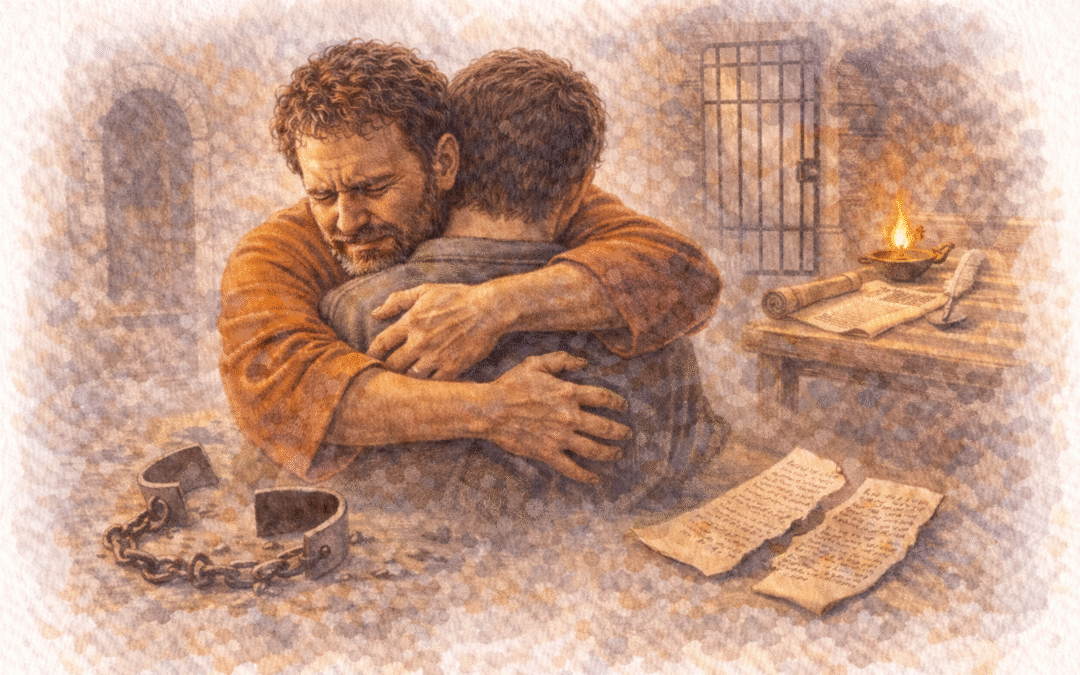
3. Paul (The Mediator): Paul is in prison in Rome. He loves Philemon and now he loves Onesimus. He is in the middle. By Roman law, Paul should have handed Onesimus over to the authorities to be punished. Harboring a fugitive slave (the crime of servi recepti) was extremely serious. But Paul decides to do something unthinkable: he sends Onesimus back to Philemon, not in handcuffs, but with this letter in his hand. Paul represents Christ. The One who places Himself between the Father (Justice) and the Sinner, to create reconciliation.
II. The Strategy of Approach: Love Over Law
The letter is a masterpiece of persuasion and emotional intelligence. Paul could have used his apostolic authority. He could have said: “Philemon, I am an Apostle, I command you to forgive Onesimus now, in the name of Jesus.” But he says:
“Therefore, although in Christ I could be bold and order you to do what you ought to do, yet I prefer to appeal to you on the basis of love.” (Philemon 1:8-9 – NIV)
Leadership Lesson: Forced obedience has no value in the Kingdom of God. Forgiveness that is wrung out by obligation is not forgiveness; it is submission. Paul wanted Philemon to forgive from the heart, not out of ecclesiastical embarrassment. The Gospel does not force us to love; the Gospel compels us to love (2 Corinthians 5:14). If you forgive only because you are “afraid of going to hell,” you haven’t understood the Cross. You forgive because you were forgiven.
Paul starts by praising Philemon (v. 4-7). He “softens the ground.” He reminds Philemon who he is: a man of love and faith. It is as if Paul were saying: “Philemon, I know you are a man of God. And men of God do hard things, like forgiving traitors.”
III. The Core of the Gospel: The Change of Status
In verse 10, Paul drops the bomb:
“I appeal to you for my son Onesimus, who became my son while I was in chains.”
Imagine Philemon’s face reading this. “Son?! That kid is a thief! He’s a runaway slave!” Paul is operating a Metamorphosis of Identity. For society and for Philemon, Onesimus was “thing,” “property,” “criminal.” For Paul (and now for God), Onesimus is “Son.”
And then comes verse 16, which is the spiritual abolition of slavery, centuries before political abolition:
“…no longer as a slave, but better than a slave, as a dear brother.”
This is radical. Paul is not just asking for clemency (don’t kill the slave); he is asking for fraternity (embrace the brother). The Gospel does not just cancel the punishment; it restores the relationship. Forgiving “lip service” is saying: “I won’t take revenge, but I never want to see you again.” Forgiving as a Christian is saying: “What you did died. Now you are my brother. Sit at my table.”
The Theology of “Before and Now”:
“Formerly he was useless to you, but now he has become useful both to you and to me.” (v. 11) Paul makes a pun on the name Onesimus (Useful). Without Christ, we are all “useless” to the Kingdom, no matter how talented we are. With Christ, even a fugitive slave becomes vital. Conversion makes the human being functional again.
IV. The Doctrine of Imputation: “Put it on My Account”
We reach the most theological verse of the letter, verse 18. It is here that Paul ceases to be just a friend and becomes a type of Christ.
“If he has done you any wrong or owes you anything, charge it to me.” (v. 18)
This phrase—“charge it to me” (or put it on my account)—is the essence of the doctrine of Imputation (Justification). What happened on the Cross?
- We (Onesimus) ran away from God and stole the glory that belonged to Him. We had an unpayable debt.
- The Law (Philemon/Justice) demanded payment. The soul who sins shall die.
- Jesus (Paul) steps in the middle and says to the Father: “Father, if they owe You anything, put it on My account. Charge Me. I will pay.”
Paul didn’t tell Philemon: “Forget the debt, money doesn’t matter.” No. Christianity doesn’t say that sin doesn’t matter. The loss existed. The money was stolen. Justice demands reparation. But Paul assumes the debt.
“I, Paul, am writing this with my own hand. I will pay it back.” (v. 19)
Practical Applications: Forgiveness is expensive. When you forgive someone who slandered you, you “absorb” the cost of the tarnished reputation. When you forgive someone who stole from you, you “absorb” the financial cost. Someone always pays the bill. In Christian forgiveness, the offended party (or a mediator) decides to pay the bill to free the offender. If you say “I forgive, but you have to pay me back every emotional penny for what you did,” you haven’t forgiven; you’ve set up a payment plan. Forgiveness is clearing the ledger.
V. The Art of Letting Go: Why Is It So Hard?
Why would Philemon have difficulty letting go of Onesimus (or Onesimus’s offense)? And why do we have so much difficulty “letting go” of those who hurt us?
- The Sense of Self-Righteousness: “But I have the right to be angry! He messed up!” Yes, Philemon had the legal right to brand Onesimus with a hot iron (the stigma Fugitivus on the forehead). But Paul subtly reminds Philemon of something uncomfortable in verse 19:“…not to mention that you owe me your very self.” Paul says: “Philemon, Onesimus owes you money. But you owe me your soul (because I evangelized you). Shall we compare the spreadsheets?” This is the key to forgiveness: Remembering how much we have been forgiven. The Parable of the Unmerciful Servant (Matthew 18) teaches this. Whoever understands the size of the debt God forgave (10,000 talents) cannot, in good conscience, strangle the brother who owes 100 denarii.
- Control: Keeping someone “in debt” to us gives us a sense of power and superiority. “He messed up, I am the victim.” As long as I am the victim, I control the narrative. Letting go of the offense is releasing control and standing on the same level (brothers).
- Fear of Recurrence: “What if he steals again?” Forgiveness is a risk. Grace is a risk. God runs this risk with us every day.
VI. Reconciliation in Practice: Receiving Him Back
Paul makes a final request that goes beyond legal forgiveness:
“So if you consider me a partner, welcome him as you would welcome me.” (v. 17)
This is Identification. Paul is saying: “When Onesimus knocks on your door, don’t look at his face; imagine it is me. Give him the hug you would give me. Give him the guest room you would give me.” This is exactly what God does with us. When we arrive in Heaven, dirty and ex-fugitives, the Father doesn’t look at our sins; He looks at Jesus. He receives us as He would receive Christ Himself.
The Test of Forgiveness: How do you know if you have forgiven? Can you pray for the person? Can you desire their good? And, if possible (and safe), can you sit at the table again? The letter doesn’t tell the end of the story. We don’t know from the Bible if Philemon forgave. But church history says he did. Fifty years later, Ignatius of Antioch writes a letter to the church in Ephesus and mentions their wonderful bishop… named Onesimus. If it is the same Onesimus (which is very likely), then the fugitive slave became the leader of the largest church in Asia Minor. All because one man (Philemon) decided to listen to Paul and practice the “Art of Letting Go.”
Your forgiveness today could be freeing the future leader of a generation. Your grudge could be killing a destiny.
VII. Application: The Protocol of Forgiveness
How do we apply Philemon to our lives, today?
1. Acknowledge the Debt, Don’t Diminish It. Don’t say “it was nothing.” Onesimus’s theft was real. The abuse you suffered was real. The betrayal hurt. Forgiveness isn’t pretending it didn’t hurt; it’s looking at the pain and deciding not to charge.
2. Use the Credit of the Cross. When the desire for revenge rises, look at your own checking account with God. Remember the “Put it on my account” that Jesus said for you. Use the credit of grace you received to pay the debt they created against you.
3. Change the Label. Stop calling the person by their sin (“The traitor,” “The one who stole from me”). Start trying to see them as Paul saw Onesimus: “Someone who can be useful,” “A potential brother.” As long as you dehumanize the offender, you won’t be able to forgive.
4. Seek Mediation. Sometimes, the wound is too deep to solve alone. Onesimus needed Paul. Maybe you need a pastor, a therapist, a mature mentor to help rebuild the bridge. Don’t try to “muscle through it” if you don’t have the emotional structure.
5. Prepare the Guest Room (v. 22). Paul ends by saying: “Prepare a guest room for me.” He expected to visit and see the reconciliation with his own eyes. Live in such a way that if Jesus (or your mentor) arrived at your house today to see how you treat those who offended you, He would feel at home. A house where there is a grudge is a house where the Holy Spirit has no “guest room.”
Conclusion: The Slave Who Became a Brother
The letter to Philemon is small, but it is an atomic bomb against human pride. It teaches us that in the Kingdom of God there is no room for “masters” and “slaves,” only for redeemed sinners serving one another.
Maybe you are Philemon: You are right, you have the law on your side, you were hurt. God calls you today to let go of the debt. Free your heart from the prison of resentment. Maybe you are Onesimus: You ran away, you messed up, you are ashamed to go back. God calls you to stop running, go back to the house, ask for forgiveness, and assume your new identity as a useful son. Maybe you are Paul: You see two brothers fighting and God calls you to be the bridge, to pay the price of peace.
Whatever your role, the command is the same: Grace must flow. Don’t break the cycle. Let go. And watch God transform slaves into brothers and tragedies into testimonies.
“Be kind and compassionate to one another, forgiving each other, just as in Christ God forgave you.” — Ephesians 4:32
Postagens/Posts/Publicaciones
- “Is It God or Is It Just My Head?” The Ultimate Guide to Stop Guessing and Start Discerning
- “Show Me Your Glory”: The Mystery of the Cleft of the Rock and the Safe Place in Jesus
- A Kenosis: The Emptying of Glory (Philippians 2)
- Anxiety and Faith: Is it a sin to take medication or go to therapy? What the Bible really says
- Celestial Breaking News: “New Year” Doesn’t Exist in the Bible? A Deep Investigation into the Theology of New Beginnings
- Celestial Breaking News: The Day Heaven Invaded Earth (The True Story of Christmas You Never Heard)
- Christmas Investigation: Does the Bible Reveal the Exact Day Jesus Was Born? (The Mystery of Tabernacles)
- Church or Cult? The Ultimate Biblical Guide for the New Convert to Find a Safe Spiritual Home
- Corinth: Sacred Monday (Tentmaker’s Work)
- Ephesus: The Theater of Shadows (Spiritual War and Culture)
- Ephesus: The Theater of Shadows (Spiritual Warfare and Culture)
- First Steps with Jesus: A Biblical Guide to Start Your Journey of Faith
- From Failure to Rock: The Denial and Restoration of Peter.
- From the Pit to the Palace: When God’s Presence Feels Like Absolute Silence
- Fruit vs. Gifts: The Priority of Character
- God’s Radar: Integrity and the Gaze of God (2 Chr 16:9)
- Grace in Lo-debar: The King’s Call (Mephibosheth / 2 Samuel 9)
- I Converted, But I Sinned Again: The Liberating Truth About Your Internal Struggle
- I Find Reading the Bible and Praying Boring: How to Overcome Spiritual Boredom and Build Consistency
- Jerusalem/Rome: The Compass (The End of the Race)
- Justification: The Courtroom of Grace
- Melchizedek: The King Without Genealogy
- Nicodemus: The Theologian in Darkness (The New Birth)
- Real Life #1: “How to Share Jesus with My Family Without Starting World War III” — The Ultimate Guide to Home Evangelism
- Real Life #2: “Do I Really Need to Get Baptized? What Really Happens in the Water” — The Ultimate Guide to the Public Wedding with Christ
- Real Life #3: “Did God Call Me? How to Discover My Purpose Without Becoming a Pastor” — Ending the Sacred-Secular Divide
- Real Life #4: “Christian Dating vs. Hookup Culture: The Survival Manual for Singles” — Purity, Purpose, and the Physics of Being Unequally Yoked
- Real Life #5: “Tithes and Offerings: Is God Broke or Am I Greedy?” — Money as a Spiritual Thermometer
- Silence in Chaos: Why Having Faith Doesn’t Make You Immune to Anxiety (And How to Find Real Peace)
- Silence is Not Absence: A Deep Guide to Resetting Your Frequency and Finding the Overflow of Purpose
- Spiritual Detox #1: “I Accepted Jesus, Now My Problems Will End” — The Big Lie and the True Promise
- Spiritual Detox #2: “Do I Have to Cut Off Non-Christian Friends?” — The Definitive Guide to the “Holy Bubble”
- Spiritual Detox #3: “Christians Don’t Get Depressed?” — Breaking the Mental Health Taboo in the Church
- Spiritual Detox #4: “Can the Devil Read My Thoughts?” — The End of Paranoia and True Spiritual Authority
- Spiritual Detox #5: “I Don’t Feel God, So He’s Not Listening” — The Danger of Goosebump-Based Faith
- Spiritual Detox #6: “If I Sin, Does God Walk Away and Stop Loving Me?” — The Survival Guide for the “Spiritual Hangover”
- Spiritual Detox #7: “Do I Have to Become a Boring Christian?” — The End of the ‘Do’s and Don’ts’ List and True Holiness
- Start Here: 7 Days to Hear God (Reading John)
- The Abyss of Glory: The Depth of the Riches (Romans 11:33).
- The Anatomy of a Heart: Why Did God Love Such an Imperfect Man So Much?
- The Art of Abiding: Prayer, Discipleship, and the Secret of Consistency
- The Art of Provocation: Communion and Mutual Encouragement in Hebrews 10:24
- The Art of Provocation: Communion and Mutual Encouragement in Hebrews 10:24
- The Crimson Mystery: The Theology, Legality, and Power of “Pleading the Blood”
- The Dungeon: The Winter of the Soul (Solitude/2 Timothy)
- The Emmaus Bread: Eyes Opened in Communion (Luke 24).
- The Eternity Code: Forensic Evidence That the Bible Is the Word of God
- The Final Metanoia: What It Really Means to Have the Mind of Christ
- The Great Discovery of December 31st: The End of Waiting (The Kingdom is Now)
- The Great Plan: The Architecture of Rescue (When the Fall Meets Grace)
- The Great Plan: Understanding the “Exchange” That Changes Everything
- The Importunate Friend: A Theology of Persistence
- The Incomparable #1: “The Terrorist of Tarsus: How God Turns His Worst Enemy Into His Greatest General”
- The Incomparable #10: The Last Breath — The Death of the Servant vs. The Death of the Atheist (Final Special)
- The Incomparable #2: “The Arabian Desert: Why Does God ‘Hide’ Those He Plans to Use?” — The Secret Power of Anonymity
- The Incomparable #3: The Fight with Barnabas and the Cost of Leadership
- The Incomparable #4: When Heaven Says “No” (The Frequency of the Spirit)
- The Incomparable #5: The Overflow — When the Gospel Faces Culture (Paul in Athens)
- The Incomparable #6: Silence in Chaos — The Theology of the Shipwreck (Paul in Acts 27)
- The Incomparable #7: The Art of Letting Go — The Radical Theology of Forgiveness (Paul and Philemon)
- The Invitation of the Maimed: The Parable of the Great Banquet
- The Invitation of the Maimed: The Parable of the Great Banquet
- The Iron Mask: Why We Feel Like a Fraud and How to Cure Spiritual Imposter Syndrome
- The Judgment of the Nations: The Sheep and the Goats
- The Kairos of God: Sovereignty Over Time in Eternity
- The Logic of Blood: Why was Jesus’ death the only solution?
- The Mirror: The Death of the Slave, The Birth of the Son
- The Orphan Syndrome: Why Do You Keep Acting Like a Slave When You Already Have the House Keys?
- The Place of the Sinner: The Alabaster Jar (Luke 7).
- The Prince, The Shepherd, and The Deliverer: When the Desert Is the Only School
- The Prison of Resentment: How to forgive someone who never said “I’m sorry”
- The Rich Young Ruler: The Tragedy of Almost-Salvation
- The Samaritan Woman: The Forgotten Jar at the Well
- The School of Prayer: How to Learn to Speak the Language of Heaven
- The Seal of the Spirit: Pledge and Property
- The Secret of the Secret Place: The Intimacy that Pleases God (Martha and Mary)
- The Shrewd Manager: Investing in Eternity
- The Sound of Silence: What God Was Doing When He Stopped Speaking
- The Tabernacle: The Engineering of Presence
- The Table in the Wilderness: The Valley of the Shadow (Psalm 23).
- The Table of Betrayal: The Dipped Bread (Judas and Rejected Grace)
- The Table of Betrayal: The Dipped Bread (Judas and Rejected Grace)
- The Ten Virgins: The Danger of Borrowed Oil
- The Terror of God (The Invisible War)
- The Upside-Down Kingdom: Why Jesus’ Logic Offends Our Human Logic
- The Widow of Nain: When Two Processions Meet
- Tongues of Fire or Strange Fire? The Gift of Tongues, Paul, and the Ghost of Montanism
- When Heaven is Silent: A Survival Guide for the “Dark Night of the Soul”
- Zacchaeus: The Tree of Curiosity