



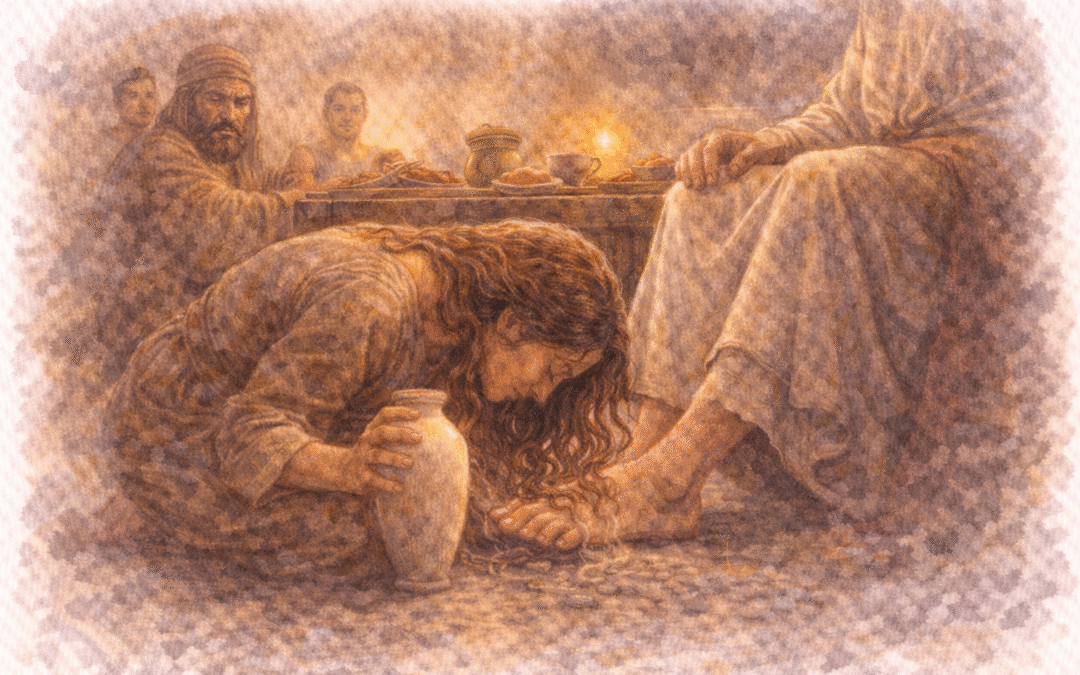
Extravagant Worship vs. Religious Judgment
Introduction
The Gospel of Luke is distinguished by its profound attention to the marginalized, the outcast, and the transformative power of grace. In the seventh chapter, we encounter one of the most poignant and theologically rich narratives in the New Testament: the anointing of Jesus by a sinful woman in the house of Simon the Pharisee. This episode is not merely a touching story of devotion; it is a masterful theological parable enacted in flesh and blood, contrasting two postures before God—extravagant worship born of forgiven sin, and sterile judgment born of perceived righteousness. At its heart lies a revolutionary principle articulated by Jesus: “Therefore, I tell you, her many sins have been forgiven—as her great love has shown. But whoever has been forgiven little loves little” (Luke 7:47, NIV). This study will explore the historical context, perform a detailed exegesis of the passage, unpack its profound theological implications, and apply its challenging truths to the contemporary church.
Historical and Literary Context
The event is situated in the Galilean ministry of Jesus, a period marked by growing popularity and escalating controversy with religious authorities. Luke places this story immediately after the account of Jesus healing the centurion’s servant (7:1-10) and raising the widow’s son at Nain (7:11-17). These miracles establish Jesus’ authority over sickness and death, and His compassion for Gentiles and Jews alike. They are followed by Jesus’ response to John the Baptist’s question, where He defines His messianic ministry by pointing to grace: “the good news is proclaimed to the poor” (7:22). This sequence is crucial. The stage is set for a demonstration of this very grace in a deeply personal, social, and religiously volatile context.
Understanding the characters requires cultural insight. Simon the Pharisee represents the religious establishment. Pharisees were zealous for the Law and oral tradition, committed to ritual purity and separation from sin and sinners. An invitation to a meal was a sign of respect, yet Simon’s omissions (no kiss, no water for feet, no anointing oil) indicate a deliberate, calculated distance—he is “sizing up” Jesus, not honoring Him. The meal itself would have been a semi-public event in a courtyard, allowing for uninvited observers.
The woman is identified only as “a woman in the city who was a sinner” (7:37). Tradition often conflates her with Mary Magdalene or the anointing woman in other Gospels (Matt 26, Mark 14, John 12), but Luke presents her distinctly. The term “sinner” (ἁμαρτωλός) here likely denotes a specific, publicly known moral failure, possibly prostitution. Her very presence in a Pharisee’s house was a scandal, a breach of social and ritual boundaries. Her act—loosing her hair in public—was considered deeply shameful for a woman. She enters as the ultimate outsider.
The alabaster jar of perfume (μύρον) was a flask, often with a long neck that was broken to release the contents. Myrrh or spikenard was incredibly costly, representing a life’s savings or a family heirloom. This was not a casual gesture but an act of profound economic sacrifice.
Exegesis of Luke 7:36-50
The Scene of Contrast (7:36-39): The narrative is built on stark juxtaposition. Simon invites Jesus to eat, but the woman brings an alabaster flask. Simon offers no customary hospitality; the woman provides it extravagantly with her tears, hair, kisses, and perfume. Simon’s internal monologue (“If this man were a prophet, he would know…”) reveals a theology of contamination: holiness is defined by separation from sin. He judges both the woman and Jesus. Jesus, however, perceives the heart (7:40), setting up His teaching moment.
The Parable of the Two Debtors (7:40-43): Jesus disarms Simon’s judgment with a story. The parable is deceptively simple: two debtors, one owing 500 denarii (nearly two years’ wages), the other 50, both forgiven. The question, “Which of them will love him more?” forces Simon into the logic of grace. His reluctant answer, “I suppose the one who had the bigger debt forgiven,” is correct. Jesus does not equate the woman with the 500-denarii debtor and Simon with the 50-denarii debtor in a direct, one-to-one moral comparison. Rather, He establishes the principle: the consciousness of debt forgiven is proportional to the love expressed. Simon’s problem is not that he is only a “little” sinner, but that he perceives he has only a “little” need for forgiveness. His love is consequently meager, cold, and conditional.
The Interpretation and Pronouncement (7:44-50): Jesus now turns from the parable to its living illustration. In a powerful triple contrast (“Do you see this woman? I entered your house…”), He itemizes Simon’s failures and the woman’s lavish substitutions. The woman’s actions are not a cause of forgiveness but its evidence. The Greek grammar of verse 47 is pivotal: “because (ὅτι) she loved much” can also be rendered “with the result that her great love is shown.” The latter is more consistent with the parable and Jesus’ closing statement in 7:47b: “But whoever has been forgiven little loves little.” Love is the fruit, not the root, of forgiveness. Her faith-filled act of worship (7:50) is the channel through which she receives the pronouncement of peace. Jesus publicly declares what God has already granted: “Your sins are forgiven” (7:48). This provokes the other guests to question inwardly, “Who is this who even forgives sins?”—a question that points directly to His divine identity.
Theological Implications
The Nature of Sin and Forgiveness: The story redefines sin not merely as discrete moral failures but as a debt—an insurmountable obligation to a holy God. Forgiveness is not earned by compensatory love; it is a unilateral act of grace from the creditor. The woman understands her debt; Simon does not. Thus, the greatest sin may be the failure to perceive one’s need for grace, a condition of spiritual blindness that produces judgment rather than mercy.
The Economics of Grace vs. the Economics of Merit: Simon operates in an economy of merit and exchange: respect for respect, honor for honor, purity through separation. The woman operates in an economy of grace: having received (or desperately hoping for) a gift of incalculable worth, she responds with a gift of total sacrifice. Her worship is “extravagant” because it is non-utilitarian, breaking social norms and personal security for the sake of devotion alone. It mirrors the extravagance of the grace she seeks.
Christology: The Prophet Who Forgives Sins: Jesus acts as both the prophet (knowing the hearts of Simon and the woman) and the forgiver of sins. In Jewish theology, forgiveness was ultimately God’s prerogative (Isaiah 43:25; Psalm 130:4). By authoritatively declaring the woman’s sins forgiven, Jesus is not merely announcing God’s verdict but enacting it Himself. He is the embodiment of the grace of God, the creditor who absorbs the debt.
The Theology of Love: The core thesis—“whoever has been forgiven little loves little”—establishes love for God as the necessary, effusive response to the realization of one’s forgiveness. This love is not sentimental but demonstrative and costly. It shatters social barriers (the woman enters a hostile space) and pours out its most valuable possessions. Christian love for God and for others is thus rooted in a continual, fresh apprehension of the grace received in Christ.
Faith and Salvation: Jesus’ final word to the woman is, “Your faith has saved you; go in peace” (7:50). Her faith was not a doctrinal checklist but a desperate, trusting movement toward Jesus, expressed in a bold act of worship. Salvation here encompasses forgiveness, reconciliation (“peace”), and restoration to wholeness. It is received by faith, not generated by works, though it inevitably erupts in works of love.
Application for the Contemporary Church
Cultivating a Culture of Extravagant Worship: The church is called to move beyond ritualistic, formal, or merely intellectual worship. True worship springs from a heart overwhelmed by grace. It should be characterized by sacrificial giving, emotional authenticity, and a disregard for “respectable” appearances when expressing devotion to Christ. The woman’s model challenges our often-tame and calculated approaches to adoration.
Confronting the Spirit of Simon (Religious Judgment): The Simon within us and our communities must be identified and challenged. This is the tendency to create hierarchies of sin, to value protocol over people, to prioritize doctrinal purity over compassionate engagement, and to be more adept at identifying sin in others than acknowledging our own debt. Leadership, in particular, must guard against a professionalism that lacks passionate love for Christ.
Embracing the “Sinner’s Place” as Our Own: There is only one place for the believer at the feet of Jesus: the place of the forgiven debtor. Spiritual maturity is not progressing from this place to a more “respectable” position beside Jesus; it is going deeper into the reality of our forgiveness and thus loving more profoundly. The church is not a society of former sinners but a community of forgiven sinners, whose shared identity at the foot of the cross breaks down all other barriers (class, race, moral background).
Being a Sanctuary for the Broken: The church must be a “Simon’s house” where Jesus is present, but with a radically different welcome. It must be a space where those known as “sinners” can come, find access to Jesus, and pour out their pain and devotion without first being scrutinized and sorted by the religious establishment. Our welcome must mirror Christ’s: seeing the person, not just the past; honoring faith, not demanding prior reformation.
Preaching and Teaching for Love: Teaching that merely informs the mind or reinforces moralism will produce Simons—people who know much but love little. Preaching must aim to unveil the staggering cost of our debt and the magnificent freeness of its cancellation in Christ. The goal is to enlarge the congregation’s perception of grace, thereby fueling love, generosity, and joyful sacrifice.
Conclusion
Luke 7:36-50 stands as an enduring masterpiece of Gospel theology. It dismantles religious pretension and elevates repentant love as the truest indicator of spiritual reality. The sinful woman, not Simon the Pharisee, is the model disciple. Her alabaster jar, broken and poured out, becomes a symbol of the heart shattered by grace and offered wholly to Christ. Jesus’ pronouncement, “Your faith has saved you; go in peace,” echoes down to every sinner who dares to approach Him with trusting love.
The ultimate “Place of the Sinner” is at the feet of Jesus, a place of forgiveness, transformation, and commissioning into peace. This narrative calls the church away from the judgment seat of Simon and to the floor beside the broken jar, where tears of repentance mingle with the perfume of worship, and where the sound of criticism is drowned out by the Savior’s words: “Your sins are forgiven.” In a world, and often a church, rife with judgment and calculation, may we recover the extravagant, debt-canceling grace that alone produces a love worthy of our Lord. For indeed, he who has been forgiven much, loves much.
Postagens/Posts/Publicaciones
- “Is It God or Is It Just My Head?” The Ultimate Guide to Stop Guessing and Start Discerning
- “Show Me Your Glory”: The Mystery of the Cleft of the Rock and the Safe Place in Jesus
- A Kenosis: The Emptying of Glory (Philippians 2)
- Anxiety and Faith: Is it a sin to take medication or go to therapy? What the Bible really says
- Celestial Breaking News: “New Year” Doesn’t Exist in the Bible? A Deep Investigation into the Theology of New Beginnings
- Celestial Breaking News: The Day Heaven Invaded Earth (The True Story of Christmas You Never Heard)
- Christmas Investigation: Does the Bible Reveal the Exact Day Jesus Was Born? (The Mystery of Tabernacles)
- Church or Cult? The Ultimate Biblical Guide for the New Convert to Find a Safe Spiritual Home
- Corinth: Sacred Monday (Tentmaker’s Work)
- Ephesus: The Theater of Shadows (Spiritual War and Culture)
- Ephesus: The Theater of Shadows (Spiritual Warfare and Culture)
- First Steps with Jesus: A Biblical Guide to Start Your Journey of Faith
- From Failure to Rock: The Denial and Restoration of Peter.
- From the Pit to the Palace: When God’s Presence Feels Like Absolute Silence
- Fruit vs. Gifts: The Priority of Character
- God’s Radar: Integrity and the Gaze of God (2 Chr 16:9)
- Grace in Lo-debar: The King’s Call (Mephibosheth / 2 Samuel 9)
- I Converted, But I Sinned Again: The Liberating Truth About Your Internal Struggle
- I Find Reading the Bible and Praying Boring: How to Overcome Spiritual Boredom and Build Consistency
- Jerusalem/Rome: The Compass (The End of the Race)
- Justification: The Courtroom of Grace
- Melchizedek: The King Without Genealogy
- Nicodemus: The Theologian in Darkness (The New Birth)
- Real Life #1: “How to Share Jesus with My Family Without Starting World War III” — The Ultimate Guide to Home Evangelism
- Real Life #2: “Do I Really Need to Get Baptized? What Really Happens in the Water” — The Ultimate Guide to the Public Wedding with Christ
- Real Life #3: “Did God Call Me? How to Discover My Purpose Without Becoming a Pastor” — Ending the Sacred-Secular Divide
- Real Life #4: “Christian Dating vs. Hookup Culture: The Survival Manual for Singles” — Purity, Purpose, and the Physics of Being Unequally Yoked
- Real Life #5: “Tithes and Offerings: Is God Broke or Am I Greedy?” — Money as a Spiritual Thermometer
- Silence in Chaos: Why Having Faith Doesn’t Make You Immune to Anxiety (And How to Find Real Peace)
- Silence is Not Absence: A Deep Guide to Resetting Your Frequency and Finding the Overflow of Purpose
- Spiritual Detox #1: “I Accepted Jesus, Now My Problems Will End” — The Big Lie and the True Promise
- Spiritual Detox #2: “Do I Have to Cut Off Non-Christian Friends?” — The Definitive Guide to the “Holy Bubble”
- Spiritual Detox #3: “Christians Don’t Get Depressed?” — Breaking the Mental Health Taboo in the Church
- Spiritual Detox #4: “Can the Devil Read My Thoughts?” — The End of Paranoia and True Spiritual Authority
- Spiritual Detox #5: “I Don’t Feel God, So He’s Not Listening” — The Danger of Goosebump-Based Faith
- Spiritual Detox #6: “If I Sin, Does God Walk Away and Stop Loving Me?” — The Survival Guide for the “Spiritual Hangover”
- Spiritual Detox #7: “Do I Have to Become a Boring Christian?” — The End of the ‘Do’s and Don’ts’ List and True Holiness
- Start Here: 7 Days to Hear God (Reading John)
- The Abyss of Glory: The Depth of the Riches (Romans 11:33).
- The Anatomy of a Heart: Why Did God Love Such an Imperfect Man So Much?
- The Art of Abiding: Prayer, Discipleship, and the Secret of Consistency
- The Art of Provocation: Communion and Mutual Encouragement in Hebrews 10:24
- The Art of Provocation: Communion and Mutual Encouragement in Hebrews 10:24
- The Crimson Mystery: The Theology, Legality, and Power of “Pleading the Blood”
- The Dungeon: The Winter of the Soul (Solitude/2 Timothy)
- The Emmaus Bread: Eyes Opened in Communion (Luke 24).
- The Eternity Code: Forensic Evidence That the Bible Is the Word of God
- The Final Metanoia: What It Really Means to Have the Mind of Christ
- The Great Discovery of December 31st: The End of Waiting (The Kingdom is Now)
- The Great Plan: The Architecture of Rescue (When the Fall Meets Grace)
- The Great Plan: Understanding the “Exchange” That Changes Everything
- The Importunate Friend: A Theology of Persistence
- The Incomparable #1: “The Terrorist of Tarsus: How God Turns His Worst Enemy Into His Greatest General”
- The Incomparable #10: The Last Breath — The Death of the Servant vs. The Death of the Atheist (Final Special)
- The Incomparable #2: “The Arabian Desert: Why Does God ‘Hide’ Those He Plans to Use?” — The Secret Power of Anonymity
- The Incomparable #3: The Fight with Barnabas and the Cost of Leadership
- The Incomparable #4: When Heaven Says “No” (The Frequency of the Spirit)
- The Incomparable #5: The Overflow — When the Gospel Faces Culture (Paul in Athens)
- The Incomparable #6: Silence in Chaos — The Theology of the Shipwreck (Paul in Acts 27)
- The Incomparable #7: The Art of Letting Go — The Radical Theology of Forgiveness (Paul and Philemon)
- The Invitation of the Maimed: The Parable of the Great Banquet
- The Invitation of the Maimed: The Parable of the Great Banquet
- The Iron Mask: Why We Feel Like a Fraud and How to Cure Spiritual Imposter Syndrome
- The Judgment of the Nations: The Sheep and the Goats
- The Kairos of God: Sovereignty Over Time in Eternity
- The Logic of Blood: Why was Jesus’ death the only solution?
- The Mirror: The Death of the Slave, The Birth of the Son
- The Orphan Syndrome: Why Do You Keep Acting Like a Slave When You Already Have the House Keys?
- The Place of the Sinner: The Alabaster Jar (Luke 7).
- The Prince, The Shepherd, and The Deliverer: When the Desert Is the Only School
- The Prison of Resentment: How to forgive someone who never said “I’m sorry”
- The Rich Young Ruler: The Tragedy of Almost-Salvation
- The Samaritan Woman: The Forgotten Jar at the Well
- The School of Prayer: How to Learn to Speak the Language of Heaven
- The Seal of the Spirit: Pledge and Property
- The Secret of the Secret Place: The Intimacy that Pleases God (Martha and Mary)
- The Shrewd Manager: Investing in Eternity
- The Sound of Silence: What God Was Doing When He Stopped Speaking
- The Tabernacle: The Engineering of Presence
- The Table in the Wilderness: The Valley of the Shadow (Psalm 23).
- The Table of Betrayal: The Dipped Bread (Judas and Rejected Grace)
- The Table of Betrayal: The Dipped Bread (Judas and Rejected Grace)
- The Ten Virgins: The Danger of Borrowed Oil
- The Terror of God (The Invisible War)
- The Upside-Down Kingdom: Why Jesus’ Logic Offends Our Human Logic
- The Widow of Nain: When Two Processions Meet
- Tongues of Fire or Strange Fire? The Gift of Tongues, Paul, and the Ghost of Montanism
- When Heaven is Silent: A Survival Guide for the “Dark Night of the Soul”
- Zacchaeus: The Tree of Curiosity